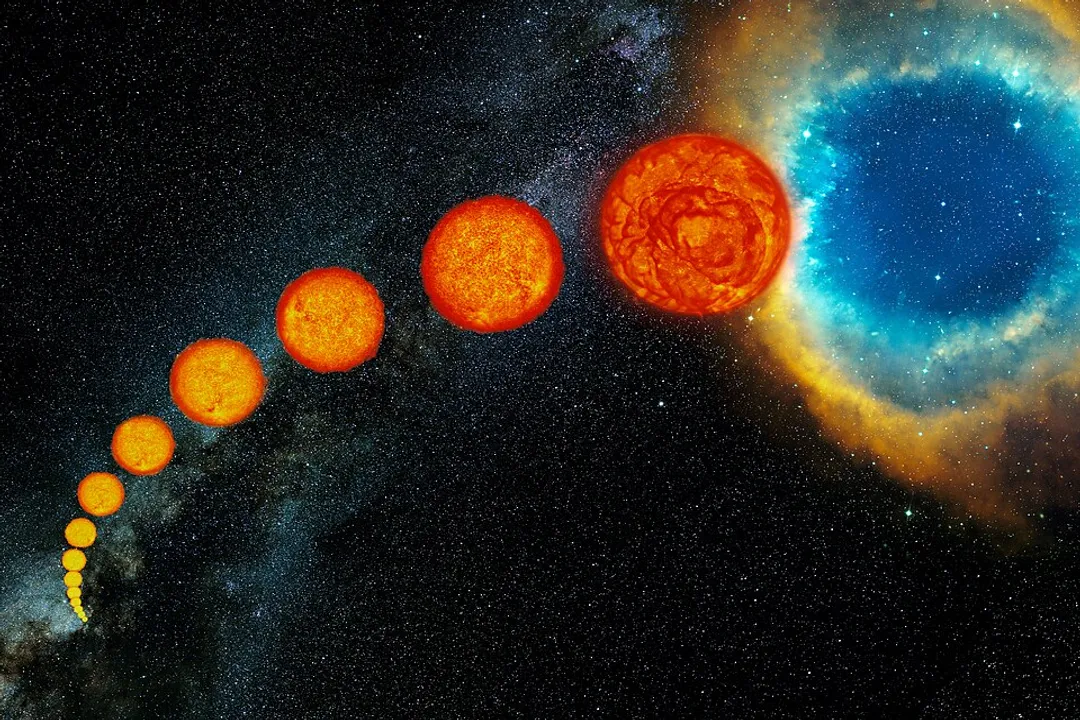
What process creates a Planetary Nebula around a dying low-mass star?
The outer layers drift away from the inert carbon/oxygen core after helium depletion.
For stars below approximately eight times the mass of the Sun, the death process is relatively gentle following the exhaustion of core hydrogen and then core helium. Once the helium fuel is depleted, the star lacks the necessary mass to generate the pressures required to ignite carbon fusion. Gravity causes the core to stabilize as inert carbon and oxygen ash. During this transition, hydrogen fusion continues in a shell surrounding the core, providing enough outward pressure to cause the star’s outer layers to expand dramatically, cool, and drift away into space. This expelled, expanding shell of illuminated gas is what constitutes the beautiful structure known as a Planetary Nebula, leaving the dense, inert core behind.