Which elements serve as isotopic evidence for the shared heritage of the Earth and the Moon?
Answer
Oxygen, titanium, and tungsten
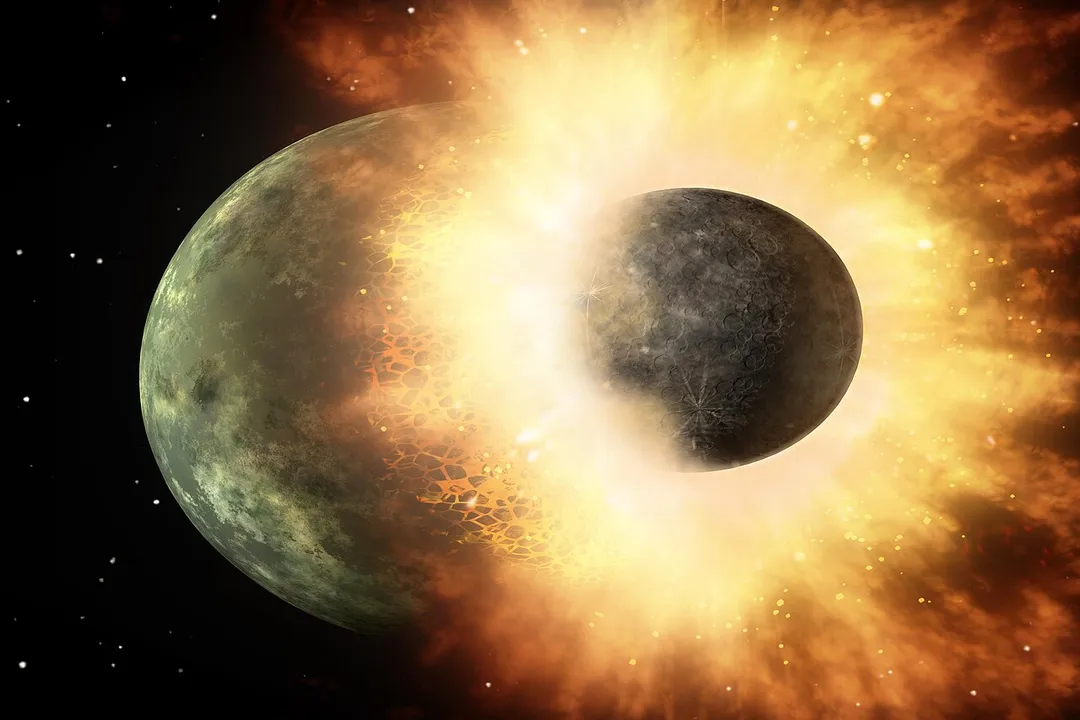
Isotopes are variations of chemical elements with different atomic weights, and they act as fingerprints for planetary bodies. Studies of lunar rocks brought back by astronauts show that the isotopes of oxygen, titanium, and tungsten on the Moon are remarkably similar to those found on Earth. This high degree of similarity indicates that the materials comprising both bodies underwent a process of homogenization, where the matter from the impactor and the Earth became mixed before forming the Moon, effectively giving them a common chemical origin.
Related Questions
What is the primary scientific name for the theory explaining the origin of the Moon?Approximately how large was the protoplanet Theia that collided with Earth?Which elements serve as isotopic evidence for the shared heritage of the Earth and the Moon?Why is the Co-accretion theory generally considered insufficient to explain the Moon?Approximately how long ago did the impact involving Theia occur?What do recent computer simulations suggest about the speed of the Moons formation?Why does the Moon lack water and other volatile compounds compared to the Earth?What became of the remnants of the protoplanet Theia after the collision?What does the angular momentum of the Earth-Moon system reveal about the impact?Why are fragments of Theia not easily found on the surface of the Earth today?