What evidence is there for the collision theory of the Moon?
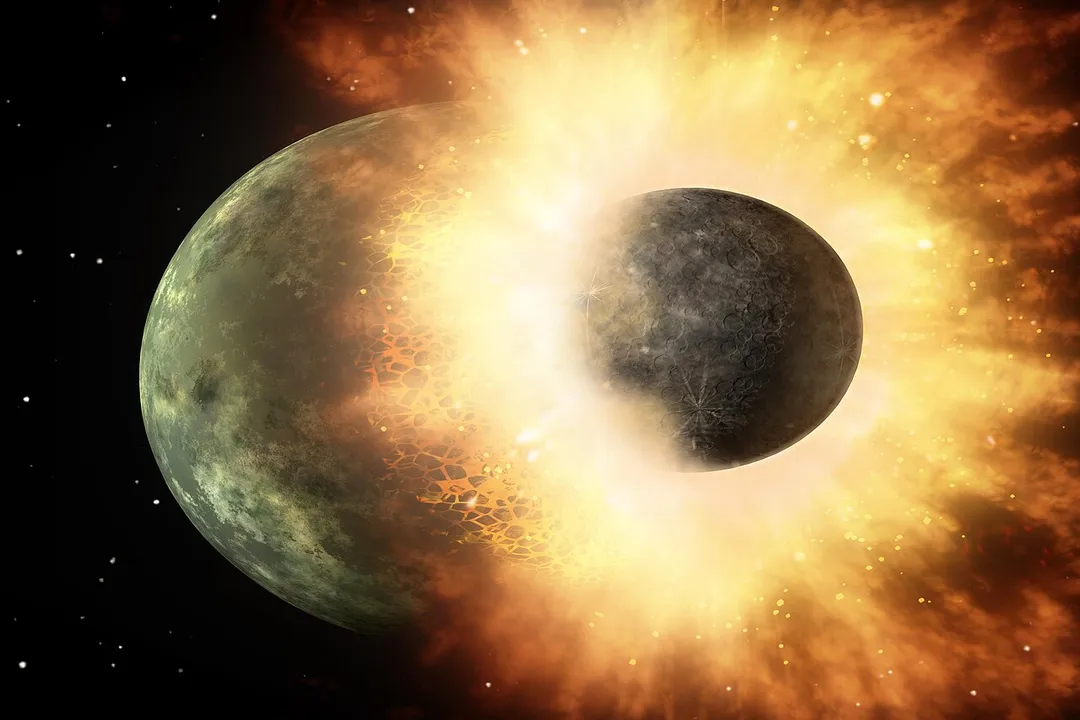
Looking up at the night sky, our Moon serves as a constant, steady companion. For generations, scientists wondered how this massive satellite came to orbit our planet. While several ideas emerged over the decades, one explanation stands out as the most compelling: the Giant-Impact Hypothesis [1][2]. This theory proposes that roughly 4.5 billion years ago, shortly after Earth formed, a Mars-sized protoplanet—often called Theia—crashed into our young world [2][6][9]. The collision was not a simple smash-and-grab; it was a cataclysmic event that ejected enough material into orbit to eventually coalesce into the Moon we see today [1][2].
# The Impact
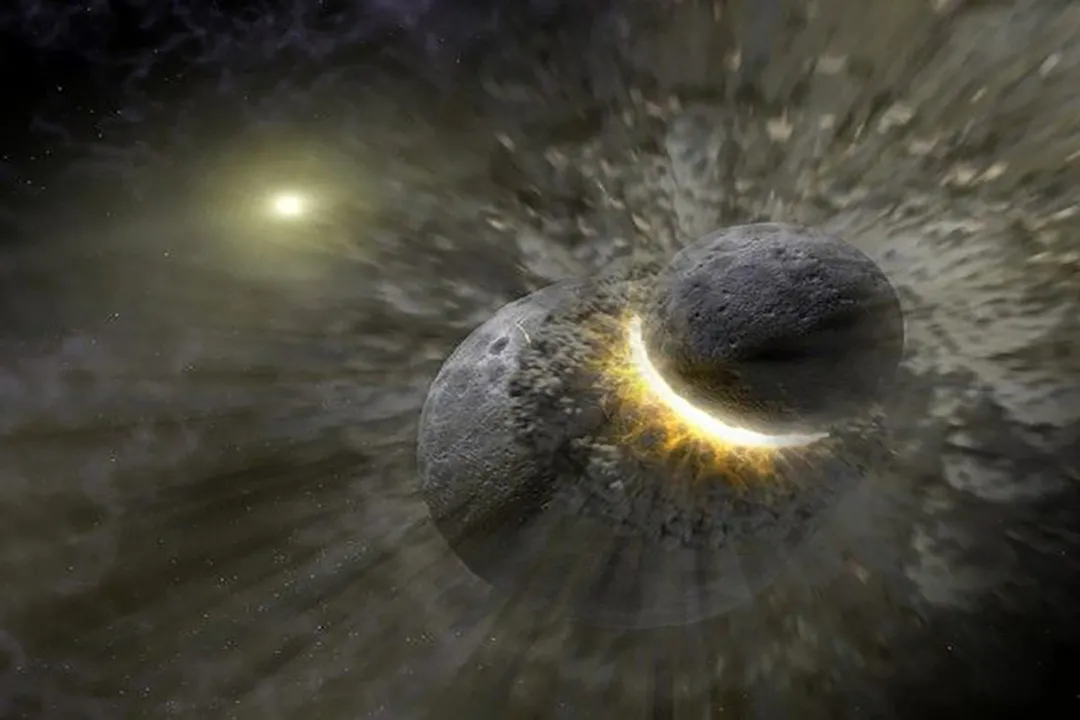
The concept of a massive collision sounds violent, yet it perfectly addresses the physical state of the Earth-Moon system. Under this model, the early Earth was hit by an object roughly half its size [6]. This impact did not destroy either body entirely. Instead, it vaporized a significant portion of the Earth’s mantle and the impactor, sending a massive plume of debris into orbit [2][6].
This debris cloud did not simply drift away. Gravity gathered the material, creating a disk around Earth that condensed into the Moon [2]. This sequence explains why the Moon has a relatively small iron core compared to Earth [2][4]. The debris that formed the Moon came primarily from the rocky, iron-poor mantles of both the impacting body and Earth, rather than from their metallic cores, which had already sunk to the centers of the respective planets [1][2].
# Isotopic Evidence
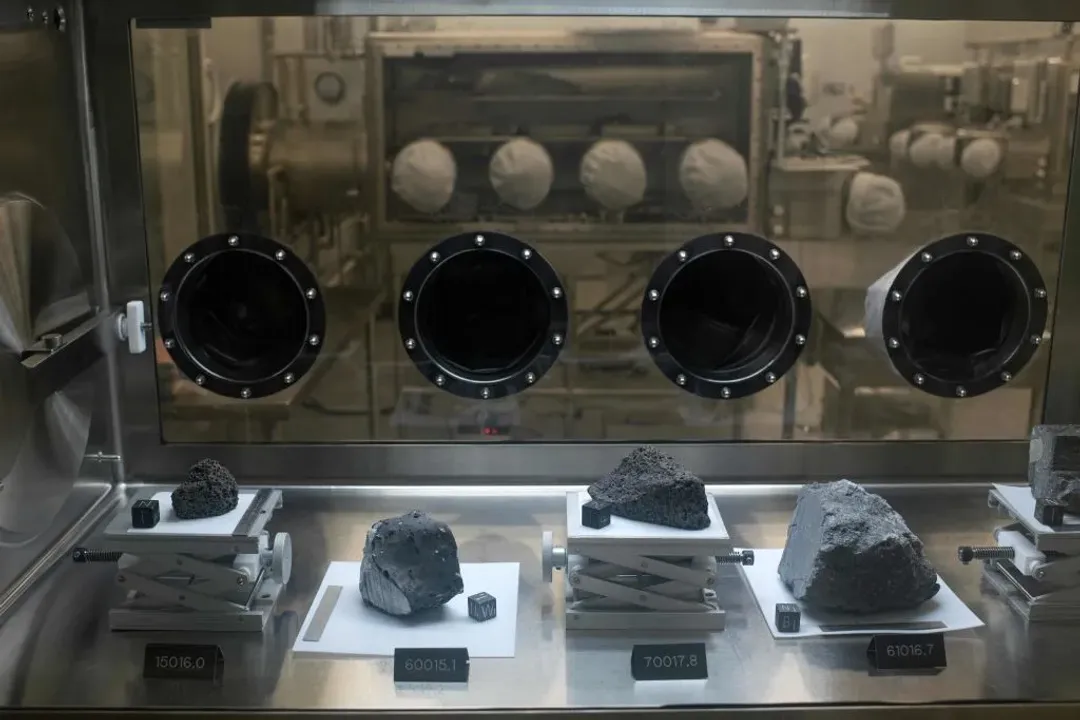
One of the strongest arguments for this theory involves chemical fingerprints. Researchers analyze isotopes—variations of elements with different atomic weights—found in lunar rocks brought back by Apollo astronauts [1][3]. Oxygen, titanium, and tungsten isotopes on the Moon are remarkably similar to those found on Earth [2][3].
If the Moon had formed from a distant object captured by Earth’s gravity, or if it had formed independently in a different part of the solar system, it would carry a different isotopic signature [1]. The fact that these signatures are nearly identical suggests that the Moon and Earth share a common heritage [3]. Some recent studies propose that the impact was so energetic that the material from Earth and Theia became completely homogenized, effectively blending into a single, shared reservoir of elements before the Moon cooled and solidified [3].
# Orbital Dynamics
The physical motion of the Earth-Moon system provides further clues. The Moon orbits Earth at a specific distance and speed that aligns with the angular momentum predicted by a large-scale impact event [2]. If the Moon had formed through the slow accretion of dust and gas alongside Earth, the orbital mechanics would look quite different [1].
The angular momentum of the Earth-Moon system is unusually high. Simulations show that a grazing impact, rather than a direct hit, would have provided the necessary "kick" to get the Moon into its current orbital state while keeping the Earth spinning at its observed rate [2]. This specific balance of rotation and orbit is difficult to replicate with other formation theories [8].
# Comparison Table
To visualize why the Giant-Impact Hypothesis holds the most weight, consider how it stacks up against alternative ideas that scientists have debated over the years.
| Theory | Mechanism | Why It Often Fails |
|---|---|---|
| Capture Theory | Earth grabbed a passing object | Highly unlikely given the Moon's size and current orbit |
| Co-accretion | Earth and Moon formed together | Does not explain the lack of iron in the Moon |
| Fission Theory | Earth spun so fast it ejected material | Requires impossible rotation speeds |
| Giant-Impact | Mars-sized body struck Earth | Explains isotopic match and low-iron composition |
This comparison highlights that the Giant-Impact model is the only one that resolves the specific chemical and physical puzzles presented by lunar samples [1].
# New Simulations
For many years, researchers struggled with one specific detail: if the Moon formed from Theia, why does it look so much like Earth? Older computer simulations suggested that the Moon should have been composed largely of material from the impactor, which would have carried a different isotopic "tag" than Earth [2]. This discrepancy fueled debates for years [8].
However, newer, high-resolution computer simulations have provided a breakthrough [6]. These models indicate that the formation process might have been much faster than previously thought. Instead of taking months or years for the debris to coalesce, the moon could have formed in a matter of hours [6]. In these rapid-formation scenarios, the impact creates a much more thoroughly mixed vapor cloud, which accounts for the isotopic similarity between the two bodies [3]. This adjustment in timing effectively bridges the gap between earlier theory and modern observations [6].
# Theia’s Legacy
The scientific community generally accepts the Giant-Impact Hypothesis, though it continues to refine the details [8]. Investigating the Moon’s origin is essentially an exercise in planetary detective work. We are looking at a "crime scene" that is 4.5 billion years old. The isotopes are our DNA evidence, the orbital mechanics are our physical clues, and the computer simulations are the reconstruction of the event.
One interesting aspect to consider is the fate of Theia itself. Scientists often wonder where the impactor went. The leading answer is that it is essentially everywhere. Because of the extreme heat and energy involved in the collision, Theia did not stay intact. It was pulverized, vaporized, and mixed into the Earth’s mantle. In this sense, a significant percentage of the Earth’s lower mantle might actually be made of the remnants of this visiting world [3]. We are not just living on Earth; we are living on a planet that effectively swallowed its own moon-maker.
# Addressing Challenges
While the theory is strong, it is not without challenges. Some critics point out that we still have not found "Theia" fragments on Earth that are distinct from our planet's material [8]. However, as the simulations suggest, the sheer violence of the collision likely erased these distinct signatures through intense mixing [3].
Another area of active research is the volatility of the Moon. The Moon is relatively dry compared to Earth. The heat from the impact would have vaporized water and other volatile compounds, preventing them from being incorporated into the Moon as it formed [2]. This perfectly matches the observations made by robotic missions and sample analysis [1][4]. The lack of water is not a flaw in the theory; it is a signature of the high-energy event that created our companion.
The story of the Moon is a testament to the chaotic nature of our early solar system. It serves as a reminder that the calm, stable night sky we see today is the result of a violent, transformative beginning. By studying the Moon, we are not just learning about our nearest neighbor; we are learning about the very origins of our own planet.
Related Questions
#Citations
What evidence supports the collision theory for the formation of the ...
Giant-impact hypothesis - Wikipedia
Science: New Evidence that Collision Produced Earth's Moon - AAAS
Where did our Moon come from? Over the years, there have been ...
Which of the following is evidence for the "Collision Theory ... - Brainly
Collision May Have Formed the Moon in Mere Hours, Simulations ...
Flaws in the giant impact hypothesis of lunar origin - NASA ADS
How widely accepted is the Theia impact theory for the formation of ...
New proof of Theia Moon formation theory