Where were heavier elements, referred to as 'metals' by astronomers, manufactured and dispersed into space?
Answer
Inside stars through nuclear fusion
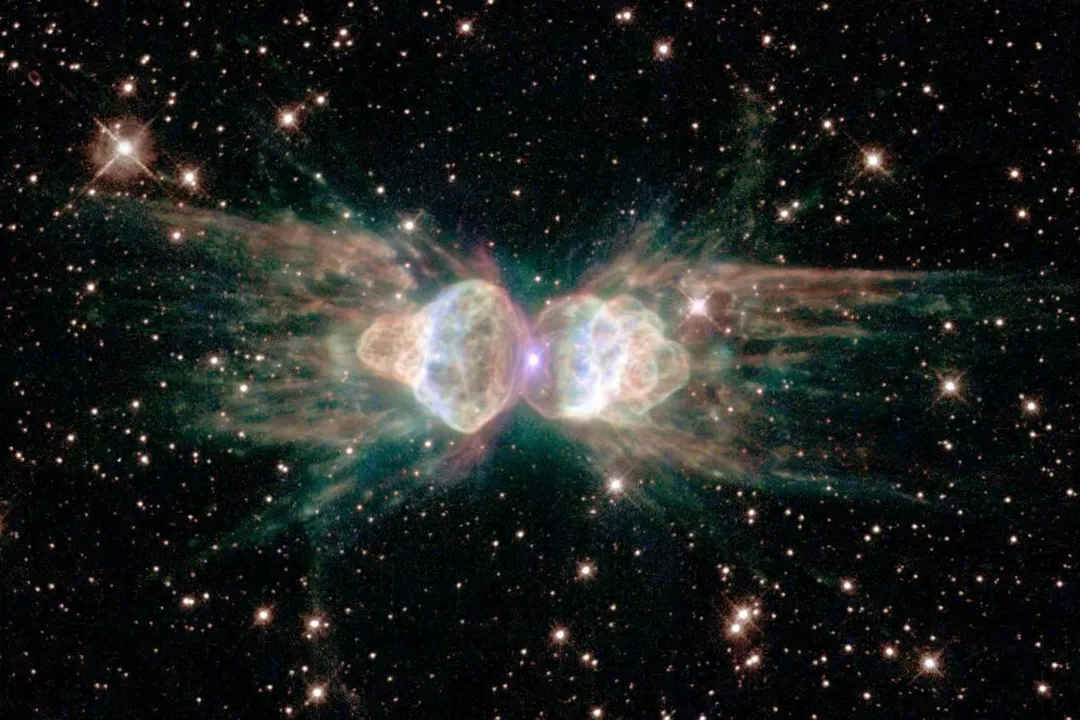
Elements heavier than hydrogen and helium, which astronomers often categorize as 'metals,' were not created during the Big Bang. Instead, these heavier constituents—such as oxygen, carbon, neon, and nitrogen—are forged deep within stars via the process of nuclear fusion. They are subsequently released into the interstellar medium when those stars reach the end of their lifecycles, frequently through explosive events like supernovae, enriching subsequent generations of nebulae.
Related Questions
What is the main element found within nebulae, reflecting the universe's earliest moments?Which element is the second most common gas constituent present in nebulae after hydrogen?What percentage of total elemental mass does Hydrogen account for in a typical star-forming region nebula?What form does Hydrogen primarily take in cold and dense molecular clouds within a nebula?Where were heavier elements, referred to as 'metals' by astronomers, manufactured and dispersed into space?What specific characteristic of emission nebulae is caused by excited hydrogen atoms?What is the Latin origin and meaning of the term 'nebula'?What diagnostic information can the ionization of Helium provide regarding hot, young stars in emission nebulae?What are the primary constituents aggregated by interstellar dust particles, which were synthesized in previous stellar generations?What primary method is utilized to confirm the elemental abundance ratios within nebulae spectra?In a typical volume of interstellar space, what fraction of the total mass might interstellar dust constitute, despite its significant role?