What sophisticated instrument is specifically designed to probe the era of the first galaxies by looking for redshifted light?
Answer
James Webb Space Telescope (JWST).
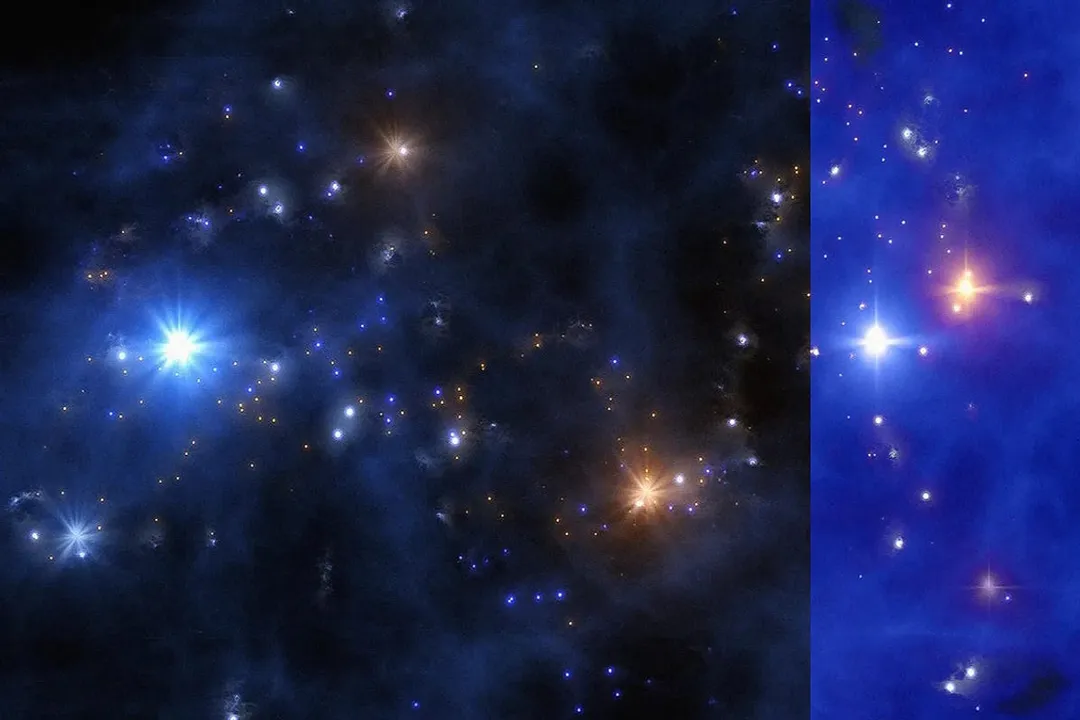
Observing Population III stars is incredibly difficult because they formed over 13 billion years ago, meaning their light is significantly redshifted deep into the infrared spectrum due to the expansion of the universe. The James Webb Space Telescope (JWST) was specifically engineered with large mirrors and infrared sensitivity to successfully detect the faint light emitted by these extremely distant, early galaxies powered by the first stars. While JWST has achieved detection of galaxies from a remarkably early epoch, isolating the signal of a pure, unmixed Population III star itself remains an active area of research.
#Videos
WHEN did the first ever stars form in the Universe? - YouTube
Related Questions
What raw material constituted the Population III stars?How massive were Population III stars compared to Population I stars like the Sun?What primarily drove the collapse of the earliest gas clouds lacking heavy elements?What colossal explosion marked the death of the massive Population III stars?What crucial chemical contribution resulted from the explosive end of the first stars?How did the main sequence lifetime of a 100-solar-mass Population III star compare to the Sun's expected lifetime?How did the scarcity of metals affect the fragmentation of early stellar nurseries?What sophisticated instrument is specifically designed to probe the era of the first galaxies by looking for redshifted light?What was the typical metal abundance of early stellar nurseries (Pop III) compared to modern Population I stars?Why was the existence of molecular hydrogen ($H_2$) critical for the initial cooling pathways of Population III clouds?