How did the scarcity of metals affect the fragmentation of early stellar nurseries?
It prevented fragmentation, favoring the creation of a few massive clumps.
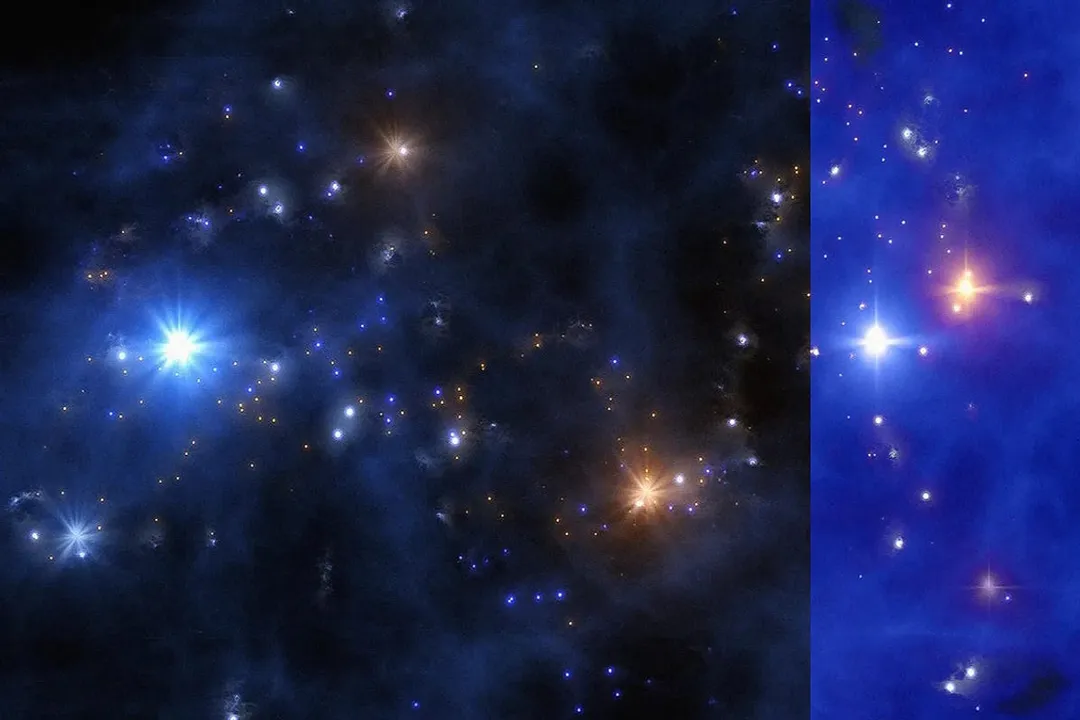
The presence of trace heavy elements, or 'metals,' in later stellar nurseries provides an excellent mechanism for radiating away thermal energy. This efficient cooling causes the massive gas clouds to readily lose internal heat, allowing the cloud to break apart into numerous smaller, gravitationally unstable fragments. In the metal-free environment of the first stars, this efficient cooling mechanism was absent. Therefore, the immense gas clouds could not fragment easily. The collapse proceeded largely unchecked by cooling, leading to runaway gravitational instability that resulted in the formation of only a few, extremely massive clumps rather than the myriad of small stars seen in contemporary nebulae.
#Videos
WHEN did the first ever stars form in the Universe? - YouTube