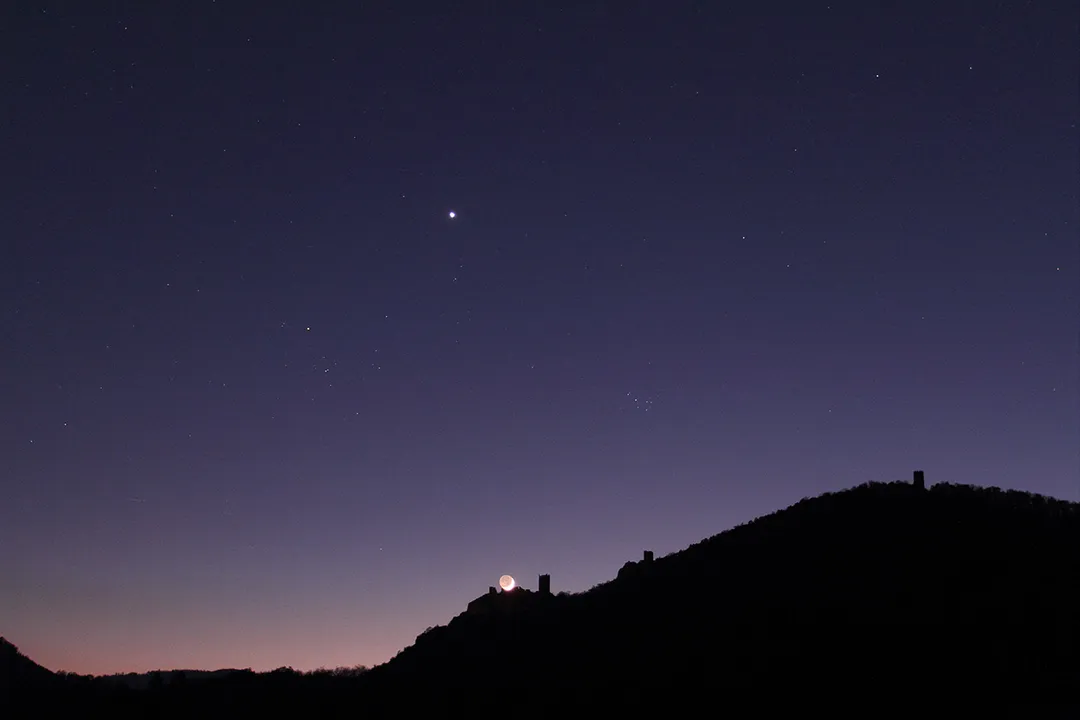
What is the primary physical difference causing stars to twinkle while planets like Venus display a steadier glow?
Stars appear as point sources whose light is refracted by atmospheric density changes, unlike planets which appear as tiny disks.
The phenomenon of twinkling, or scintillation, is directly related to the distance of the light source. True stars are incredibly distant suns, meaning their light reaches Earth as essentially a single, pinpoint source. As this pinpoint beam travels through Earth's atmosphere, slight variations in air density and temperature cause continuous refraction, resulting in the flickering effect we perceive as twinkling. Planets, being solar system neighbors, are close enough that even the naked eye perceives them as tiny disks. Light from this slightly wider source area is averaged out by atmospheric turbulence, leading to a much steadier, unwavering light emission that does not typically twinkle.