morning articles

What substance primarily composes the highly reflective clouds of Venus that cause its spectacular glow?

What substance primarily composes the highly reflective clouds of Venus that cause its spectacular glow?

By what factor does Venus shine brighter than Jupiter when both are at their brightest observable magnitudes?

By what factor does Venus shine brighter than Jupiter when both are at their brightest observable magnitudes?

What celestial body is identified as the *only* natural object more conspicuous in the night and morning skies than the planet Venus?

What celestial body is identified as the *only* natural object more conspicuous in the night and morning skies than the planet Venus?

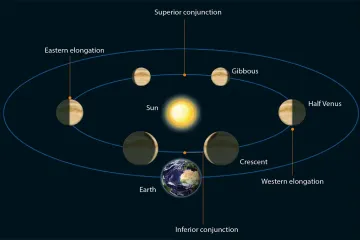
If an observer sees Venus shining brilliantly in the morning sky, what does this imply about Venus's orbital motion relative to the Sun as seen from Earth?

If an observer sees Venus shining brilliantly in the morning sky, what does this imply about Venus's orbital motion relative to the Sun as seen from Earth?

What is the primary physical difference causing stars to twinkle while planets like Venus display a steadier glow?

What is the primary physical difference causing stars to twinkle while planets like Venus display a steadier glow?

What is the typical peak apparent magnitude that Jupiter reaches, which is noticeably dimmer than Venus's brightest magnitude of $-4.9$?

What is the typical peak apparent magnitude that Jupiter reaches, which is noticeably dimmer than Venus's brightest magnitude of $-4.9$?

If an observer looks towards the western horizon just after sunset and sees Venus, what historical title is it earning at that time?

If an observer looks towards the western horizon just after sunset and sees Venus, what historical title is it earning at that time?

What percentage of sunlight is reflected back into space by the clouds composed mostly of sulfuric acid surrounding Venus?

What percentage of sunlight is reflected back into space by the clouds composed mostly of sulfuric acid surrounding Venus?

What is the key observational characteristic used to differentiate Venus from a true star, assuming the observer cannot resolve a visible disk?

What is the key observational characteristic used to differentiate Venus from a true star, assuming the observer cannot resolve a visible disk?

Which planetary neighbor is often identified as the second-brightest planet, typically exhibiting a steady, yellowish-white light?
Which planetary neighbor is often identified as the second-brightest planet, typically exhibiting a steady, yellowish-white light?

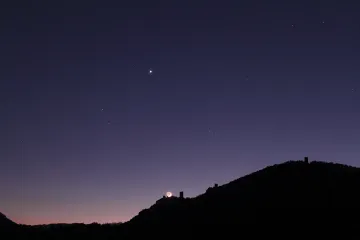
What celestial body is almost always the single brightest "star" seen low in the eastern sky before sunrise?

What celestial body is almost always the single brightest "star" seen low in the eastern sky before sunrise?

What physical characteristic is responsible for Venus's high luminosity?

What physical characteristic is responsible for Venus's high luminosity?

What distinguishes the steady glow of a planet from the twinkling of a star when observed?

What distinguishes the steady glow of a planet from the twinkling of a star when observed?

Why is Venus's visibility transient, limited to hours before sunrise or after sunset?

Why is Venus's visibility transient, limited to hours before sunrise or after sunset?

Besides the Moon and Venus, what planet is generally considered the third brightest natural object visible in the night sky?

Besides the Moon and Venus, what planet is generally considered the third brightest natural object visible in the night sky?

What feature is Mars famous for?

What feature is Mars famous for?

What makes Mercury the most challenging of the naked-eye planets to spot?

What makes Mercury the most challenging of the naked-eye planets to spot?

What phenomenon causes a bright planet viewed very low in the east to appear to twinkle or shimmer more noticeably?

What phenomenon causes a bright planet viewed very low in the east to appear to twinkle or shimmer more noticeably?

Which title does Venus take when it appears in the western sky after sunset?

Which title does Venus take when it appears in the western sky after sunset?

How can Venus temporarily vanish from visibility in the morning sky over time?

How can Venus temporarily vanish from visibility in the morning sky over time?