What is the primary mechanism generating heat to maintain liquid oceans on icy moons like Europa and Enceladus?
Answer
Internal friction caused by intense gravitational tugging from their massive parent planets, known as tidal flexing.
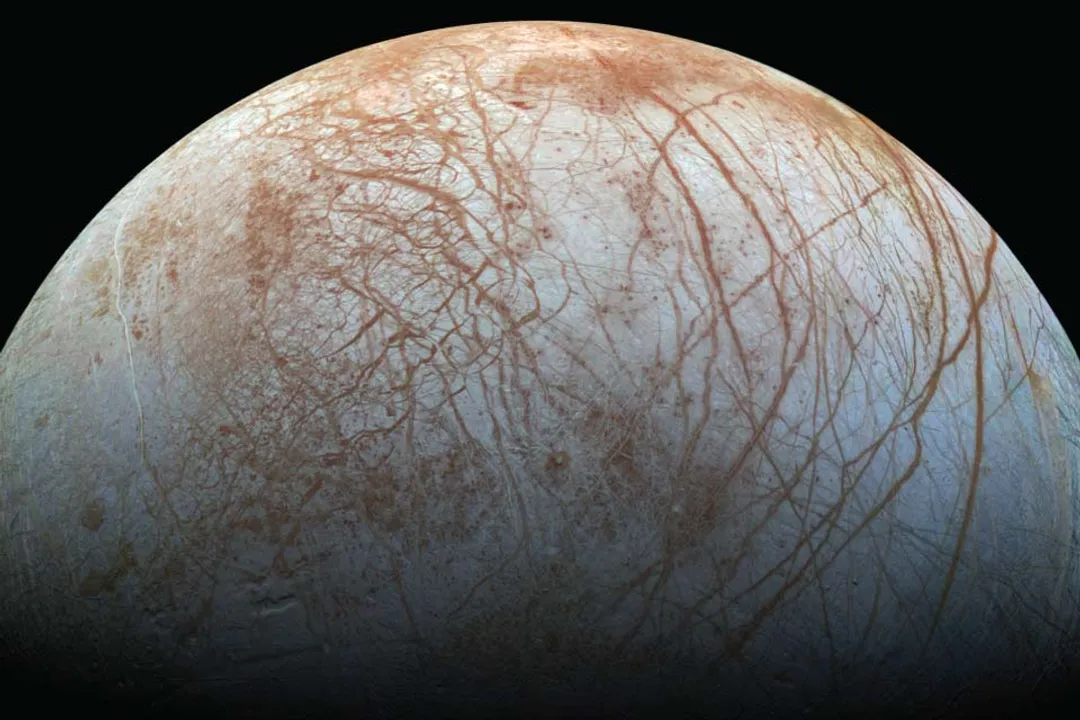
The liquid water environments on the ocean worlds orbiting Jupiter and Saturn—such as Europa and Enceladus—are sustained by gravitational interactions with their massive parent planets. The constant squeezing and stretching of the moons' interiors, driven by these gravitational forces, generates internal friction. This process, termed tidal flexing, produces enough thermal energy to melt vast quantities of internal water ice, creating and sustaining deep, global subsurface oceans beneath thick icy shells.
#Videos
They Finally Found Liquid Water on Mars - YouTube
Just in: NASA Has Found Oceans of Liquid Water on Mars...For Real
Related Questions
Why is stable liquid water currently untenable on the surface of Mars?What keeps the deep, subsurface liquid water reservoirs beneath the Martian south polar ice cap from freezing?What is the primary mechanism generating heat to maintain liquid oceans on icy moons like Europa and Enceladus?What unique advantage does Enceladus offer scientists seeking to sample its subsurface ocean composition?What possibility is raised by the assumption that Europa’s ocean is in direct contact with its rocky seafloor?How does the composition of liquid water found deep beneath the Martian surface fundamentally differ from Earth's surface oceans?What defines the primary heating mechanism for the liquid water reservoirs on Mars, contrasting with the icy moons?What major engineering obstacle currently restricts access to the confirmed liquid water reservoirs deep beneath the Martian surface?What scientific priority shift is occurring because of the inherent difficulty in accessing deep Martian liquid water?What characteristic defines the condition of most extraterrestrial liquid water found off-world, as opposed to Earth's temperate water?