What is the magnification achieved with an objective focal length of 2000 mm and an eyepiece focal length of 20 mm?
Answer
100x
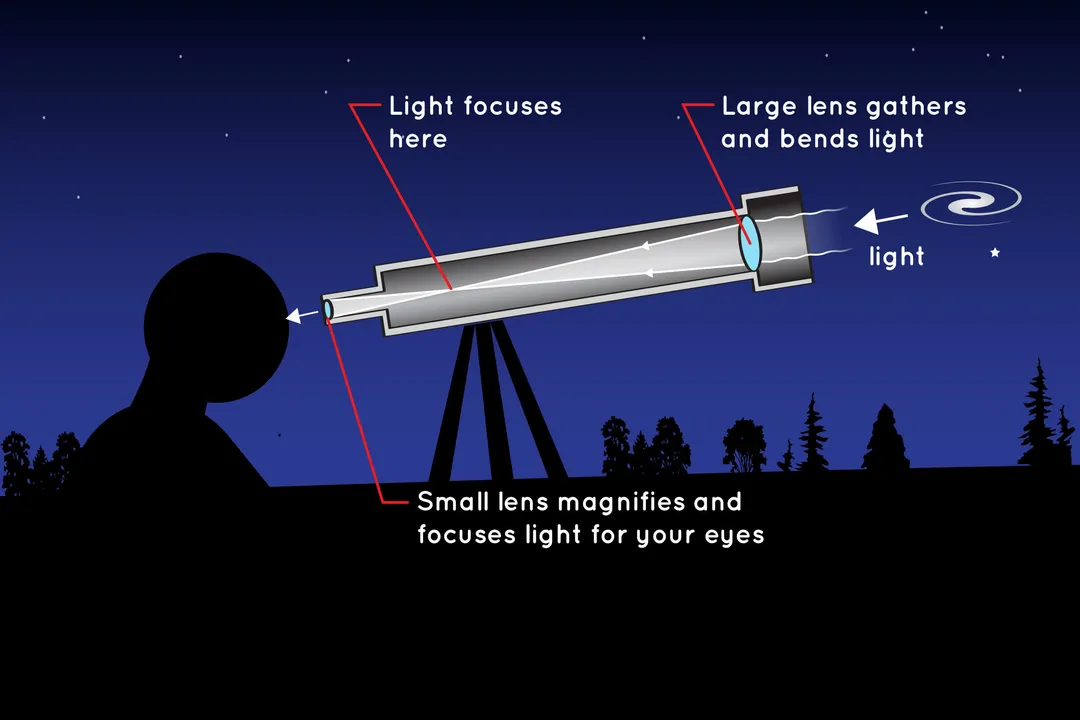
The magnification achieved by a telescope is calculated using a straightforward ratio involving the focal lengths of its optical components. Specifically, magnification (M) is determined by dividing the objective focal length ($f_o$), which is determined by the main mirror or lens, by the focal length ($f_e$) of the eyepiece currently inserted into the optical path. Using the given values, the calculation is $2000 ext{ mm} / 20 ext{ mm}$, which results in a magnification factor of $100 imes$. This demonstrates how different eyepieces allow an observer to vary the view, making high-power observation possible when paired with a long focal length optical system.
Related Questions
How does doubling the aperture diameter affect a telescope's light-gathering power?What optical challenge is inherent to refracting telescopes using an objective lens?Why do reflecting telescopes primarily avoid chromatic aberration?What is the magnification achieved with an objective focal length of 2000 mm and an eyepiece focal length of 20 mm?What specific axis adjustment is required to track a celestial object using an aligned Equatorial Mount?What is often cited as a typical trade-off when choosing a reflector over a refractor telescope?What causes 'empty magnification' when using a telescope eyepiece?What optical combination defines a catadioptric or compound telescope system?What is the primary role of the small, low-magnification finderscope attached to the main telescope tube?What electronic component relies on external power sources like batteries or AC adapters in a modern telescope setup?