What does a telescope use?
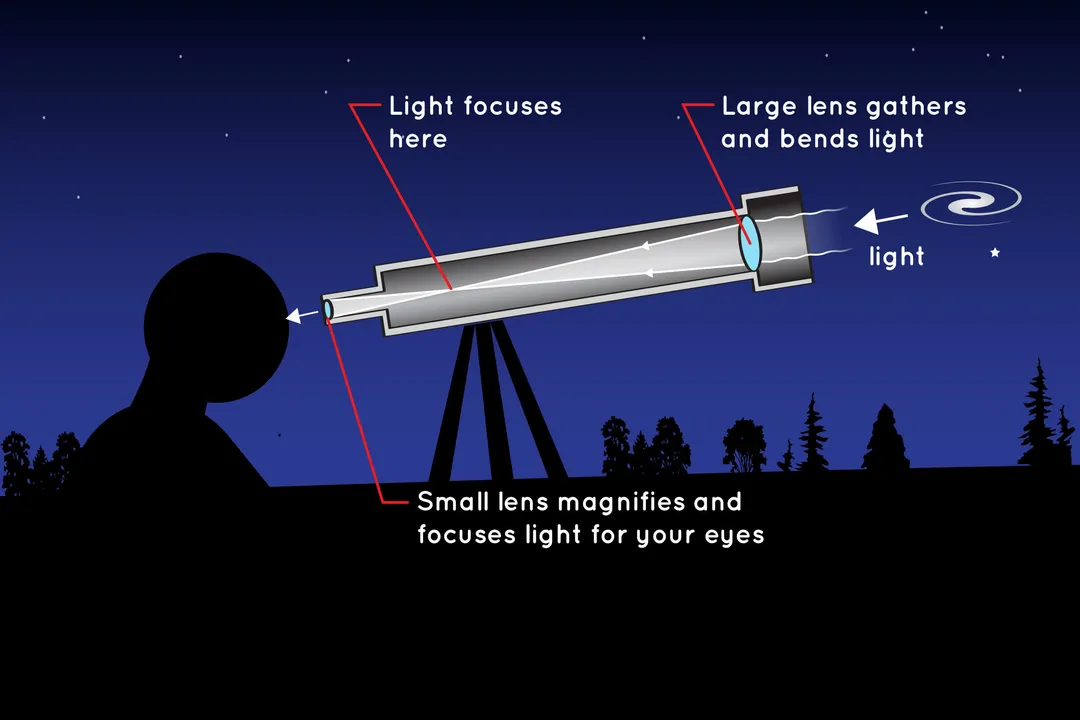
The device that lets us peek into the depths of space doesn't rely on magic, but rather a precise arrangement of optics and mechanics designed to overcome the limitations of the human eye. At its most fundamental, a telescope is an instrument built primarily to accomplish two things: to gather significantly more light than our pupil can, and to magnify the image formed by that gathered light, making distant objects appear closer and brighter. [1][3][5] This capability transforms faint smudges of light into discernible structures, whether we are observing the Moon, planets, or galaxies millions of light-years away. [9]
# Light Gathering
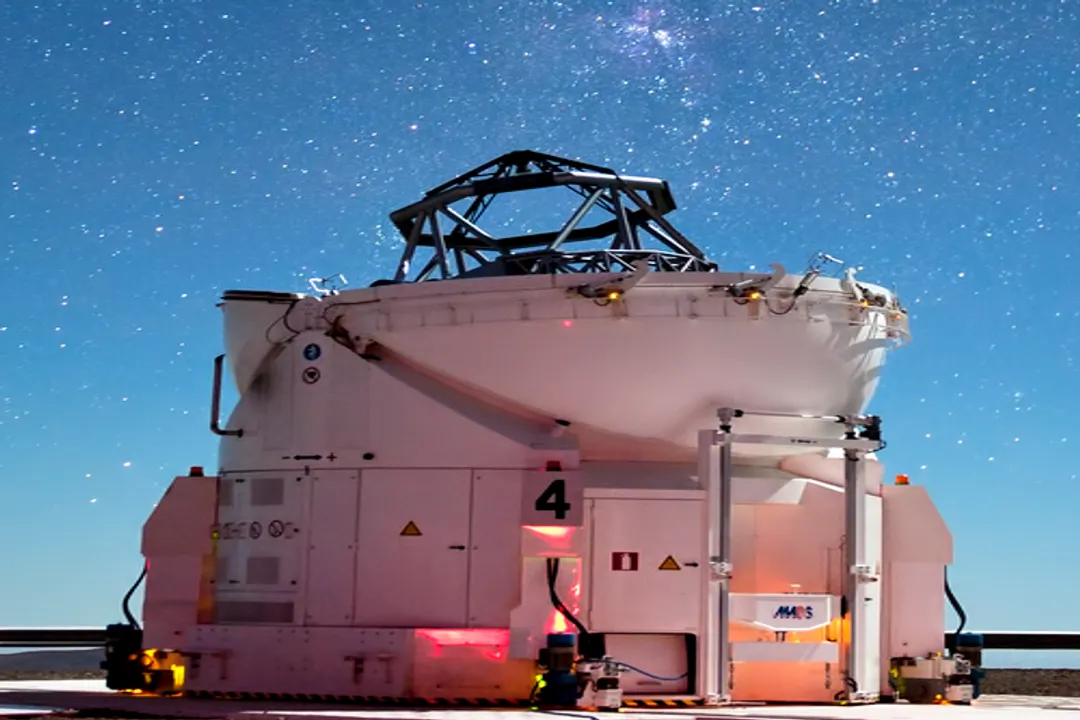
The single most critical component determining a telescope's performance is its aperture—the diameter of the main light-collecting element, which is either a lens or a mirror. [3][5] This aperture dictates the light-gathering power of the instrument. [3] More light means fainter objects become visible, and brighter objects reveal more detail. [5]
When thinking about what a telescope uses to see, the answer is light, but the size of the instrument dictates how much light it can capture. For instance, a telescope with twice the aperture gathers four times as much light as one with half the diameter. [3] This principle is particularly relevant when observing from light-polluted urban environments. In such settings, the extra light-gathering capacity provided by a larger aperture often provides a more immediate and noticeable benefit than trying to achieve extreme theoretical magnification, as it helps push the faint background skyglow down relative to the target object. [1]
# Image Optics
Once the light is collected, it must be focused to form a clear image. The method used to focus that light defines the primary type of telescope being used. Historically and currently, telescopes fall into two main categories based on their primary optical element: refractors and reflectors. [6]
# Lens Bending
A refracting telescope employs a large lens, called the objective lens, placed at the front end of the tube. [3][6] This lens works by refracting, or bending, incoming light rays toward a single focal point near the back of the tube. [3] The resulting image is viewed through a smaller lens called the eyepiece. [3][6] While refractors offer views known for high contrast and sharp details, they face an inherent optical challenge: chromatic aberration. [6] Because different colors (wavelengths) of light bend at slightly different angles when passing through glass, the color fringes around bright objects can become noticeable, especially in simpler designs. [6]
# Mirror Reflection
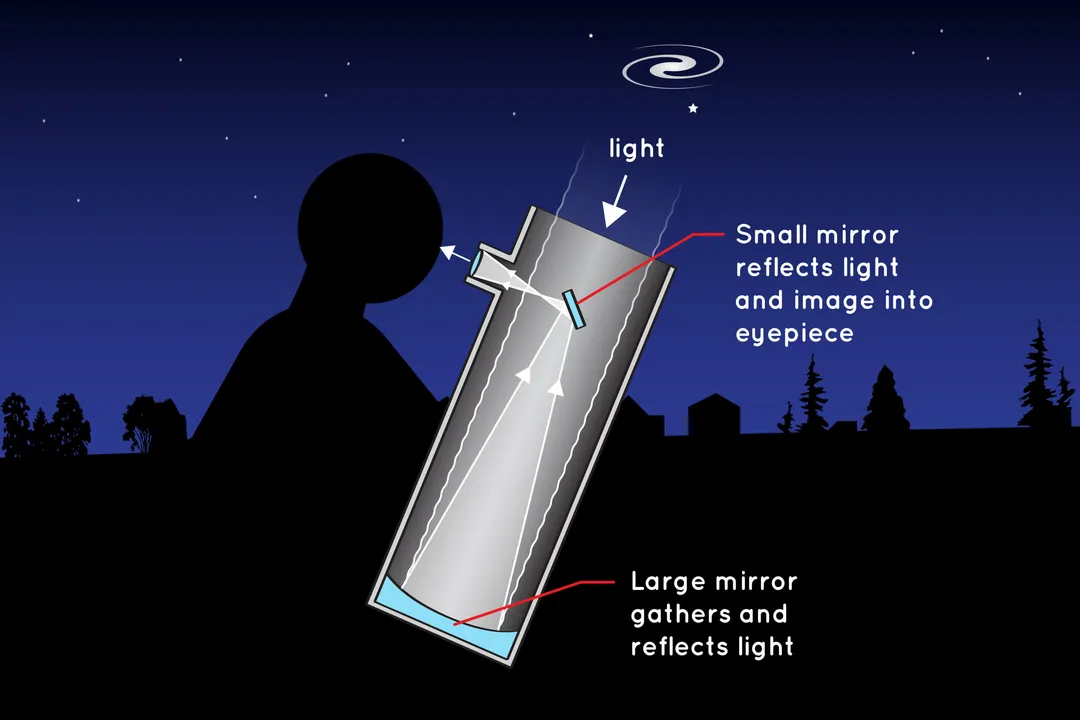
A reflecting telescope uses a curved mirror, the primary mirror, instead of a lens to gather and focus light. [3][6] This mirror reflects the light back up the tube to a focal point. [3] In a common configuration, like the Newtonian design, a small, flat secondary mirror diverts the focused light to the side of the tube where the eyepiece is located, allowing the observer to look in comfortably. [3][6] Reflectors largely avoid the chromatic aberration common to refractors because mirrors reflect all colors of light equally. [6] However, they introduce their own set of optical considerations, such as the need for the primary mirror’s surface to be perfectly shaped to avoid spherical aberration, and they require periodic alignment, known as collimation, to ensure the light paths remain perfect. [6] Choosing between these two types often boils down to a trade-off: the cleaner optical path of a refractor versus the typically lower maintenance cost and larger aperture potential of a reflector for the same price point. [6]
# Compound Systems
A third class, the catadioptric or compound telescope, uses a combination of both lenses and mirrors to fold the light path, often resulting in a much shorter physical tube for a given focal length. [6] These systems compensate for spherical errors using a corrector lens at the front end of the tube. [6]
# Image Magnification
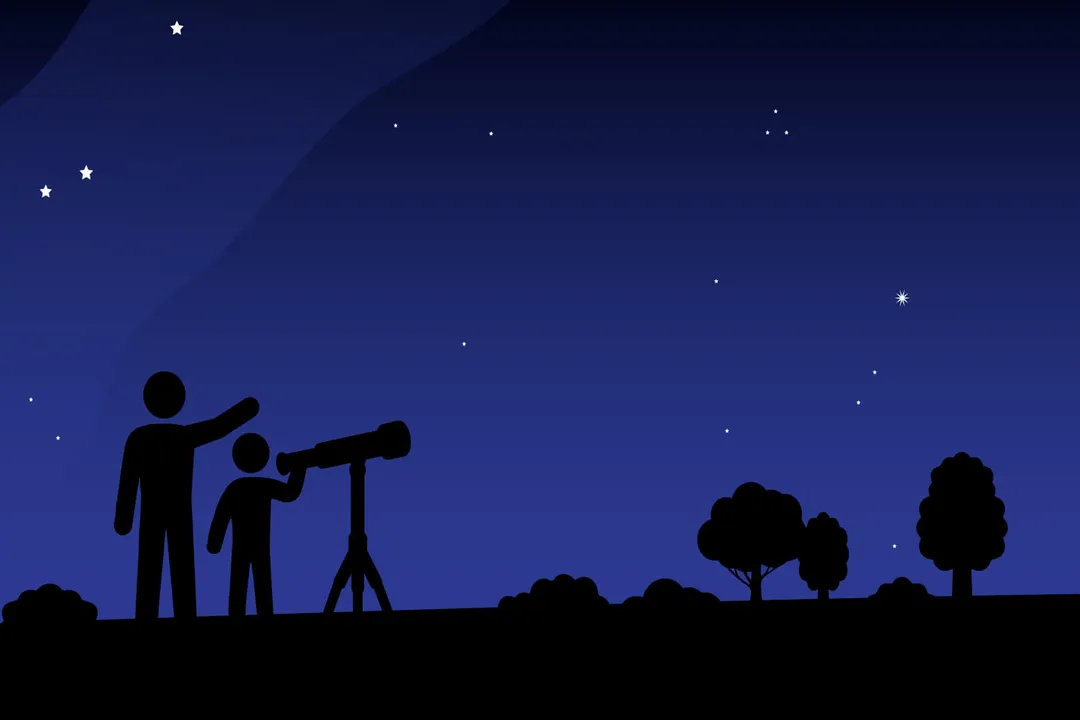
Gathering light is only half the battle; the other necessary use of a telescope is magnification. This is achieved by the eyepiece, which acts as a magnifying glass for the focused image created by the objective lens or primary mirror. [3][6][7]
Magnification is not an inherent quality of the telescope tube itself but is determined by the combination of the main optical element and the eyepiece currently inserted. [5] The formula is straightforward:
If a telescope has a focal length of and an eyepiece with a focal length of is inserted, the magnification achieved is . [3] A telescope will come with a set of eyepieces, perhaps , , and , allowing the user to dial in different views based on what they are observing. [7]
It is important to recognize that while higher magnification seems desirable, it is useless without sufficient light gathering and resolution. [3] Resolution is the ability to separate fine details, and it is fundamentally limited by the aperture size. [3][5] Magnifying an image beyond the telescope's resolving capability simply results in a larger, blurry version of the image, which is often referred to as "empty magnification". [5]
# Mechanical Support
Even the best optics are useless if the image shakes or drifts out of view. Therefore, a telescope absolutely requires a mount to hold it steady and allow for movement. [1][5] The choice of mount significantly impacts the experience of using the instrument. [5]
# Movement Types
Telescope mounts generally fall into two primary mechanical categories:
- Alt-Azimuth Mounts: These are intuitive, moving simply up and down (altitude) and side to side (azimuth). [1] They are easy to set up and use for casual terrestrial viewing or quick astronomical looks. [5] However, because celestial objects appear to move in an arc across the sky due to Earth’s rotation, tracking a star requires constant, simultaneous adjustment on both the altitude and azimuth axes. [5]
- Equatorial Mounts: These are engineered to align one axis parallel to the Earth’s axis of rotation. [1][5] Once aligned (polar aligned), tracking a celestial object only requires adjusting this single axis—the Right Ascension axis—often achieved through a slow-motion motor drive. [5] This makes long-exposure photography or extended visual observation of deep-sky objects much more practical. [5]
# Fine Control
In addition to the main mount structure, the telescope tube often uses a focuser, which is a mechanical sliding assembly that moves the eyepiece slightly in and out until the image is perfectly sharp. [7] For aiming, a smaller, low-magnification scope called a finderscope is attached parallel to the main tube. This smaller scope provides a wide field of view, making it much easier to locate a target star or planet before switching to the high-power main eyepiece. [7]
# Essential Accessories and Power
While the optics and mount are the physical structure, a modern telescope often uses various electronic and accessory components to enhance performance. For instance, computerized mounts, known as GoTo systems, incorporate motors and databases that allow the user to select an object by name, and the telescope automatically slews (moves) to that location. [1] This relies on internal sensors and sometimes external power sources like batteries or AC adapters. [1]
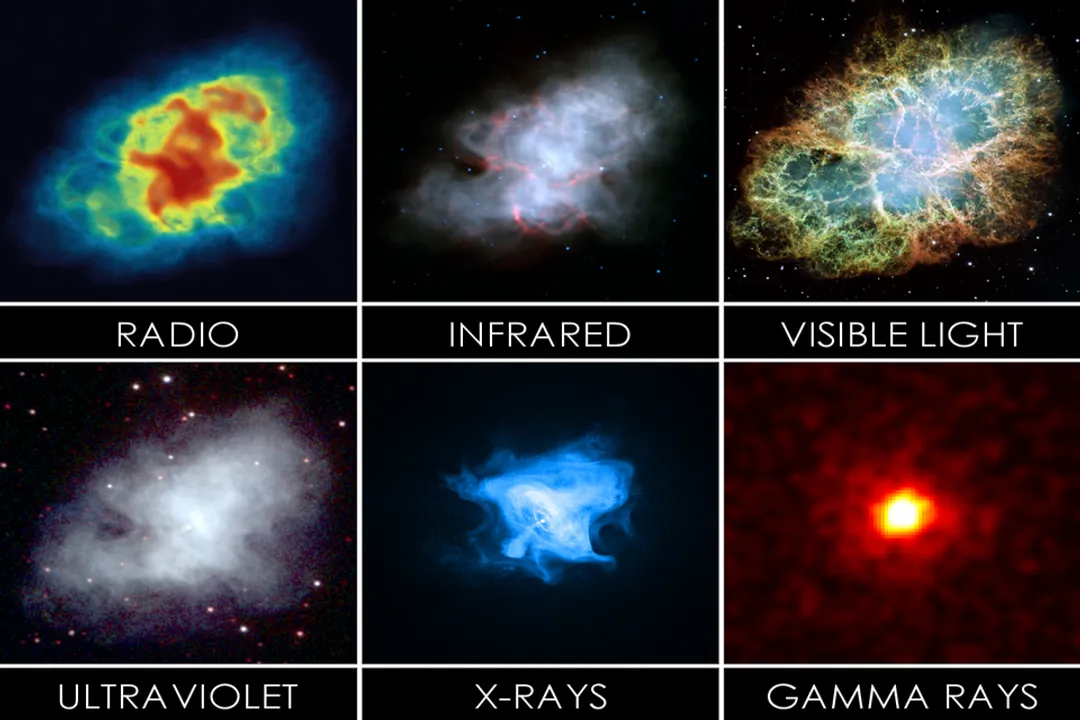
Furthermore, many advanced users supplement their vision with digital sensors. While visual observation is direct, modern astronomical research and even advanced amateur astronomy rely on imaging. [9] These imaging setups replace the eyepiece with a sensitive digital camera, which uses the telescope's optics to focus light onto a chip, recording data that can later be processed to reveal colors and details invisible to the eye alone. [9] These electronic components introduce the need for stable power and data connections, making them another core "user" of a modern telescope system.
The practical differences between optical designs highlight how the selection of components affects use. A short, wide-field refractor might be perfect for scanning large star clusters or the Milky Way band, prioritizing a broad view over extreme magnification. Conversely, a long focal length reflector or refractor, paired with a sturdy equatorial mount, is used by deep-sky observers specifically to maximize light gathering on faint galaxies or nebulae where high magnification on a stable platform is required. The very parts a telescope uses—lenses, mirrors, mounts, and eyepieces—are selected to optimize it for a specific astronomical goal, balancing light collection, magnification, and stability against cost and maintenance requirements. [5][6]
Related Questions
#Citations
How Do Telescopes Work? - NASA Space Place
Telescope - Wikipedia
How do telescopes work? - Museums Victoria
How a Telescope Works - Imaging.org
How a Telescope Works | Glacier's Night Skies
Can some explain what the different parts of a telescope do - Reddit
Types of Telescopes Explained - Learn What Fits Your Needs at OPT
For what purpose is a telescope used? - Quora
Space Telescopes - Cosmic Dark to Cosmic Dawn - UCLA