How does doubling the aperture diameter affect a telescope's light-gathering power?
Answer
It gathers four times as much light.
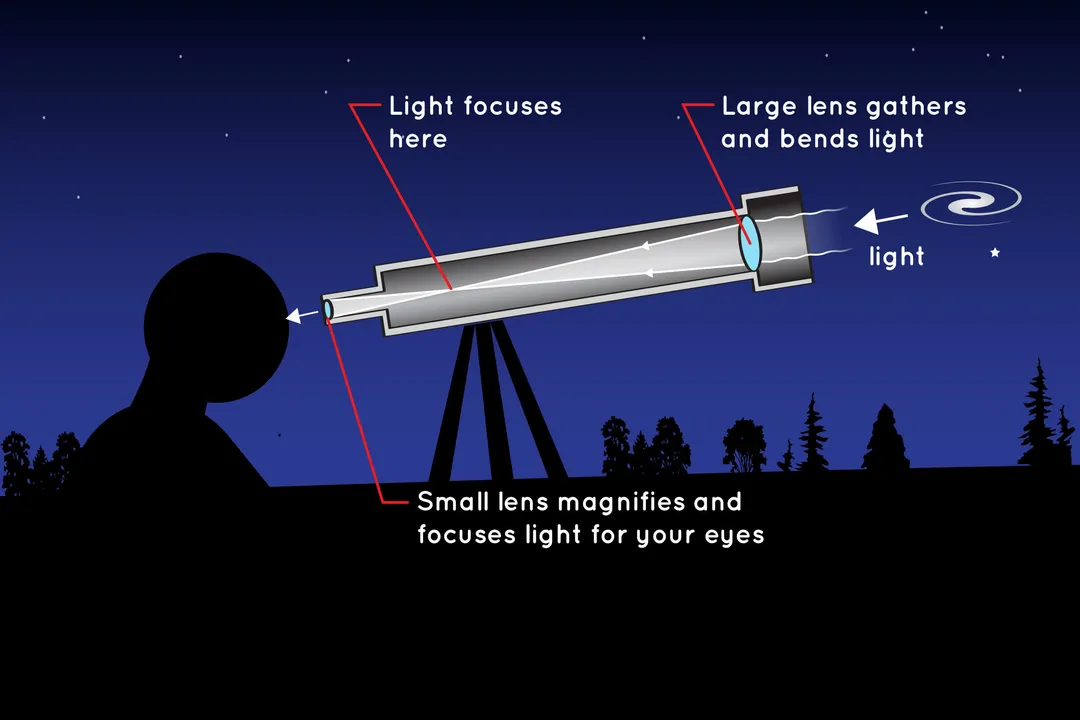
Light gathering power is directly related to the area of the main light-collecting element, known as the aperture. Since the area of a circle is proportional to the square of its diameter ($D^2$), if the diameter of the aperture is doubled (multiplied by 2), the light-gathering capacity increases by a factor of $2^2$, resulting in four times the light capture. This increased capacity is vital for making faint objects visible and for reducing the negative impact of background skyglow when observing from light-polluted environments.
Related Questions
How does doubling the aperture diameter affect a telescope's light-gathering power?What optical challenge is inherent to refracting telescopes using an objective lens?Why do reflecting telescopes primarily avoid chromatic aberration?What is the magnification achieved with an objective focal length of 2000 mm and an eyepiece focal length of 20 mm?What specific axis adjustment is required to track a celestial object using an aligned Equatorial Mount?What is often cited as a typical trade-off when choosing a reflector over a refractor telescope?What causes 'empty magnification' when using a telescope eyepiece?What optical combination defines a catadioptric or compound telescope system?What is the primary role of the small, low-magnification finderscope attached to the main telescope tube?What electronic component relies on external power sources like batteries or AC adapters in a modern telescope setup?