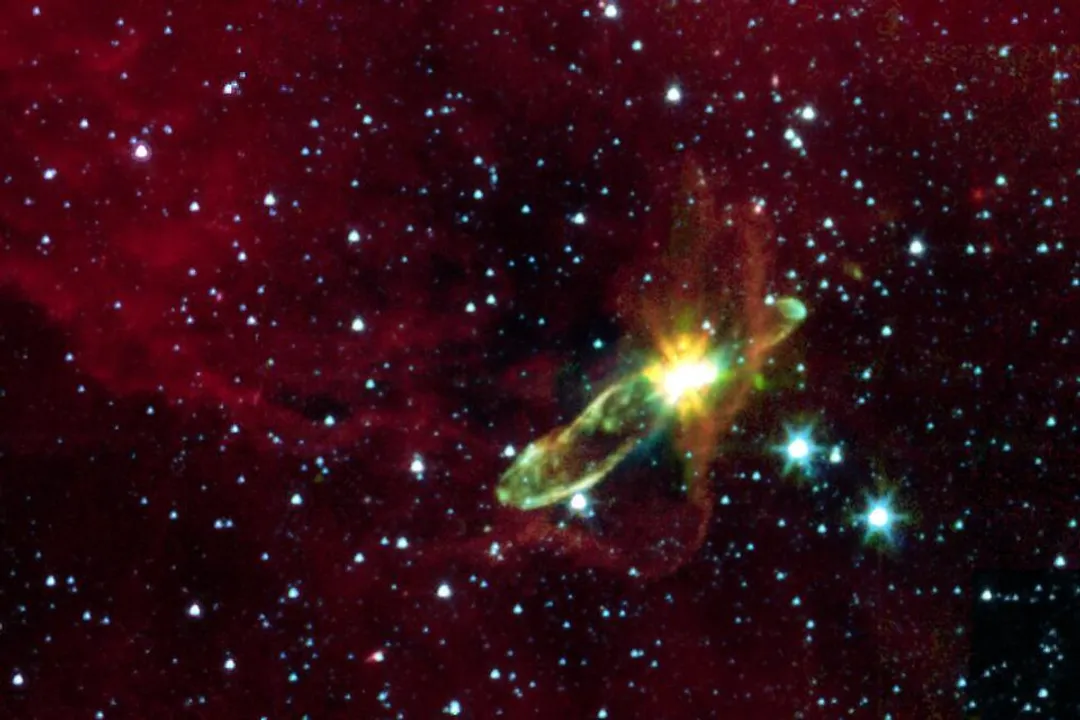
Why does an intensely luminous protostar shine brightly mainly in infrared light?
Answer
Infalling dust and gas traps heat, re-radiating it at longer wavelengths
The surrounding layer of obscuring infalling dust and gas traps the heat generated near the core, causing the system to re-radiate this energy primarily at longer, infrared wavelengths.
Related Questions
What is the primary energy source powering a protostar before nuclear fusion ignites?What is the approximate core temperature required to initiate sustained nuclear fusion in a protostar?What astrophysical mechanism specifically describes the slow contraction of a celestial body that is not yet fusing hydrogen?How is energy converted into heat during the gravitational collapse of a dense clump?Why does an intensely luminous protostar shine brightly mainly in infrared light?What is the composition of the initial interstellar cloud material that forms a star?What transition marks the end of the protostar phase and the beginning of main-sequence life?If a collapsing object does not accumulate enough mass to trigger fusion, what might it become?What role does the rotation of the initial cloud fragment play in the protostar system?How does the gravitational heating mechanism of a stellar-mass protostar compare to that of Jupiter?