Where does the protostar get the energy to glow?
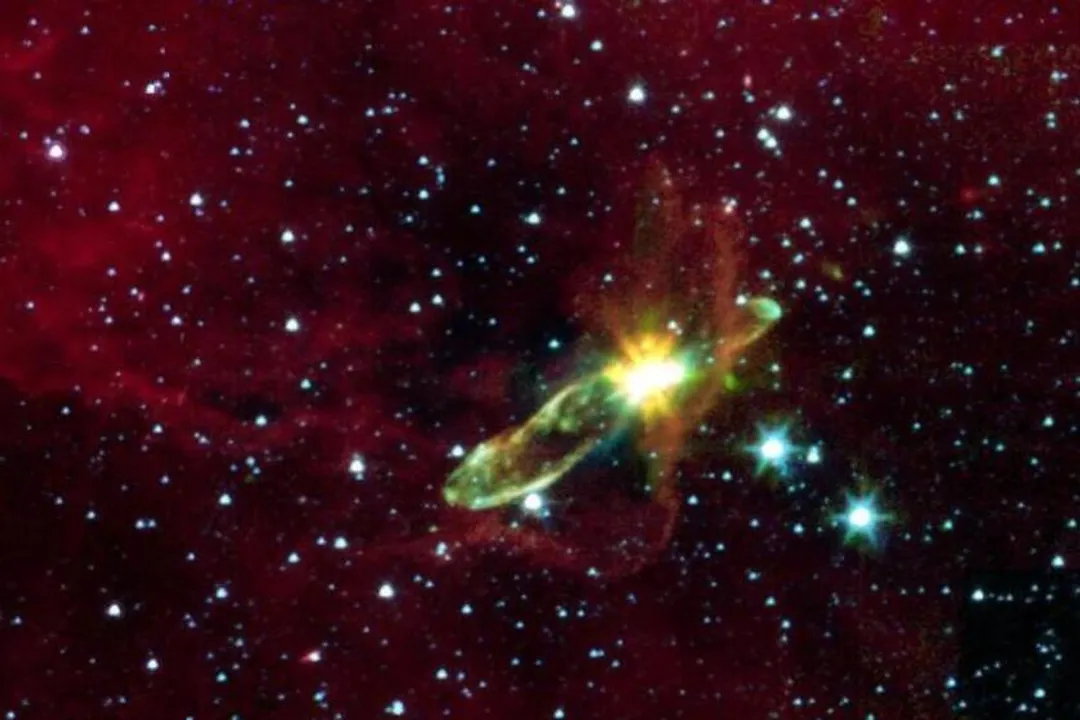
The glow emanating from a protostar—that brilliant, yet deeply hidden, infant of the stellar world—is a direct consequence of its dramatic, violent birth, not yet the steady power of a true star. A genuine star, like our Sun on the Main Sequence, shines because the core is hot and dense enough to sustain nuclear fusion, converting hydrogen into helium, which converts mass directly into staggering amounts of energy according to . The protostar, however, has not yet reached that critical milestone. Its luminosity is powered by a much more fundamental, albeit temporary, process: the conversion of gravitational potential energy into heat as the massive cloud collapses inward.
# Cosmic Cradle
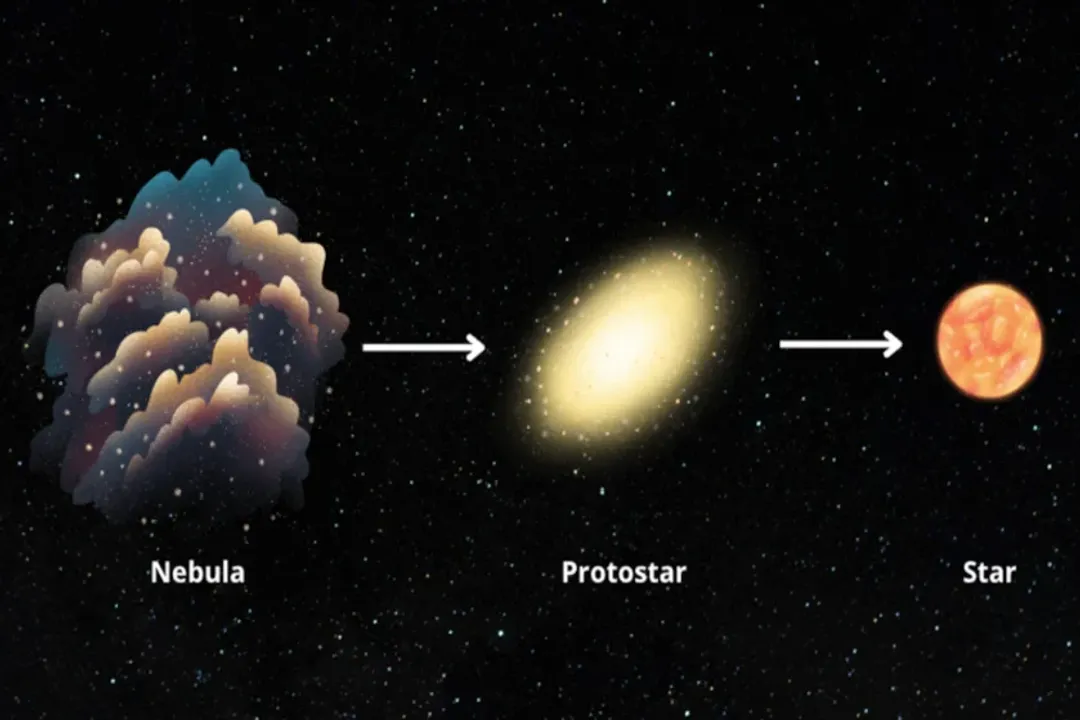
The story begins far from the bright stellar nurseries we might imagine. Stars form within vast, cold regions of space called molecular clouds, which are essentially enormous reservoirs of thinly spread gas, predominantly molecular hydrogen, mixed with trace elements and dust. These clouds, which can span hundreds of light-years, possess an average density so low that, by Earth standards, they would be considered a near-perfect vacuum. To initiate star birth, this diffuse material must overcome its own internal pressure and magnetic fields to collapse under self-gravity.
This trigger for collapse can come from external forces, such as the shockwave generated by an ancient, exploding star—a supernova—slamming into the cloud, or even a simple collision between two interstellar clouds. Once triggered, dense pockets, or "cores," within the cloud begin to concentrate matter. As gravity pulls this material inward, the entire fragment starts to contract. The key characteristic that defines this initial, condensing object as a protostar is this very process of rapid accumulation of mass, known as accretion, from the surrounding envelope.
# Collapse Heating
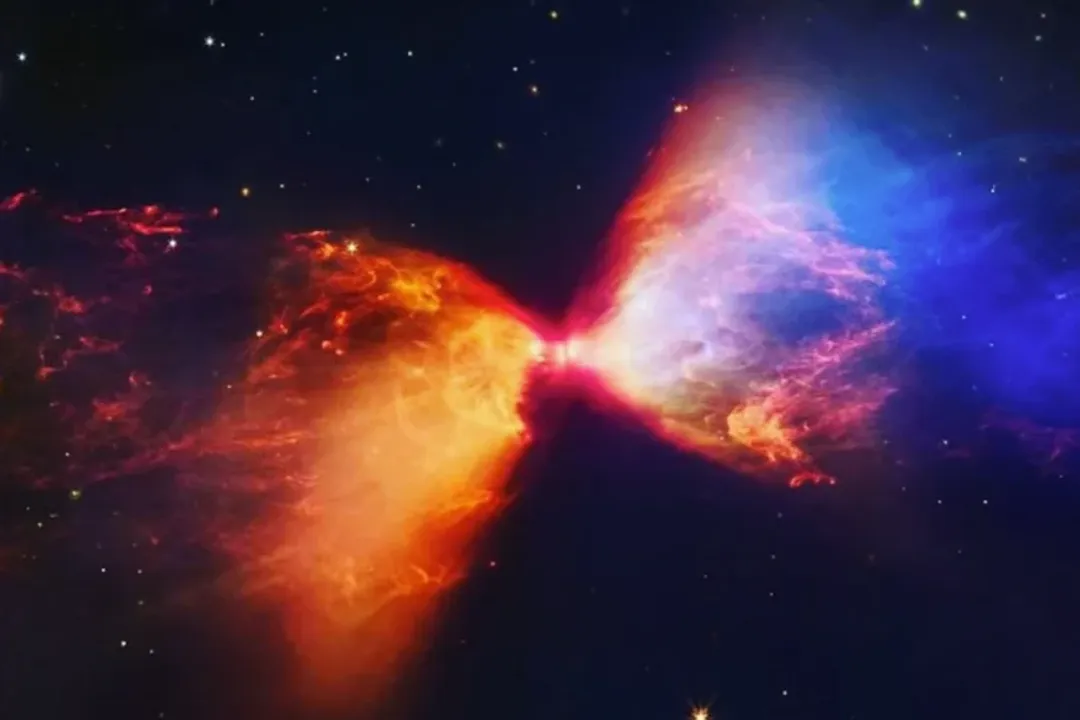
As the gas falls toward the center of the nascent object, its gravitational potential energy is transformed into kinetic energy, and upon impact and compression, this kinetic energy becomes thermal energy—heat. This gravitational contraction is the primary engine driving the protostar’s glow. The more the cloud shrinks, the more the core is compressed, and the higher the temperature rises. This transformation of potential energy into heat is what causes the object to become luminous, allowing it to radiate energy, even though its core is still too cool for true fusion.
When the initial dense core begins its transformation, it can be surprisingly luminous—over a hundred times brighter than the main-sequence star it will eventually become. However, because this initial temperature is very low (around $10$ Kelvin), this early radiation peaks in the far-infrared and millimeter wavelengths, making it completely invisible to optical telescopes.
It is worthwhile to pause and consider the sheer difference in energy mechanisms at play. Nuclear fusion is incredibly efficient, releasing energy per reaction based on the speed of light squared. In contrast, the energy released by gravitational contraction depends on the mass and the radius change. When a star finally ignites fusion, the outward radiation pressure from the newly created photons balances the crushing inward pull of gravity, stopping the rapid contraction and establishing hydrostatic equilibrium. The gravitational energy release, while intense enough to heat the object until fusion begins, is inherently limited by the amount of material that can fall onto the core. Once accretion ceases, the gravitational heating stops, and the subsequent evolution—the contraction of a pre-main-sequence star—is much slower and dimmer until the core ignites. This tells us that the protostellar phase is a rapid, high-energy preamble, while the Main Sequence is a long, stable, and sustained energy output derived from a completely different physical principle.

# Accretion Disk
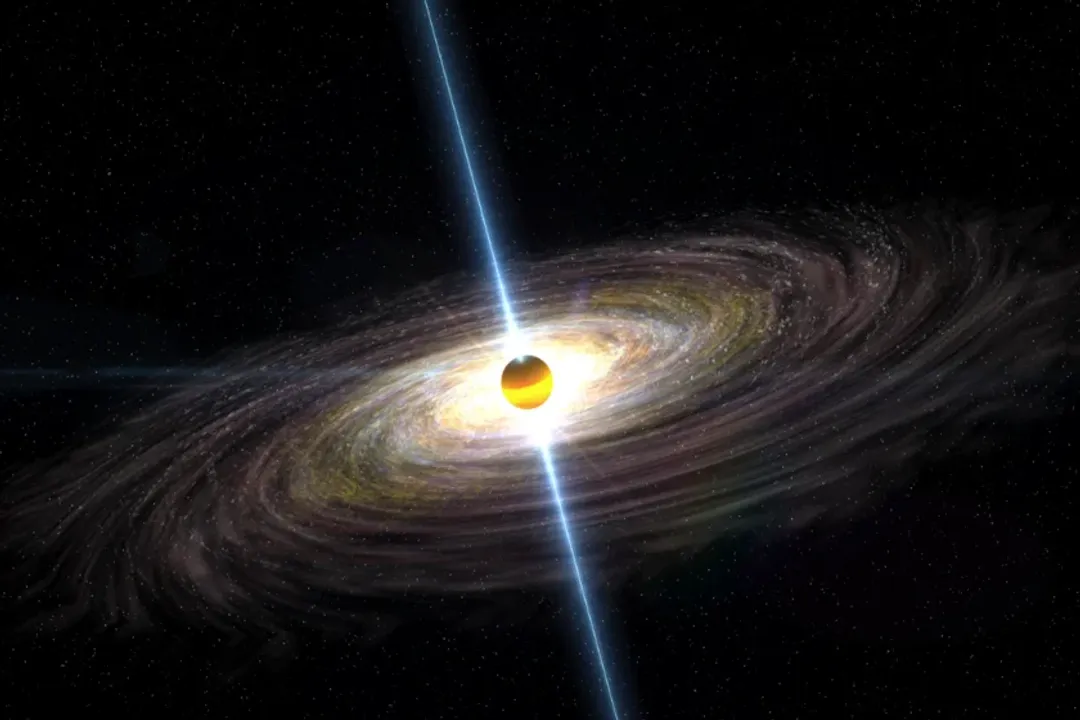
The energy generation process is intimately tied to the mechanism by which the protostar grows. Due to the conservation of angular momentum, the collapsing gas cloud spins faster as its radius shrinks, flattening into a circumstellar disk orbiting the central core. This accretion disk feeds material onto the protostar.
Crucially, most of the protostar’s observed luminosity, particularly its infrared signature, is generated not just by the compression of the core, but by the shock of this infalling material as it slams into the protostar's surface and the inner edge of the disk. This ongoing, high-velocity impact is the dynamic conversion of gravitational energy directly into the heat that makes the object glow in longer wavelengths. The accretion phase is what defines the protostar, lasting perhaps $100,000$ years or more, during which the object rapidly increases its final mass.
# Deeper Processes
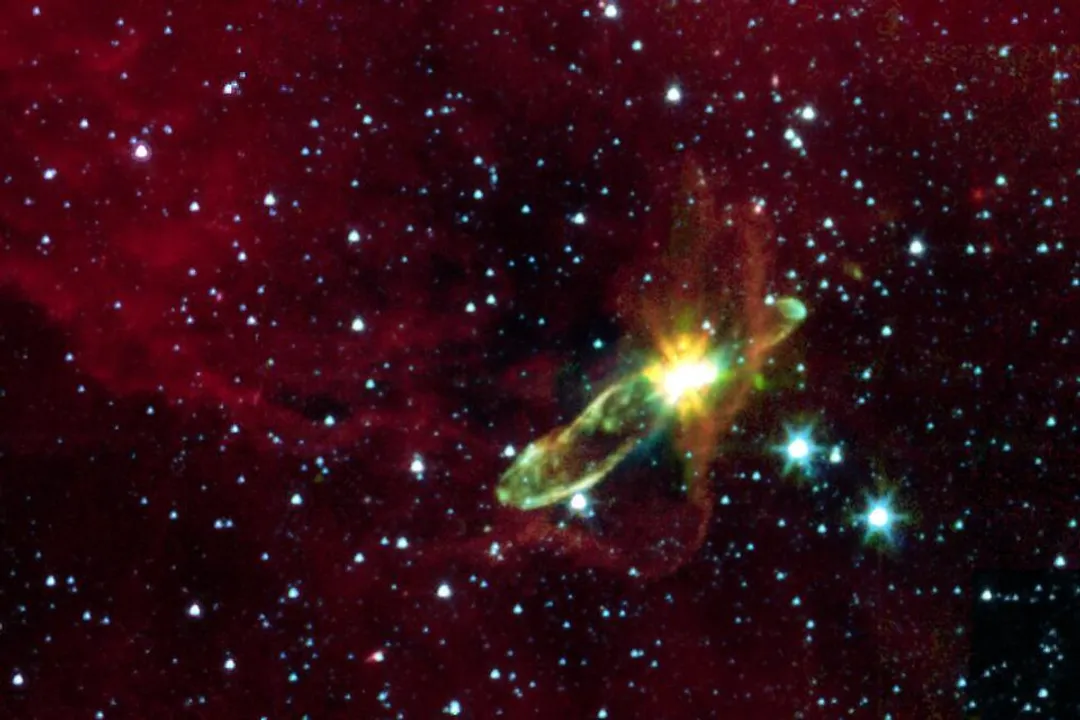
While gravitational collapse and accretion provide the main energy budget, some complexity exists in the heating mechanism even before full hydrogen fusion starts. In the core of a protostar, temperatures climb rapidly. Even before reaching the $10$ million Kelvin threshold for normal hydrogen fusion, the core can hit about $1$ million Kelvin. At this temperature, a relatively rare form of hydrogen called deuterium (hydrogen-2, which contains one proton and one neutron) can fuse with a standard proton ().
This deuterium burning reaction, , releases energy, though less dramatically than the main process. What is fascinating about this reaction is that it appears to regulate the temperature in a way that keeps it steady around $1$ million K, acting as a stellar thermostat. This allows the protostar to maintain its heat and remain in the protostar phase longer, collecting more mass before the environmental conditions finally allow the much higher temperature required for standard hydrogen fusion to ignite. This process of forging new elements, even on a small scale, is an early taste of nucleosynthesis.
# Stellar Arrival
The radiant glow powered by gravity and accretion is the precursor signal. The object stops being a protostar and truly becomes a star when its core achieves a density and temperature sufficient to ignite sustained, self-sustaining hydrogen fusion. For a Sun-like star, this ignition point is approximately $10$ million Kelvin ($10^7$ K).
Once fusion takes hold, the energy output switches from the localized, temporary heating of collapse to the vast, steady thermonuclear power locked within the hydrogen nuclei. This new energy creates a powerful outward pressure that finally counteracts the relentless inward crush of gravity, halting the contraction. The object settles onto the Zero-Age Main Sequence (ZAMS) on the Hertzsprung-Russell diagram, beginning the longest and most stable phase of its existence. The protostellar phase is brief—perhaps $500,000$ years for a Sun-like object, much faster for more massive ones—compared to the billions of years it spends fusing hydrogen.
# Veiled Objects
The nature of a protostar’s energy source explains its peculiar visibility. Since the gravitational heating occurs deep within, and the infalling matter is shrouded by a thick envelope of gas and dust, the object emits very little visible light. Instead, the energy is radiated away as infrared and millimeter radiation from the surrounding cocoon. This means that identifying a protostar requires looking at the sky through the longer, penetrating wavelengths only accessible to specialized infrared telescopes.
Observational data, particularly spectral energy distributions, confirms this energy budget. A protostar’s spectrum is dominated by a peak near $100$ micrometers, representing the radiation from the cold outer envelope ($30$ Kelvin) that is being heated by the central gravitational processes. This contrasts sharply with a pre-main-sequence star, which has shed its envelope and whose emission peaks much closer to the $2$ micrometer range, dominated by the warmer surface and disk, though still showing signs of slower contraction.
To truly appreciate the dynamics of this early growth, consider the rate of mass transfer. A protostar might gain mass at a rate equivalent to an Earth-sized planet every year. However, if we look at the timescales, a high-mass protostar might complete its gravitational collapse phase in only a million years, whereas a Sun-like one takes about $50$ million years, and smaller stars can take over a hundred million years. This suggests that massive protostars must accrete matter much faster than solar-mass counterparts to achieve their final state so quickly, meaning their gravitational energy conversion rate must be proportionally higher in the early stages.
Furthermore, the observation that protostars are often rotating much faster than later pre-main-sequence stars suggests that the process of accretion itself might be "spinning up" the central object, with the accretion disk coupling its angular momentum to the core through magnetic fields. The energy of the glow, therefore, is not just heat; it is the kinetic energy of the entire collapse and accretion machinery—the magnetic energy driving the jets and the rotational energy of the disk—all momentarily converted into photons before the core settles into the calm, long-term energy production of fusion. This interplay between gravitational collapse, accretion flow, magnetic fields, and eventual thermonuclear ignition is what makes the glowing protostar phase the most energetic, albeit brief, chapter in a star's life.
Related Questions
#Citations
Protostar - Wikipedia
Protostar - Las Cumbres Observatory
Star Basics - NASA Science
Protostars and Nebulae - ASPIRE
Live of Stars, Chap. 11
Lecture 12: Star Formation
Protostars | American Scientist
Nuclear Fusion in Protostars | ASTRO 801
What Are Protostars? The Birth And Formation of New Stars
Protostar - Universe Today