What type of radiation dominates the early emission from a protostar, making it invisible to standard optical telescopes?
Answer
Far-infrared and millimeter wavelengths
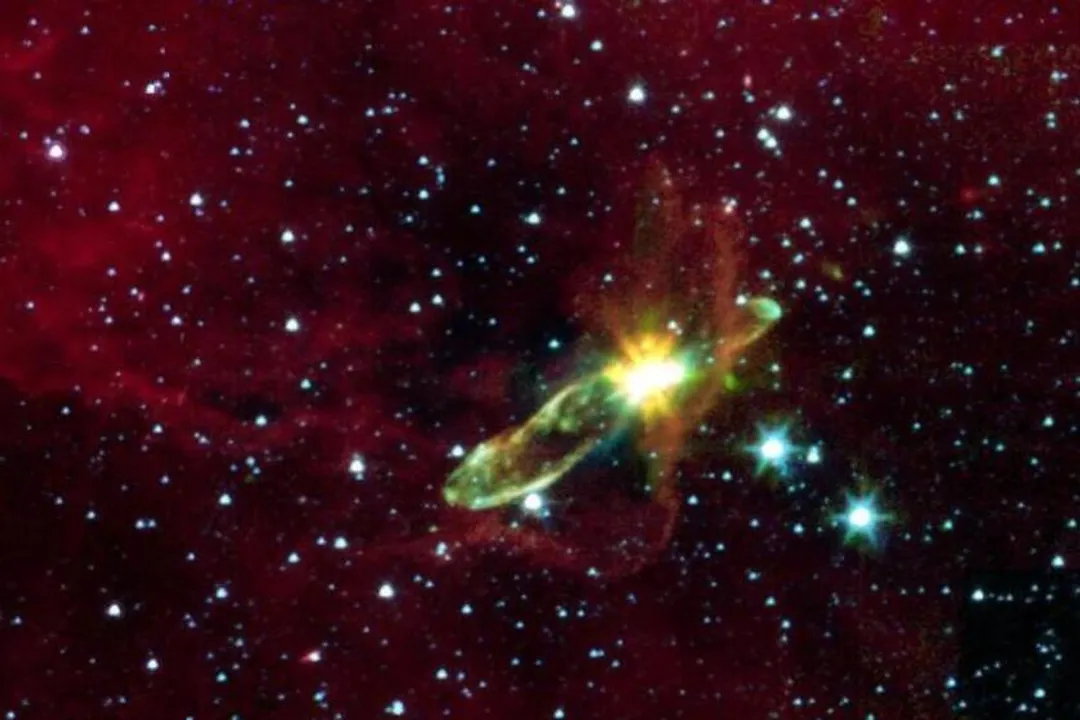
Because the initial temperatures of the condensing object are very low (around 10 Kelvin), the energy radiated away peaks in the longer, cooler wavelengths of the far-infrared and millimeter spectrum, requiring specialized telescopes for detection.
Related Questions
What primarily powers the luminosity of a protostar before it becomes a true star?What core temperature must a Sun-like object reach to ignite sustained hydrogen fusion and become a Main Sequence star?What physical principle forces the rapidly shrinking, collapsing gas cloud into a spinning, flattened structure?How does the luminosity of a protostar compare to the main-sequence star it will eventually become?What type of radiation dominates the early emission from a protostar, making it invisible to standard optical telescopes?What role does deuterium burning play within the protostar core before hydrogen fusion ignites?What external event can serve as a trigger for the initial gravitational collapse leading to star formation?What process defines the object as a protostar rather than just a contracting dense core?When a star reaches the Zero-Age Main Sequence (ZAMS), what mechanism ultimately stops the rapid gravitational contraction?Why must astronomers use infrared telescopes to observe the ongoing accretion onto a protostar?