What is the primary source of light emitted by a shining protostar during contraction?
Answer
Energy released by continued gravitational contraction (Kelvin-Helmholtz mechanism)
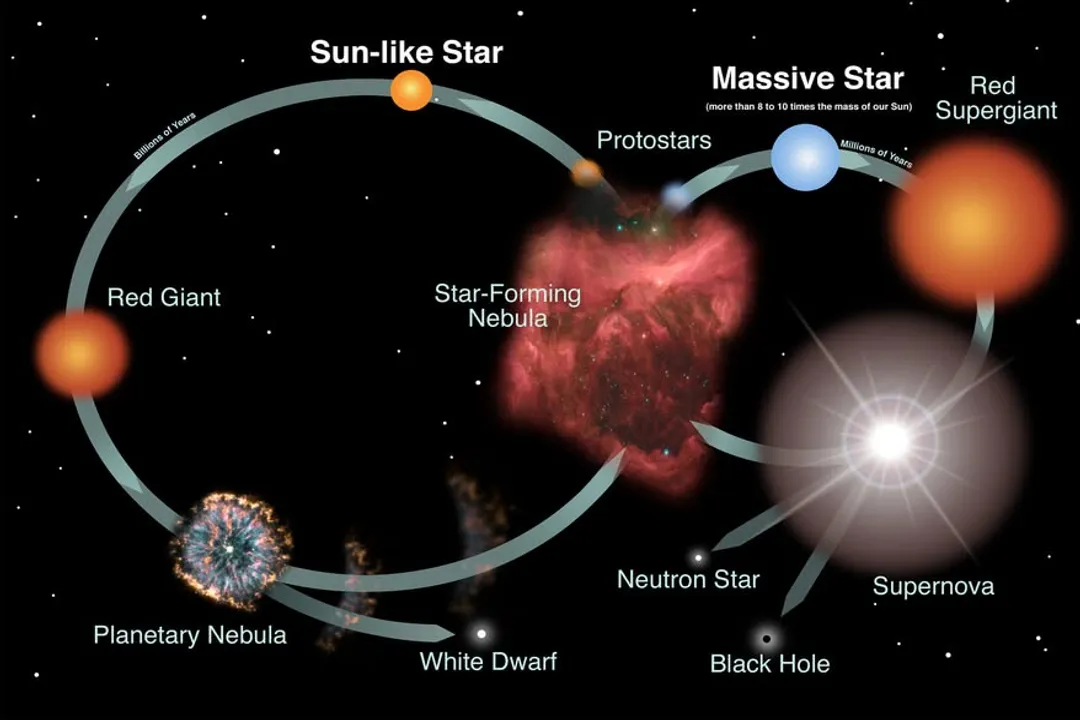
A protostar radiates light because of the intense heat generated by the continued gravitational collapse of material drawing inward, a process sometimes referred to as the Kelvin-Helmholtz mechanism. This light is due to the heat of the crush, not sustained nuclear fusion.
Related Questions
What is the critical mass threshold required for a protostar to become a true star?What is the primary source of light emitted by a shining protostar during contraction?What is the specific astronomical object formed when a protostar fails to meet the $0.08 M_{\odot}$ ignition threshold?What definitive nuclear event transforms a protostar into a main-sequence star?What mass range, expressed in Jupiter masses, defines the category of a brown dwarf?What is the approximate core temperature required for hydrogen nuclei to fuse into helium at a sustainable rate?What allows a brown dwarf, despite being a 'failed star,' to temporarily generate internal heat and glow?What happens to the contraction process of a protostar that fails to reach the ignition state?What prevents a failed protostar (brown dwarf) from replenishing energy lost to space over cosmic timescales?How do astronomers often confirm that a low-mass object is a brown dwarf rather than a star just prior to ignition?