What happens to the contraction process of a protostar that fails to reach the ignition state?
Answer
The contraction slows down significantly, driven by residual heat
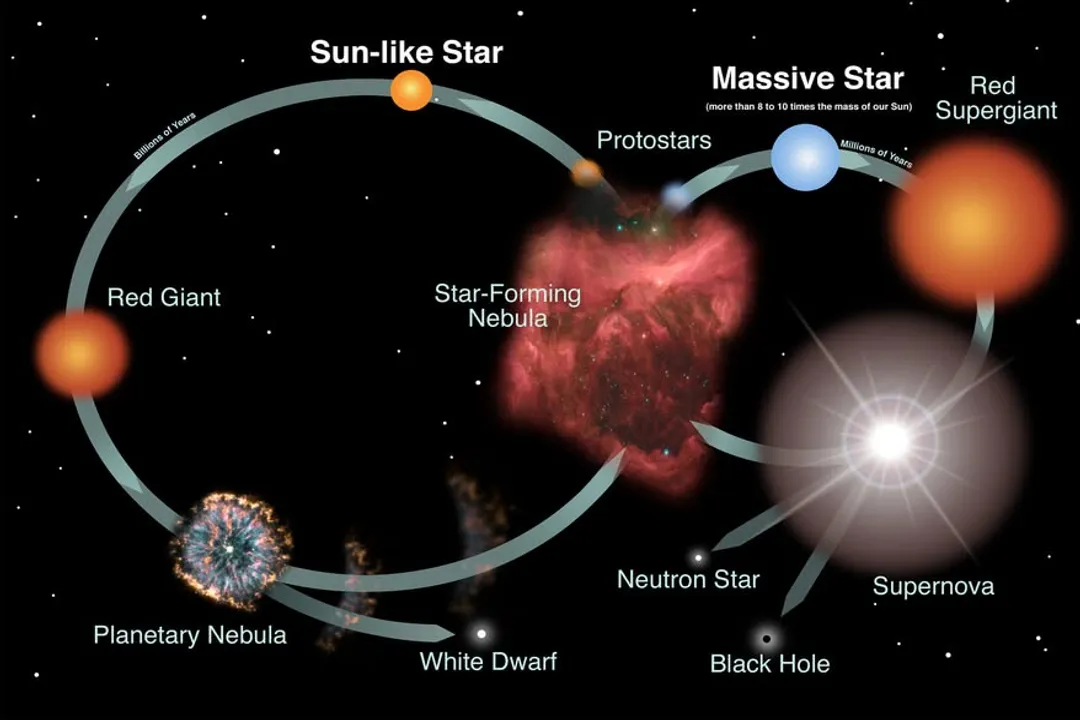
If the critical fusion state is not reached, the relentless inward crush of gravity does not truly stop, but it becomes much slower, driven by residual heat and lower-grade nuclear reactions that eventually fade.
Related Questions
What is the critical mass threshold required for a protostar to become a true star?What is the primary source of light emitted by a shining protostar during contraction?What is the specific astronomical object formed when a protostar fails to meet the $0.08 M_{\odot}$ ignition threshold?What definitive nuclear event transforms a protostar into a main-sequence star?What mass range, expressed in Jupiter masses, defines the category of a brown dwarf?What is the approximate core temperature required for hydrogen nuclei to fuse into helium at a sustainable rate?What allows a brown dwarf, despite being a 'failed star,' to temporarily generate internal heat and glow?What happens to the contraction process of a protostar that fails to reach the ignition state?What prevents a failed protostar (brown dwarf) from replenishing energy lost to space over cosmic timescales?How do astronomers often confirm that a low-mass object is a brown dwarf rather than a star just prior to ignition?