How does a protostar work?
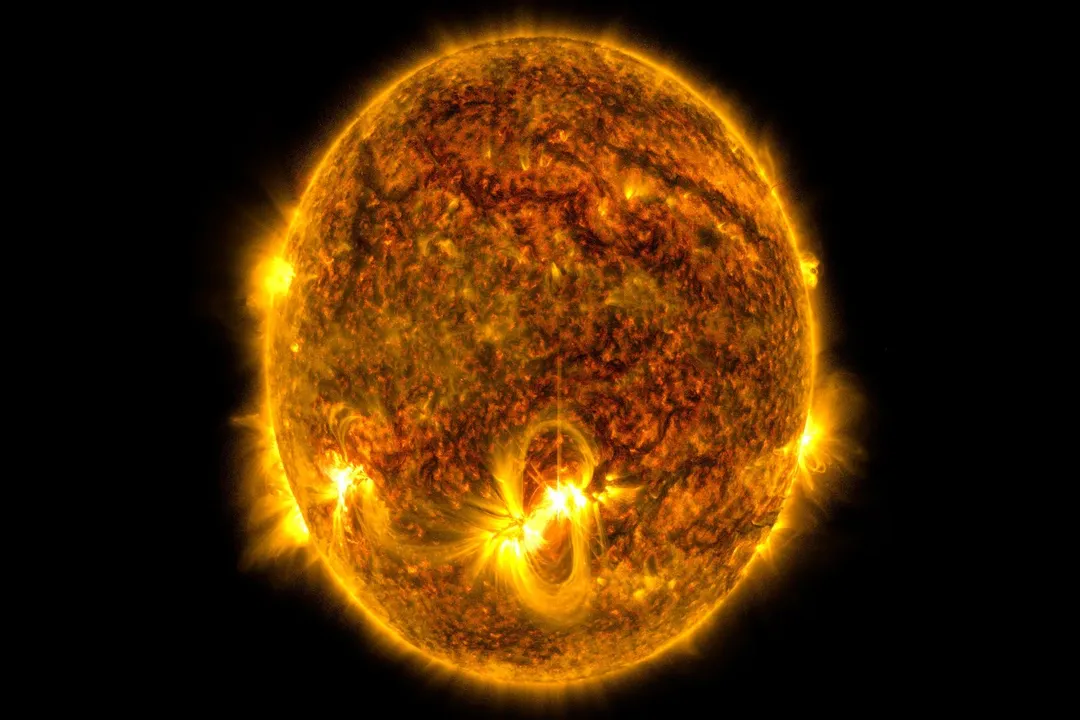
The story of a star begins not with a brilliant flash, but with a slow, cold gathering of material in the vastness of space. A protostar is the infant stage of a star, representing the phase after a dense core begins to collapse from a giant molecular cloud but before nuclear fusion ignites in its center, allowing it to officially join the main sequence. [3][6] It is an object defined by its process: it is still actively gathering mass from its surroundings while simultaneously generating heat through gravitational contraction, rather than the sustained energy production of a true star. [4][7]
# Gravitational Collapse
Star birth starts inside immense, cold nurseries known as giant molecular clouds, which are regions composed primarily of molecular hydrogen and dust. [2][6] These clouds can be light-years across and contain enough raw material to form many stars. [2] For a star to form, some part of this diffuse cloud must overcome its internal thermal pressure and begin to contract under its own gravity. [4] This initial triggering event can be initiated by external forces, such as the shockwave from a nearby supernova explosion or the pressure from the radiation of nearby massive stars. [2]
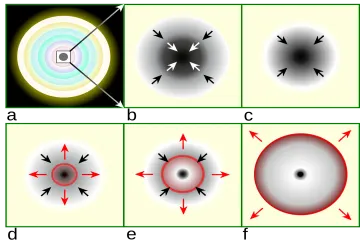
Once this critical mass begins to collapse, gravity takes over, drawing the gas and dust inward toward a central point. [4] As the material falls inward, the gravitational potential energy is converted into kinetic energy, and then, upon collision with the forming core, into thermal energy, causing the central region to heat up significantly. [7] This initial collapse phase is relatively quick, driven purely by the overwhelming force of gravity acting on the increasingly dense core. [4]
# Rotating Material
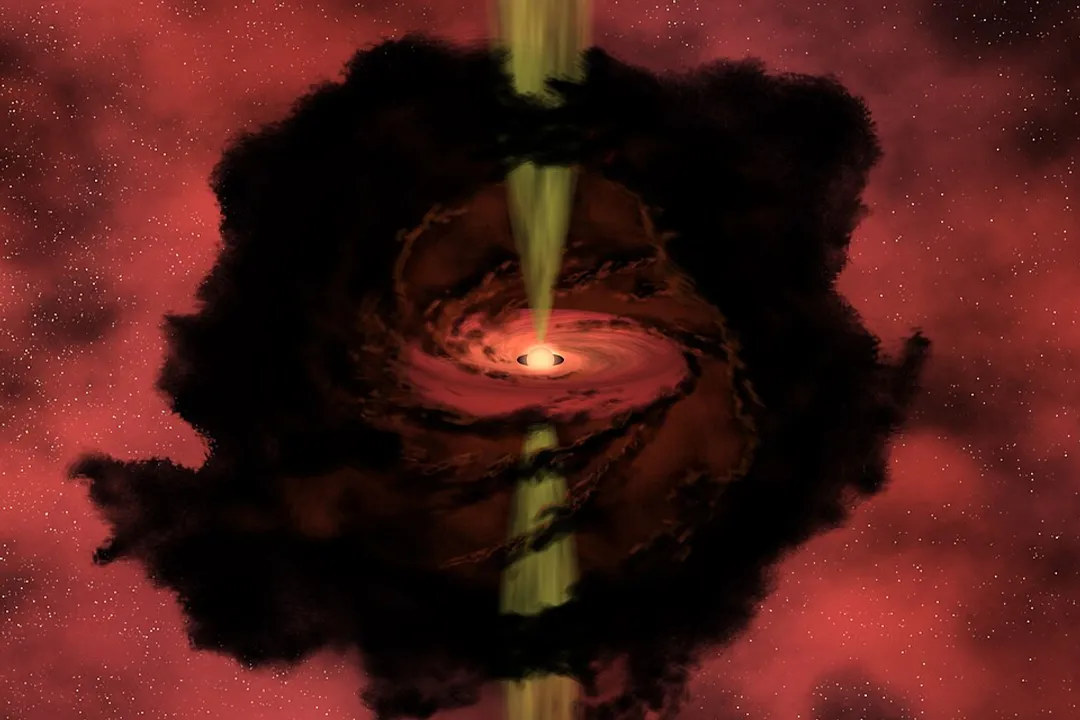
As the large, original cloud collapses, it rarely does so perfectly symmetrically. Most interstellar clouds possess some degree of rotation, however slight. [1] This rotation becomes critically important as the cloud shrinks. Due to the principle of conservation of angular momentum—the same physics that makes an ice skater spin faster when they pull their arms in—the material spins increasingly rapidly as it contracts toward the center. [1][7]
This rapid spin prevents all the material from falling directly onto the central core. Instead, the centrifugal forces flatten the surrounding material into a rotating structure called an accretion disk. [1] This disk feeds material onto the central protostar over time, which is why this phase is sometimes referred to as an accretion stage. [1] This disk structure is essential; without it, the angular momentum would prohibit further collapse or force the resulting object to spin so fast it would tear itself apart. [1] The presence of this disk structure is one of the most observable characteristics of nascent stellar systems, often observable in infrared light where the protostar itself might still be obscured by surrounding dust. [5]
An interesting way to contextualize this is to consider the difference between a simple hypothetical free-fall and what actually happens. If a small, non-rotating cloud collapsed, it would hit the center quite quickly. However, the conservation of angular momentum acts like an invisible brake on the equator of the collapsing sphere, forcing the material into a pancake shape. This disk allows the collapse to proceed slowly and steadily, parceling out the material over millions of years while ensuring the protostar's final rotation rate is manageable, rather than catastrophic. [1][7]
# Internal Heating
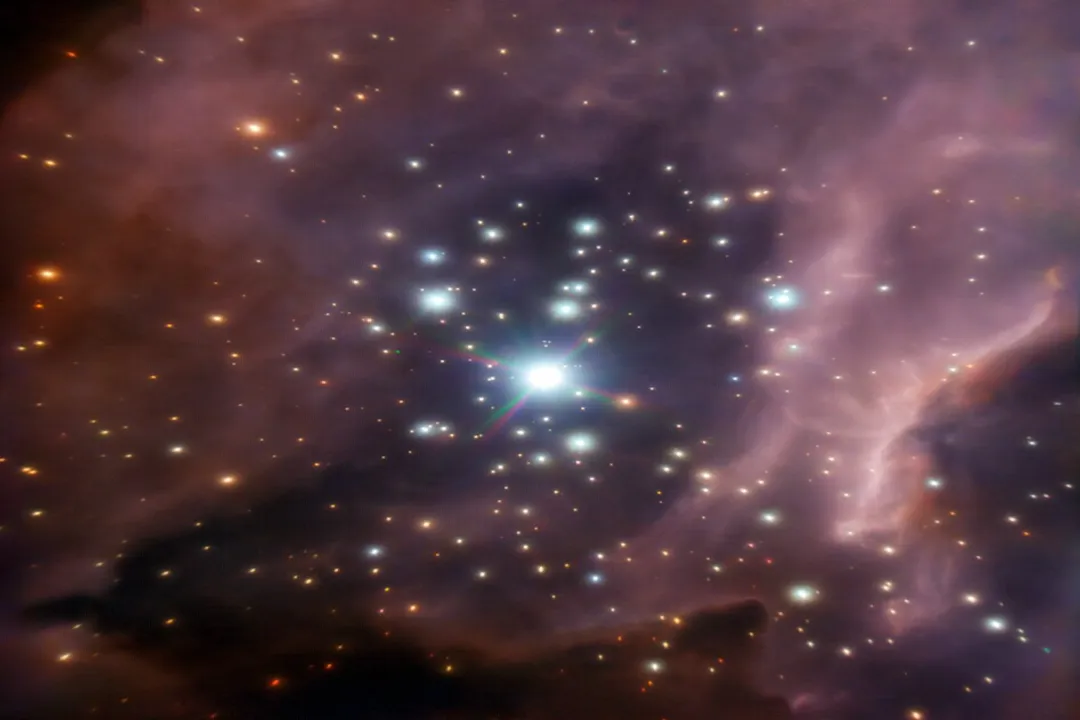
During this extended phase of gravitational collapse and mass accumulation, the protostar is luminous, but its energy source is purely mechanical, not nuclear. [7] The heat being radiated away is the direct result of the intense compression caused by gravity. [4] Astronomers refer to this mechanism as Kelvin-Helmholtz contraction. [7] As the material continues to fall onto the growing core, the internal pressure rises, causing the core to heat up further. [7] This contraction process dictates the protostar's position on the Hertzsprung-Russell (H-R) diagram for much of its pre-main sequence life. [7]
The rate at which a protostar contracts and heats up is highly dependent on its mass. [7] More massive protostars contract faster and reach much higher core temperatures sooner than less massive ones, like our Sun. [7] A star like the Sun will spend tens of millions of years contracting before fusion begins, whereas a much larger star might take only a few hundred thousand years to complete this phase. [7]
# Bipolar Jets
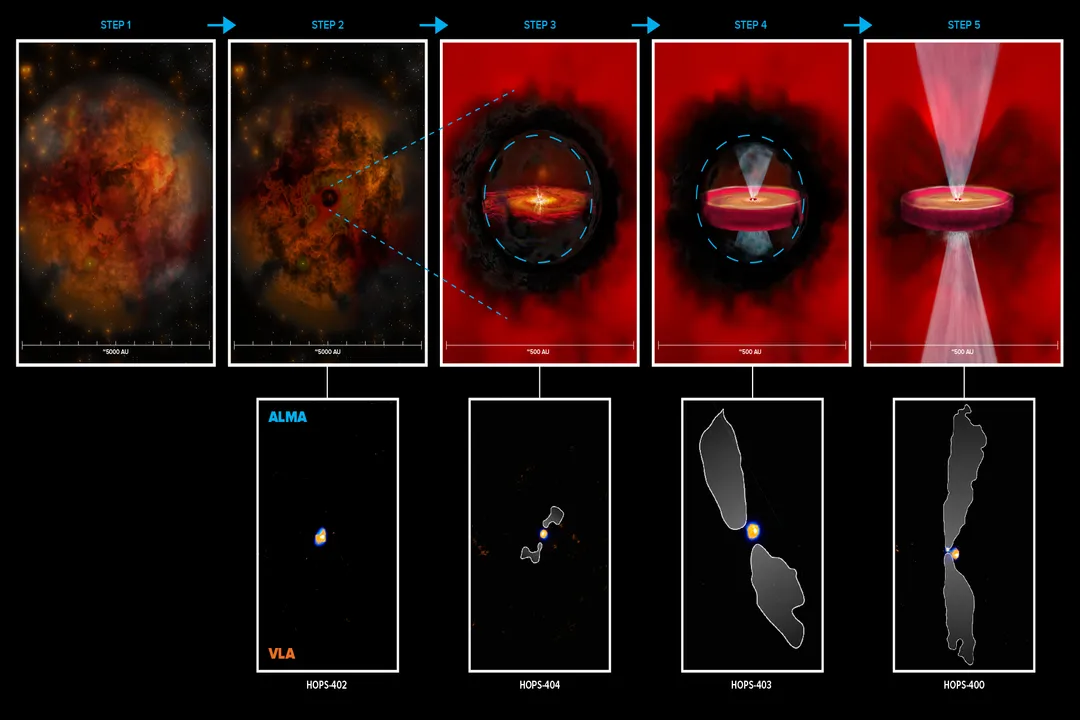
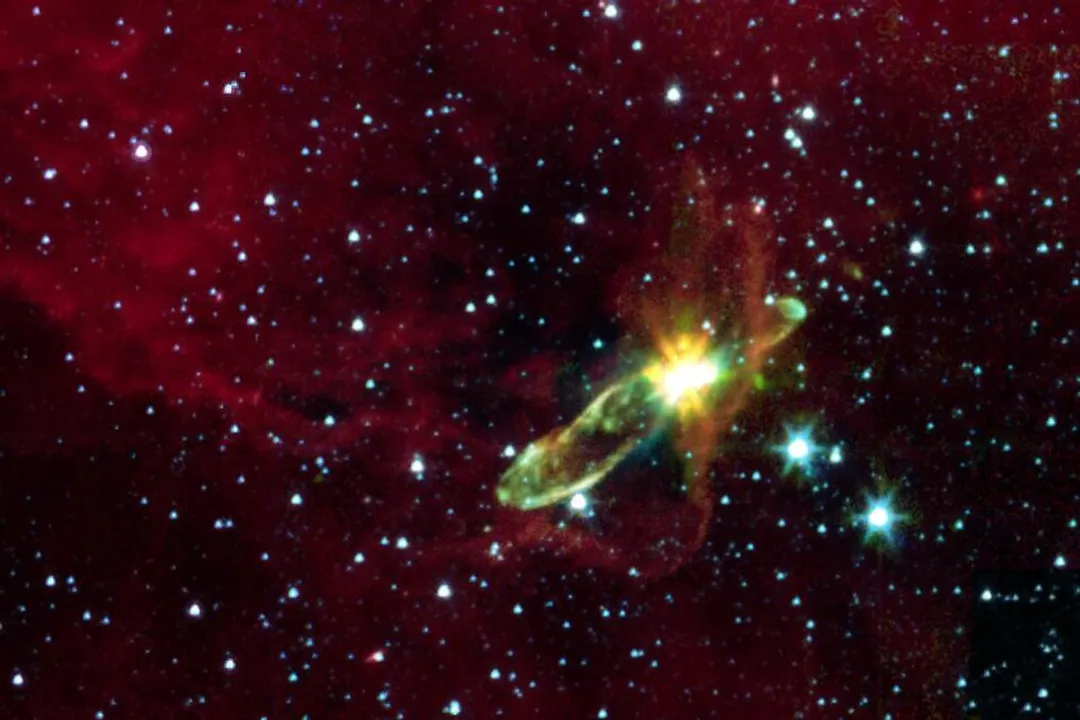
The ongoing accretion process, while feeding the central object, also presents a problem: how does the protostar shed excess angular momentum or eject material that is falling in too steeply? The answer lies in powerful outflows of gas known as bipolar jets. [1][2] These jets erupt from the poles of the protostar, perpendicular to the plane of the accretion disk. [1][5]
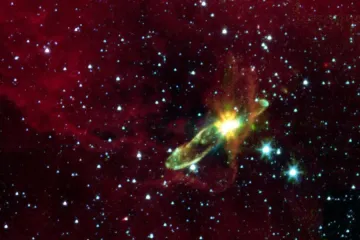
These jets, often traveling at hundreds of kilometers per second, clear away the surrounding envelope of gas and dust that initially shrouded the young object. [2] They are often visible as Herbig-Haro objects when they collide with denser interstellar material farther out. [2] The action of these powerful outflows is believed to be a critical feedback mechanism, controlling how much material the protostar can ultimately accumulate, effectively setting the upper limit on its final mass. [1] The presence of these outflows signals that the object is actively accreting material and has not yet fully transitioned to a stable state. [2]
# Evolutionary Stages
The transition from a dense cloud core to a visible pre-main sequence star is not a single event but a sequence of defined stages, categorized primarily by the visibility of the central object and the properties of its surrounding envelope. [1] These classifications help astronomers track the object's development:
| Class | Dominant Feature | Visibility | Key Process |
|---|---|---|---|
| Class 0 | Embedded in a dense core | Invisible in optical light (only far-infrared/radio) | Pure, rapid infall of material |
| Class I | Possesses a significant envelope and disk | Obscured by dust | High accretion rate |
| Class II | Envelope dissipated, prominent accretion disk | Visible (e.g., T Tauri Stars) | Dominated by disk accretion |
| Class III | Disk substantially gone, envelope dissipated | Fully visible | Gravitational contraction continues |
Class 0 objects are the earliest stage, deeply buried within the natal envelope of gas and dust, making them detectable only at the longest wavelengths, like far-infrared or radio waves. [1] They are defined by their extremely high rate of mass infall. [1] As the object evolves into a Class I stage, the surrounding envelope begins to thin, allowing more infrared light to escape. [1]
# T Tauri Star
As the envelope of material surrounding the protostar dissipates—largely due to the clearing action of the bipolar jets and stellar winds—the object becomes optically visible, marking the transition into a Class II object. [1][2] These visible young stellar objects are often referred to as T Tauri stars if they are low-mass, similar to the Sun. [2][8]
T Tauri stars are characterized by being much more luminous than a main-sequence star of the same mass, a consequence of their ongoing Kelvin-Helmholtz contraction. [7] They are still highly variable in brightness, sometimes flickering dramatically due to hot spots on the surface or instabilities in the remaining accretion disk. [2] At this stage, they still possess a significant, if diminishing, accretion disk, which is the source of their powerful, magnetically driven stellar winds and often the cause of their erratic behavior. [2][8]
Consider the long-term environmental impact: For a protostar forming in a dense cluster, the timescale required for its surrounding envelope to be completely dispersed by nearby massive stars or its own powerful winds dictates whether it ever reaches the T Tauri stage as a true disk-bearing object. If the surrounding gas is blown away too quickly (perhaps in less than a million years), the protostar might transition directly from a Class I object to a Class III object, having only briefly, if at all, shown the classic signature of a Class II T Tauri star with a large, long-lived disk. [1] This environmental pressure accelerates the final stages of stellar formation.
# Main Sequence
The final stage of the protostar's life occurs when the gravitational contraction has raised the core temperature and pressure high enough—around 10 million Kelvin—for sustained thermonuclear fusion of hydrogen into helium to begin. [6] This ignition marks the end of the protostellar phase and the beginning of the main sequence lifetime. [7][9] Once fusion takes over, the outward pressure generated by the nuclear reactions perfectly balances the inward pull of gravity, establishing a state of hydrostatic equilibrium. [4] The object has officially become a star, settling into a stable period of life that will last billions of years, depending on its mass. [6] The path from a collapsing cloud fragment to a fully fledged star, like our Sun, can take around 50 million years. [4]
Related Questions
#Citations
Protostar - Wikipedia
Protostars | American Scientist
Protostars | Research Starters - EBSCO
Protostars and Nebulae - ASPIRE
The formation of protostars - National Radio Astronomy Observatory
Star Basics - NASA Science
Lecture 12: Star Formation
What's the difference between protostars and pre-main sequence ...
Glossary term: Protostar - IAU Office of Astronomy for Education