Which three locations constitute the globally distributed Deep Space Network (DSN) complexes?
Answer
Goldstone in California, Madrid in Spain, and Canberra in Australia
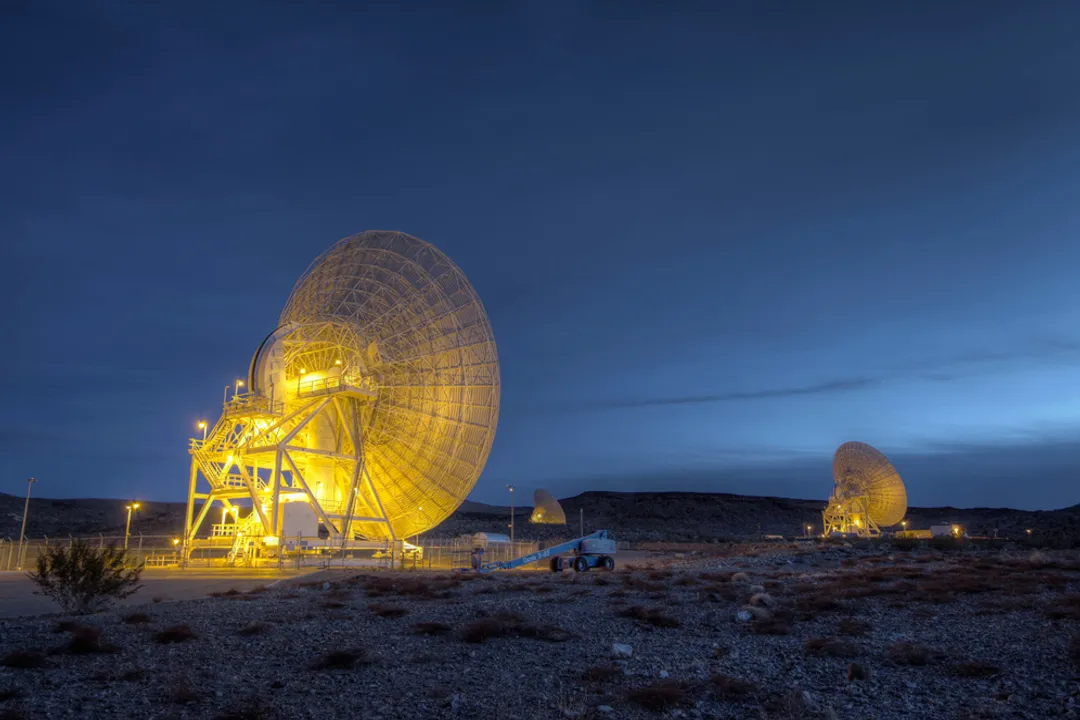
The Deep Space Network (DSN) is not a single dish but a globally distributed network essential for receiving signals from Mars. This network is strategically divided into three complexes situated roughly 120 degrees apart in longitude to ensure constant coverage. These three complexes are explicitly identified as Goldstone, located in California; Madrid, located in Spain; and Canberra, located in Australia. This precise geographical spacing guarantees that as Mars rotates beneath Earth's view, at least one station always maintains a clear, high-angle line of sight necessary for maintaining communication links.
#Videos
How Does The Perseverance Rover Communicate With Earth?
Related Questions
What antenna type do rovers like Curiosity primarily use to communicate with orbital assets such as MRO?Which three locations constitute the globally distributed Deep Space Network (DSN) complexes?What is the primary advantage of using an orbiter like Mars Odyssey as a data relay instead of direct HGA communication to Earth?What physics constraint dictates that instantaneous, real-time control of a Mars rover is impossible?What is the main operational consequence of the substantial time delay inherent in Earth-Mars communication?What key design feature of the Deep Space Network (DSN) facilities enables reliable continuous communication coverage?What is the role of the X-band transmitters on the Mars orbiters in the communication chain?How does the communication architecture prioritize data return volume and system redundancy?What situation would cause a rover to miss a scheduled communication opportunity with an overhead orbiter?How does the function of the High Gain Antenna (HGA) differ fundamentally from the UHF system on a rover?What specific data rate range signifies the one-way travel time from Earth to Mars at opposition, the farthest distance?