Does a rover have communication?
Mars rovers definitely communicate, but the process is far more intricate than simply pointing a radio dish at the Red Planet and waiting for a reply. Unlike a cell phone connection, getting data from a vehicle millions of miles away requires a meticulously managed, multi-stage relay system involving specialized spacecraft and massive ground stations. [4][9] The ability to send commands down and receive telemetry and images back is fundamental to the entire mission's success. [8]
# Signal Path

The architecture for sending information back to Earth hinges on the fact that direct communication from a Mars surface asset to Earth is often inefficient or impossible, depending on the rover’s location and power state. [1] While rovers do possess antennas capable of transmitting directly to Earth, typically a High Gain Antenna (HGA), relying solely on this method would drastically limit data return and require significantly more power than the mission budget allows. [1][8]
The favored method involves using an intermediary, a high-powered orbiter circling Mars. [1] A rover, such as Curiosity or Perseverance, transmits its collected data using a UHF antenna, which communicates with one of NASA’s orbital assets overhead—like the Mars Reconnaissance Orbiter (MRO), Mars Odyssey, or MAVEN. [3][8] These orbiters are positioned perfectly to catch the rover's signal when they pass overhead. [6]
Once the orbiter captures the data packet, it stores it temporarily. The orbiter then uses its own more powerful X-band transmitters to send that large volume of data across interplanetary space to Earth. [1][5] This relay technique conserves the rover’s battery life, which is critical for driving and scientific operations, by allowing it to use a low-power UHF transmitter for short bursts. [8]
# Ground System
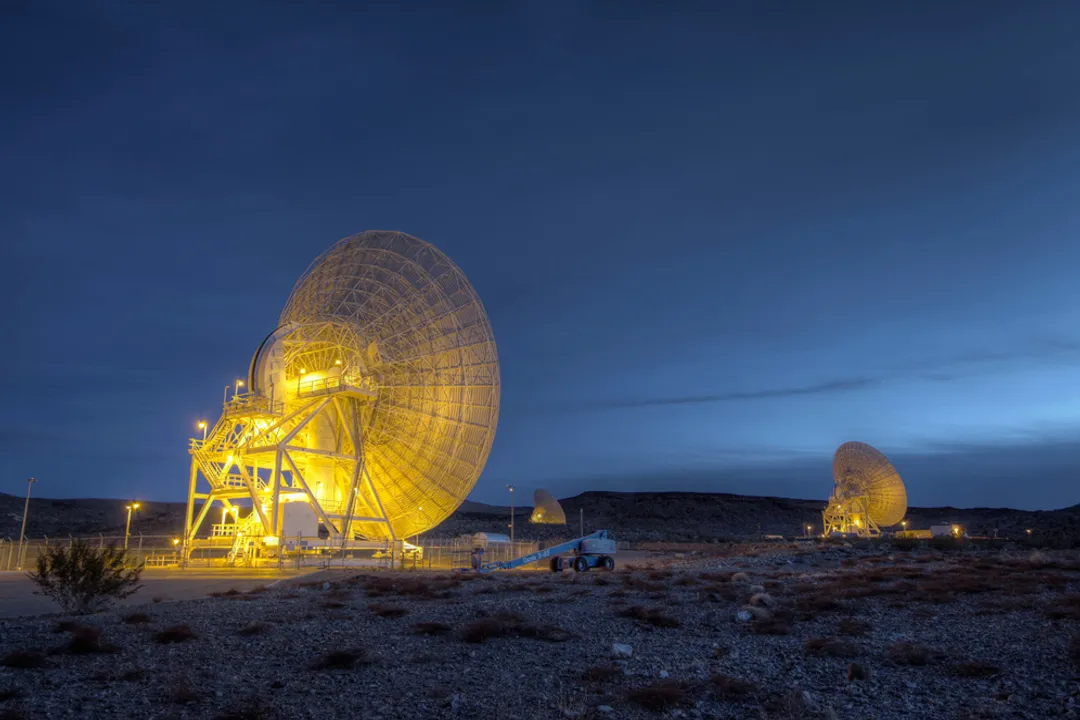
The receiving end of this interplanetary link is not a single dish, but a globally distributed network known as the Deep Space Network (DSN). [7] The DSN is composed of three complexes located strategically across the globe: Goldstone in California, Madrid in Spain, and Canberra in Australia. [7] This triangulation is necessary because Mars is constantly rotating beneath the Earth's view. By having stations spaced roughly 120 degrees apart in longitude, engineers ensure that at least one station has a clear, high-angle line of sight to Mars at any given time. [7]
The DSN facilities house extremely large parabolic antennas, some measuring 70 meters across, designed to pick up the incredibly faint signals arriving from Mars. [7][9] These giant dishes are vital because the signal weakens significantly over the vast distance; by the time the signal reaches Earth, it is often weaker than the background noise of space itself. [4] The DSN not only receives data but also transmits the command sequences from mission control back toward Mars, bouncing them up to the correct orbiter for eventual delivery to the rover. [5][7]
# Communication Schedule
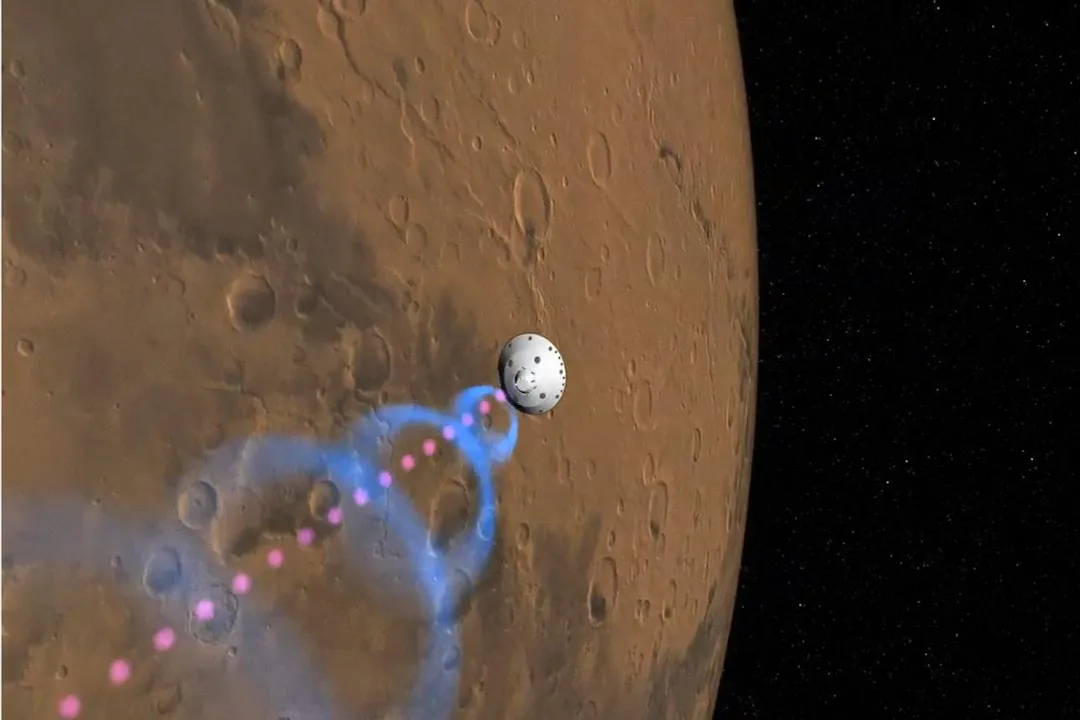
One common misconception is that continuous, real-time communication exists between Earth and a rover on Mars. [6] In reality, contact is strictly scheduled and dictated by orbital mechanics and line-of-sight constraints. [6] A rover cannot just "call home" whenever it wants; it must wait for a suitable pass opportunity with one of the designated orbiters. [8]
These communication windows are brief. For instance, a pass with an orbiter might only last for a few minutes each day, depending on the relative positions of the Earth, Mars, and the specific orbital track of the relay satellite. [6] If the rover is positioned behind a mountain or in shadow during a scheduled pass, the communication opportunity is missed, and the data must wait until the next available window. [6] The science and engineering teams must plan operations around these rigid scheduling requirements, prioritizing which data gets sent during the limited time available. [8]
# Speed Limits
The inherent limitation in all interplanetary communication is the speed of light, which is approximately $299,792$ kilometers per second. [4] Because Mars and Earth are separated by distances that vary from about 54.6 million kilometers (at closest approach) to over 400 million kilometers (at opposition), the time it takes for a radio signal to travel one way can range from about 3 minutes to over 22 minutes. [4]
This substantial time delay means that instant response—true real-time control—is physically impossible. [4] When mission control sends a command, there is an unavoidable lag before the command even reaches Mars, and a second lag before the rover’s acknowledgement or status report returns. [4] Consider a simple command like "drive forward one meter." If executed live, the round trip delay means that the rover could easily drive 10 or 20 meters before the operator even saw the initial telemetry confirming the first meter was driven. This physics constraint necessitates that rovers operate with a high degree of autonomy, executing complex scripts and making immediate hazard avoidance decisions without moment-to-moment human guidance. [4]
# Hardware Differentiation
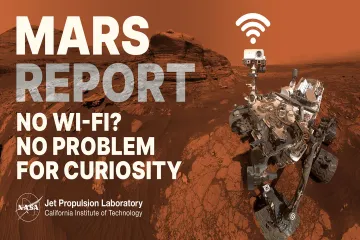
The different communication requirements—high bandwidth for science data versus low bandwidth for basic commands—result in different hardware implementations on the rover itself. The High Gain Antenna (HGA) is designed for the fastest possible transfer of large data files directly to Earth when conditions are optimal, often requiring the rover to stop all other activities and precisely orient itself toward Earth. [1][8] However, this configuration consumes a significant amount of battery power. [8]
In contrast, the UHF system is the workhorse for daily check-ins and relay operations. [8] It is lower power, less directional (making pointing less critical), and perfectly suited for the frequent, short-duration handoffs with orbiters. [1] Thinking about it this way, the system functions much like a satellite phone connection that only works when you have a direct line to a powerful relay tower (the orbiter), rather than trying to maintain a weak, direct cell signal across continents (the HGA to Earth). [1][5]
# System Reliability Tradeoffs
The communication architecture reveals a core engineering tradeoff: prioritizing power conservation and high data return volume through redundancy, even at the cost of scheduling inflexibility. [8] While a direct X-band link to Earth offers the fastest potential speed, the necessity of keeping the UHF relay system operational—even when the HGA is offline or pointed elsewhere—ensures that daily status updates and essential command uploads are not jeopardized by orbital alignments or unexpected power dips. [1][6] The entire system is designed to be fault-tolerant; if one orbiter relay fails or a specific pass is lost, another orbital asset can usually step in, provided the rover has enough onboard storage to hold the data until the next opportunity. [8] This distributed approach, blending ground segment power with orbital relays, is what makes sustained robotic presence on Mars possible year after year.
#Videos
How Does The Perseverance Rover Communicate With Earth?
Related Questions
#Citations
Communicating with Curiosity - NASA Science
Earth to Mars: How NASA Keeps Curiosity Connected (Mars Report)
How does Curiosity stay in contact with Earth when Mars is ... - Reddit
How can we communicate with a mars rover million of miles away ...
How Does The Perseverance Rover Communicate With Earth?
Are Mars rovers in continuous contact with Earth when in line of sight?
Communicating with Mars: The Deep Space Network and ... - Peraton
Communications | Rover – NASA Mars Exploration
Rover (space exploration) - Wikipedia