Which star is specifically compared to Betelgeuse to demonstrate the most dramatic, easily observable contrast in stellar hues?
Answer
Rigel
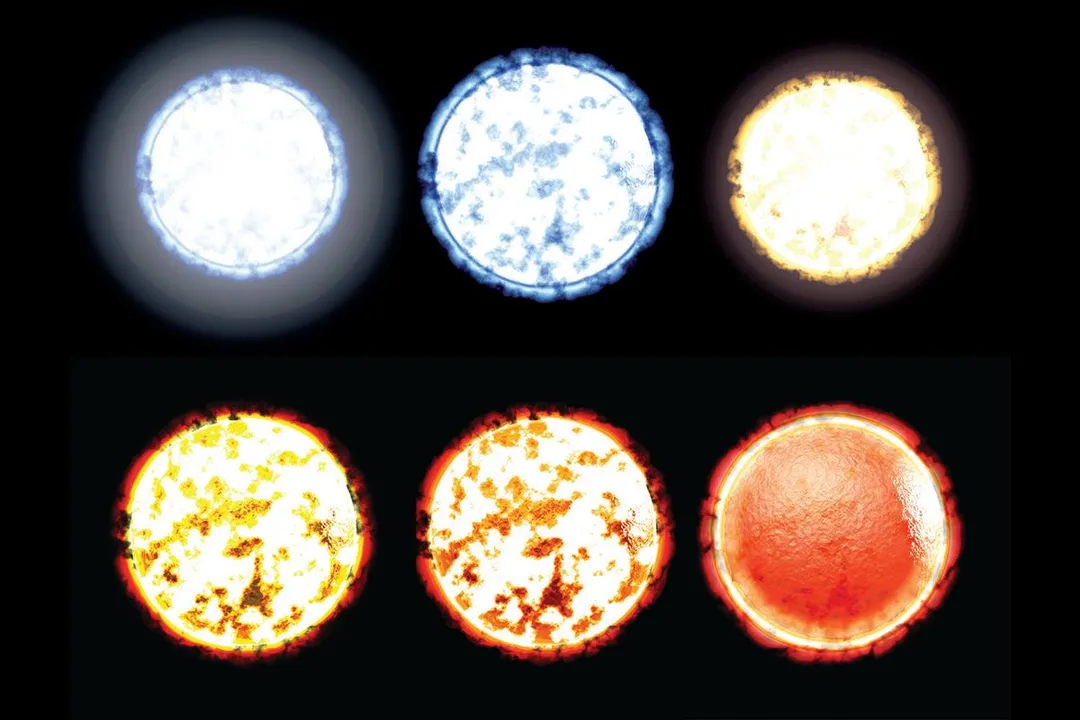
To help observers solidify the rule that blue means hot and red means cool, a side-by-side comparison involving prominent stars in the constellation Orion is recommended. Rigel, which is identified as a blue-white giant, serves as the contrasting hot object. This star is explicitly compared against Betelgeuse, which is classified as a red supergiant, to provide the clearest and most dramatic visual representation of the temperature gradient visible in the sky.
Related Questions
Which spectral types correspond to the very hottest blue stars at the top of the temperature scale?What colors represent the coolest stars visible through observation, terminating the sequence at the bottom?What is the stellar classification type for our Sun, which is described as a familiar yellow star?How does the peak wavelength of emitted light relate to the color sequence from blue (hottest) to red (coolest)?Where are white stars positioned in the thermal ladder relative to hotter blue varieties and cooler yellow stars?What is the approximate temperature range for the coolest M-type red dwarfs mentioned in the context of O-type stars?Despite the Sun appearing yellow to us on Earth, where does its actual light output peak in the spectrum?Which star is specifically compared to Betelgeuse to demonstrate the most dramatic, easily observable contrast in stellar hues?What is the mnemonic used to remember the spectral classification system ordered by decreasing temperature?What factor causes an observer to sometimes perceive subtle color variations inaccurately, especially when observing a faint star?