What is the color of a star?
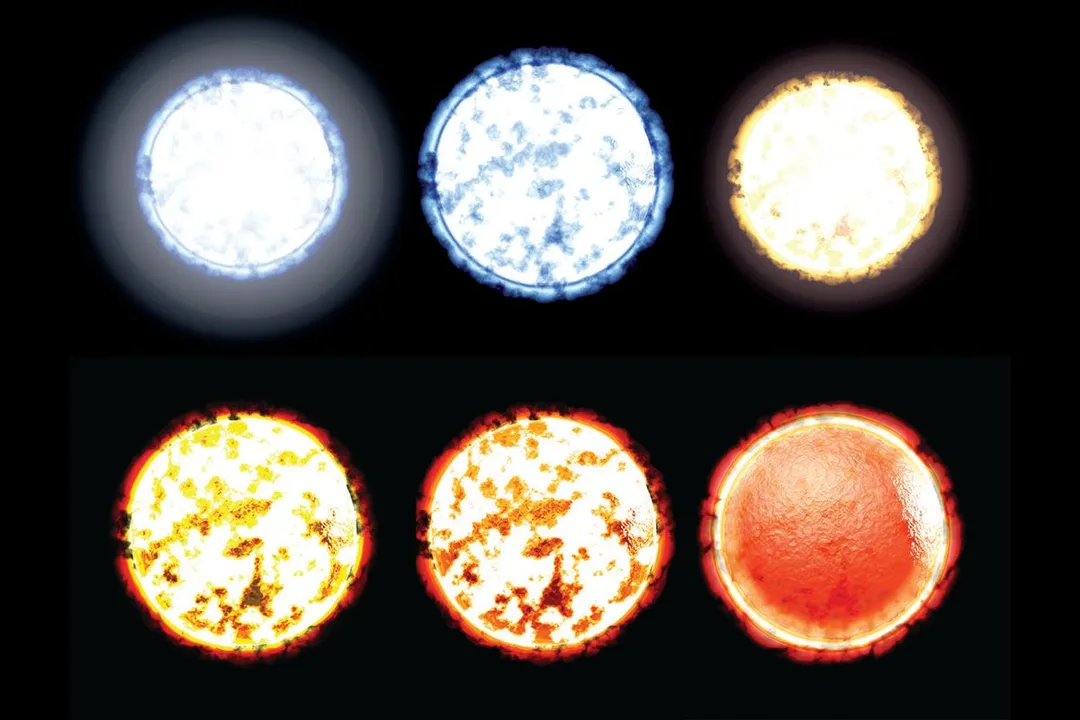
Gazing at the night sky reveals a collection of shimmering lights that often appear deceptively similar to the naked eye. While most stars seem to radiate a pure, stark white, a more careful observation—or the assistance of optical equipment—reveals a subtle variety of hues. [2] These colors are not random; they serve as a direct indicator of the physical properties defining each star. [1] Understanding what determines these colors provides a window into the life cycle and temperature of the objects scattered throughout the galaxy.
# Stellar Temperature
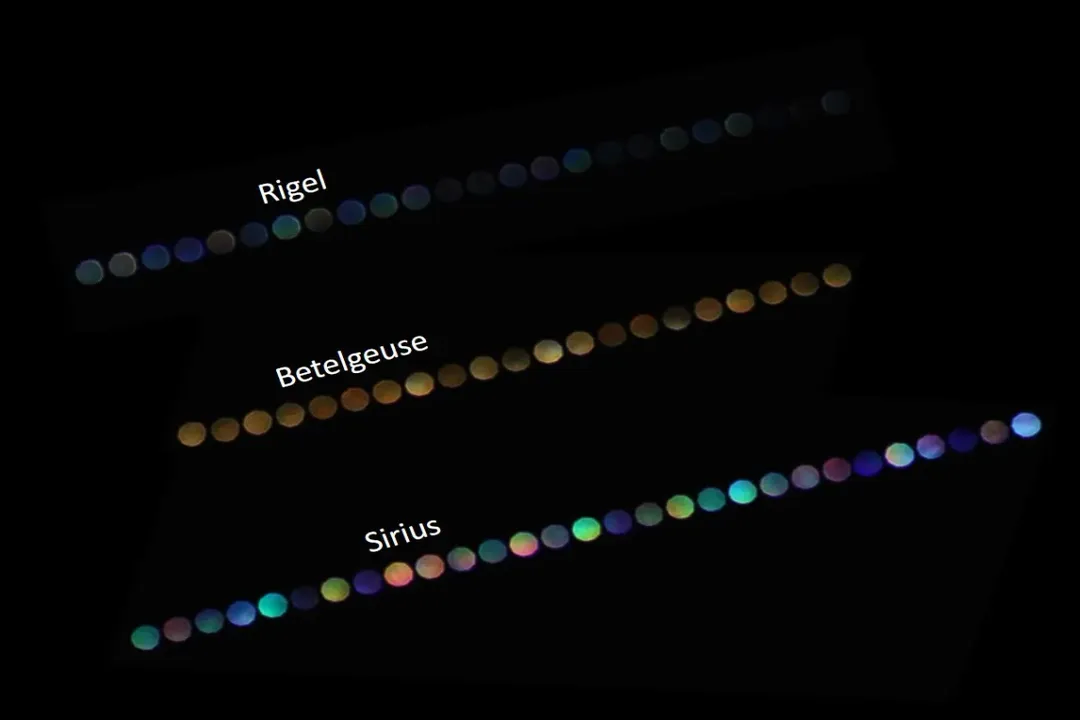
The primary factor governing a star’s color is its surface temperature. [1] This relationship operates on the principle of blackbody radiation, a concept in physics describing how an object emits light as it heats up. [8] When an object is cool, it emits long-wavelength, low-energy radiation. As it gets hotter, the energy output increases, and the peak wavelength of the emitted light shifts toward shorter, higher-energy wavelengths. [1][8]
Think of a blacksmith heating a piece of iron. Initially, the iron might be cool enough to appear dark. As it warms, it begins to glow a deep, dull red. With continued heating, it transitions to orange, then yellow, then brilliant white, and finally a searing blue. [8] Stars follow this exact progression. A red star is relatively "cool," with a surface temperature of about 3,000 Kelvin, while a blue star is incredibly hot, often exceeding 30,000 Kelvin. [1]
# Visible Spectrum

While the physics dictates a clear progression, the human eye often fails to register the full range of these colors. This occurs because the light from most stars is spread across a broad spectrum. [1] Even if a star peaks in the green part of the spectrum, our eyes interpret the combination of all wavelengths as white. This is why we rarely, if ever, see a truly green star; the physics of stellar emissions does not produce a "pure" green light in the way it produces pure red or blue. [2]
The standard classification system for stars, known as the Harvard spectral classification, categorizes these temperatures into letters: O, B, A, F, G, K, and M. [1]
| Spectral Type | Surface Temp (K) | Apparent Color | Example |
|---|---|---|---|
| O | > 30,000 | Blue | Alnitak |
| B | 10,000 – 30,000 | Blue-White | Rigel |
| A | 7,500 – 10,000 | White | Sirius |
| F | 6,000 – 7,500 | Yellow-White | Procyon |
| G | 5,000 – 6,000 | Yellow | The Sun |
| K | 3,500 – 5,000 | Orange | Arcturus |
| M | < 3,500 | Red | Betelgeuse |
This table illustrates the strong correlation between temperature and color. The "G" type stars, such as our Sun, occupy the middle ground, appearing yellow to our eyes, while the "M" type stars at the end of the scale represent the cooler, older, or dying stars. [1][5]
# Human Vision

Why do stars look white to us even when we know they have distinct colors? The answer lies in the biology of the human eye. In low-light conditions, such as those experienced during nighttime stargazing, our eyes rely primarily on rod cells rather than cone cells. [2] Rods are highly sensitive to light but do not distinguish between colors. Because most stars are relatively faint, they do not trigger the cone cells—which are responsible for color perception—with enough intensity to register a specific hue. [2]
Consequently, the brain interprets the faint input from these point sources as white. To perceive true stellar color, the light must be bright enough to stimulate the cone cells. This is why planets like Mars (which is distinctly reddish) are easier to identify by color than most distant stars; they are significantly brighter and closer, providing the necessary photon density to activate our color-sensing biology. [2]
# Measuring Color
Astronomers move beyond the limitations of human perception by using photometry, which involves measuring the intensity of light through specific filters. [5] A common method is the B-V color index, which compares the magnitude of a star as seen through a blue (B) filter against its magnitude through a visual (V) filter. [5][8]
The calculation is straightforward: astronomers subtract the magnitude of the visual filter from the magnitude of the blue filter. A low or negative number indicates a blue star (brighter in blue than in visible light), while a high positive number indicates a red star. [5][8] This quantitative approach removes the subjectivity of human vision and allows scientists to calculate temperatures accurately, even for stars millions of light-years away. [8]

# Practical Observation
If you want to move beyond the naked-eye perception of "white" stars, you can use simple techniques to enhance your color recognition.
- Defocusing: If you are using a telescope, slightly defocus the star image. Spreading the point of light over a larger area on your retina increases the brightness density in one spot, which can trigger your cone cells and make the color more apparent.
- Binoculars: Even modest binoculars gather more light than the human eye. Looking at stars like Albireo in the constellation Cygnus through binoculars often reveals a striking color contrast between the two stars in the system—one blue, one gold—that is difficult to see without aid. [2]
- Peripheral Vision: Sometimes, looking slightly to the side of a star allows you to use the more sensitive parts of your retina, which might help you perceive the subtle chromatic nuance of a star before your brain defaults to the "white" interpretation.
While stars may appear static and monochrome from our vantage point on Earth, they are dynamic, temperature-dependent objects. [1] Whether identified by their spectral classification or the B-V color index, their light is a silent, constant broadcast of their internal temperature and chemical makeup. The next time you look up, remember that the slight variation you might catch—the faint orange of a distant giant or the sharp, cold blue of a young star—is a glimpse into the raw thermodynamics of the universe.
#Videos
STAR COLORS EXPLAINED - YouTube
Related Questions
#Citations
Colors of Stars | Astronomy - Lumen Learning
Star colours explained for beginners | BBC Sky at Night Magazine
STAR COLORS EXPLAINED - YouTube
Question about stars colors : r/askastronomy - Reddit
Magnitude and Color - Las Cumbres Observatory
At a Glance: Star Color and Temperature - ViewSpace
What is the colour of stars? What is the real shape of the stars? - Quora
The Colour of Stars - Australia Telescope National Facility
A star's color depends on its surface temperature. Very ... - Instagram