What type of structure glows because nearby hot, young stars excite its gas into luminescence?
Answer
Emission Nebula
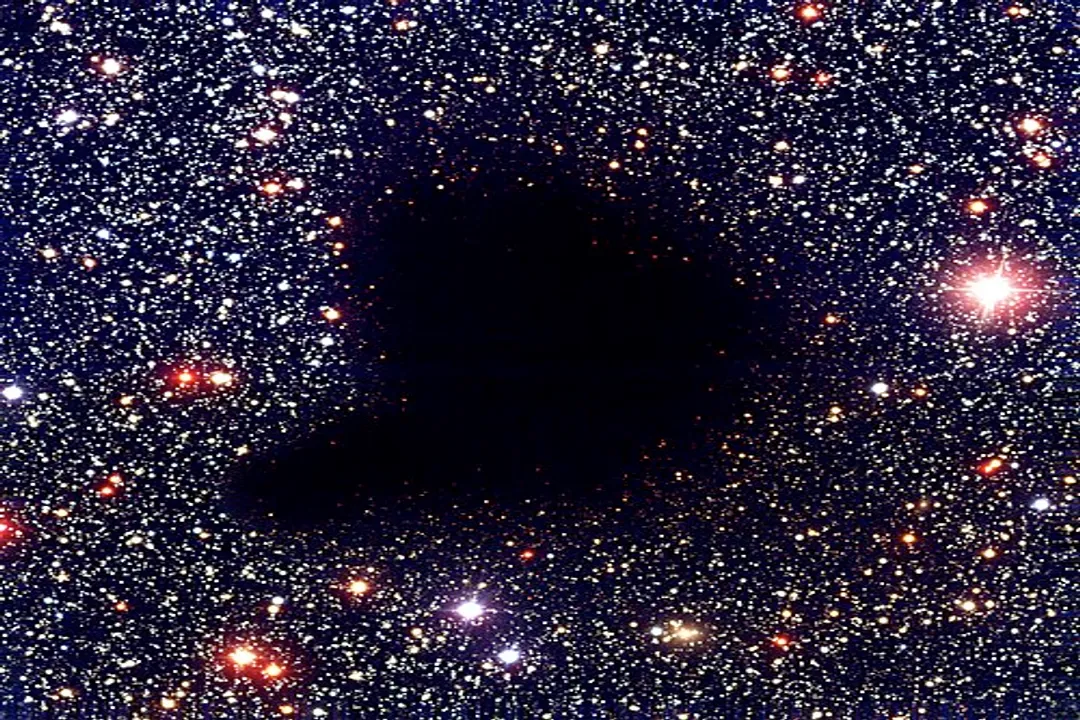
Nebulae can exhibit light emission through different physical processes. An Emission Nebula is specifically defined by the property that it glows because it contains gas that has been energized or excited by the intense radiation emitted by nearby hot, young stars. This excitation causes the gas atoms to jump to higher energy states; as they relax back down, they emit light at characteristic wavelengths, making the nebula visibly luminous. This contrasts with reflection nebulae, which scatter starlight, and dark molecular clouds, which primarily absorb background light.
#Videos
A newly found gas cloud lurks near the solar system | Science News
Related Questions
What is the typical temperature hovering inside a cosmic molecular cloud?What percentage of a molecular cloud's total mass is accounted for by molecular hydrogen ($ ext{H}_2$)?What is the primary scientific importance ascribed to molecular clouds?Why do atomic hydrogen ($ ext{H}$) atoms combine into molecular hydrogen ($ ext{H}_2$) within dense molecular clouds?Why do interstellar molecular clouds appear as dark patches against the Milky Way background?How does the composition of an H I Cloud compare to a Molecular Cloud regarding hydrogen state?What combination of data sources helped confirm the massive, previously undetected local molecular cloud system?What force must gravity ultimately overcome for a section of a molecular cloud to begin gravitational collapse?By mass, what element constitutes nearly 24% of a molecular cloud's composition, second only to molecular hydrogen?What discovery timeline and associated research institutions announced the finding of the massive, previously hidden local cloud?What type of structure glows because nearby hot, young stars excite its gas into luminescence?