What two intrinsic properties organize stars on the H-R diagram?
Answer
Luminosity and surface temperature
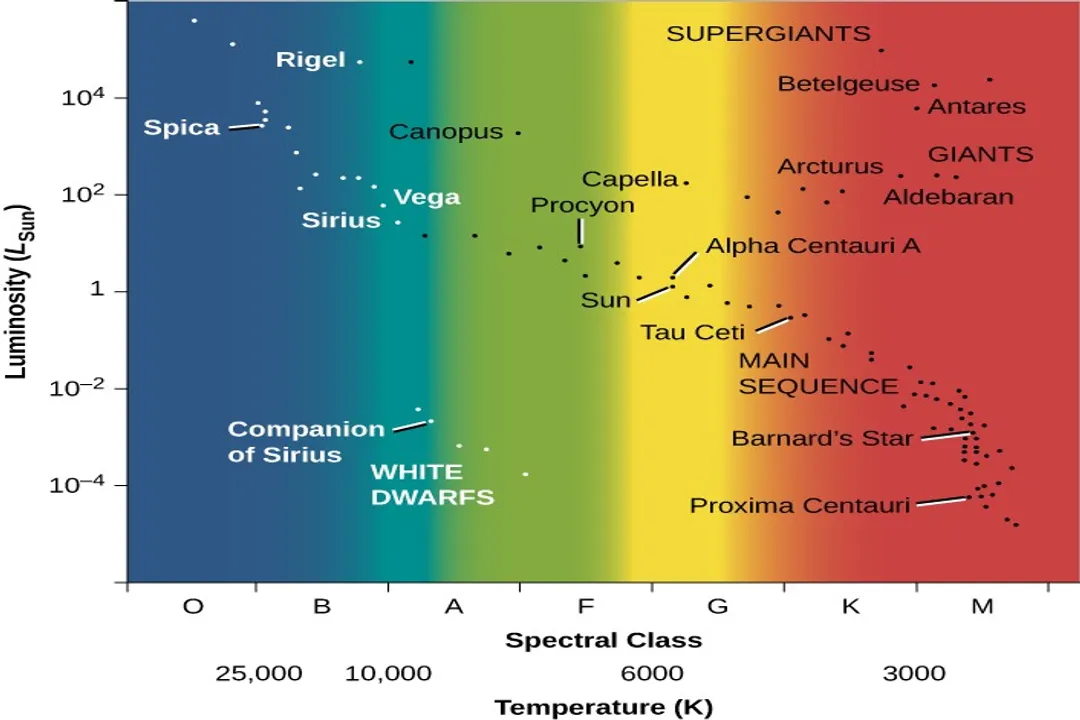
The Hertzsprung-Russell diagram functions as a scatter plot where the organization of stars is determined by plotting two primary intrinsic characteristics. The vertical axis represents the star's luminosity, which quantifies the total energy radiated per second and is often measured using absolute magnitude. The horizontal axis represents the star's surface temperature, which is usually categorized via spectral classification types (O, B, A, F, G, K, M). Plotting these two values together transforms a random grouping of stars into a structure that reveals evolutionary stages and stellar families.
#Videos
HR Diagram Explained - Star Color, Temperature and Luminosity
Related Questions
What two intrinsic properties organize stars on the H-R diagram?Why does the H-R diagram place O-type stars on the far left side?What phase of stellar life does the Main Sequence primarily represent?Where are the physically enormous Giants and Supergiants located on the H-R diagram?What defines the position of White Dwarf stars on the H-R diagram?What path does a Sun-like star follow after exhausting its core hydrogen?How does the evolutionary path of Massive Stars differ post-Main Sequence?What path represents the pre-Main Sequence contraction phase known as the Hayashi track?What analytical feature on the H-R diagram reveals a star cluster's age?In inferring stellar radius (R), what relationship governs L, R, and T?