How does the evolutionary path of Massive Stars differ post-Main Sequence?
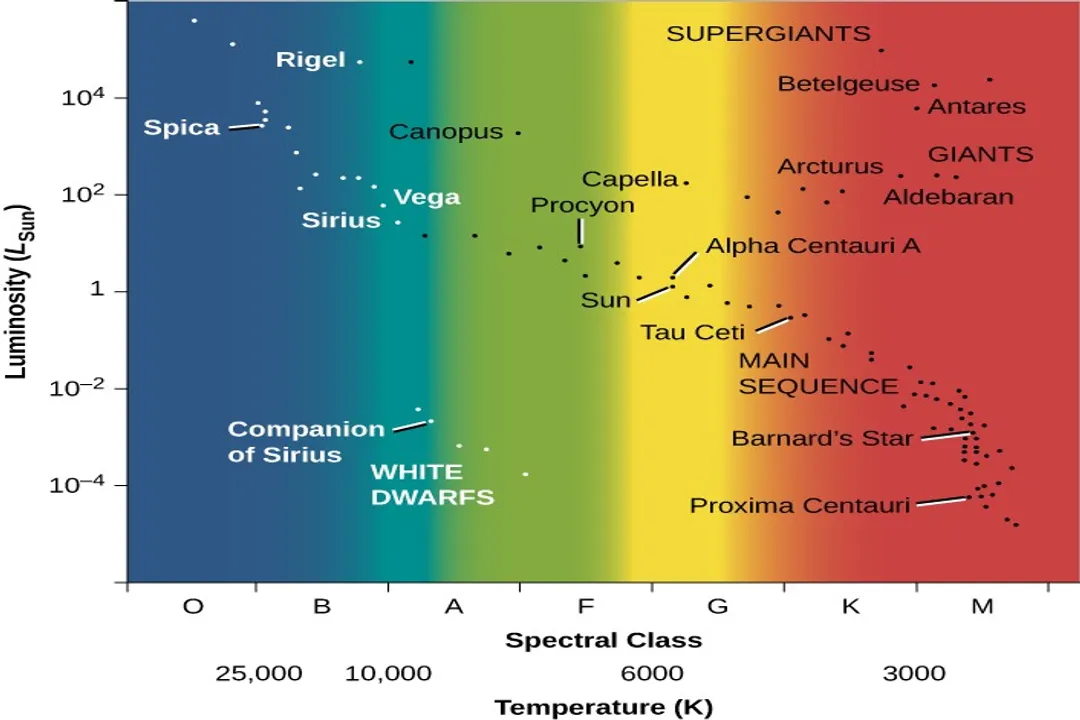
They move almost horizontally across the diagram becoming Red Supergiants.
Stars significantly more massive than the Sun experience a post-Main Sequence evolution characterized by a path that moves almost horizontally across the H-R diagram after they cease fusing core hydrogen. This path leads them directly into the Red Supergiant category, where they remain extremely luminous but relatively cool compared to their main sequence predecessors of similar mass. This transition often occurs much faster than the time they spent on the Main Sequence, sometimes taking only a few million years. Their ultimate fate involves core collapse leading to a supernova, leaving behind a neutron star or a black hole, which typically do not register clearly on standard plots of living stars.
#Videos
HR Diagram Explained - Star Color, Temperature and Luminosity