What phase of stellar life does the Main Sequence primarily represent?
Answer
The stable phase of hydrogen fusion in the core.
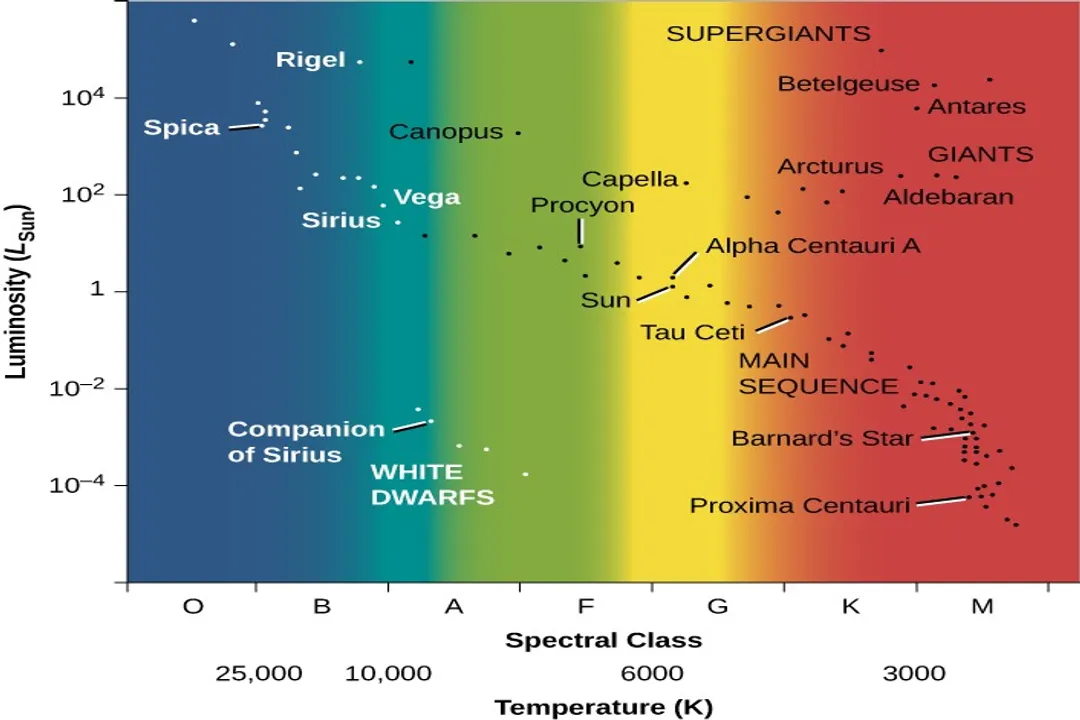
The Main Sequence is the most prominent feature on the H-R diagram, appearing as a strong diagonal band stretching from the upper-left to the lower-right regions. Stars found here constitute approximately 90 percent of all observed stars, including our Sun. This position signifies the most stable and longest period of a star's existence, characterized by the continuous and active fusion of hydrogen into helium within its core. A star's specific position along this sequence is critically determined by its mass: more massive stars are hotter and more luminous (upper-left), while less massive stars are cooler and dimmer (lower-right).
#Videos
HR Diagram Explained - Star Color, Temperature and Luminosity
Related Questions
What two intrinsic properties organize stars on the H-R diagram?Why does the H-R diagram place O-type stars on the far left side?What phase of stellar life does the Main Sequence primarily represent?Where are the physically enormous Giants and Supergiants located on the H-R diagram?What defines the position of White Dwarf stars on the H-R diagram?What path does a Sun-like star follow after exhausting its core hydrogen?How does the evolutionary path of Massive Stars differ post-Main Sequence?What path represents the pre-Main Sequence contraction phase known as the Hayashi track?What analytical feature on the H-R diagram reveals a star cluster's age?In inferring stellar radius (R), what relationship governs L, R, and T?