What mass threshold must an object exceed to fuse ordinary hydrogen ($ ext{}^1 ext{H}$) into helium?
Answer
About 0.08 times the Sun's mass ($0.08 M_{ ext{SOLAR}}$)
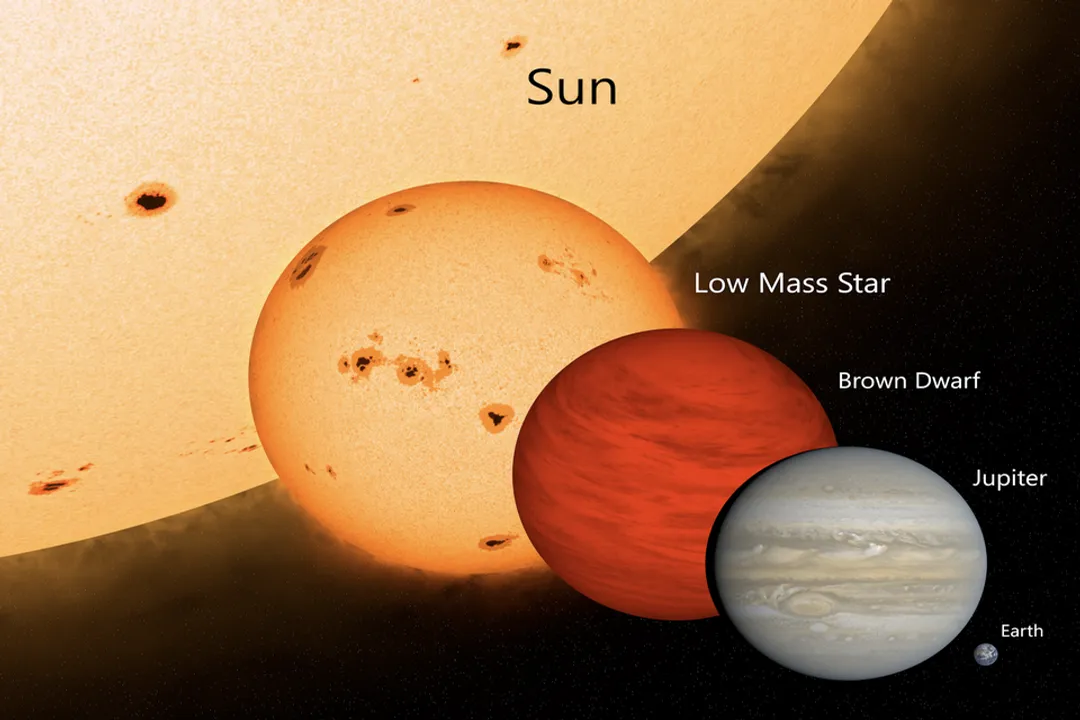
The critical distinction between a true star and a substellar object like a brown dwarf hinges on achieving sufficient core temperature and pressure to initiate the sustained fusion of ordinary hydrogen ($ ext{}^1 ext{H}$). This ignition point requires an object to possess at least $0.08$ solar masses, which is equivalent to roughly 80 times the mass of Jupiter. If an object falls below this specific threshold, the core conditions necessary for the long-term, self-sustaining hydrogen-to-helium reaction cannot be met, preventing it from achieving main-sequence status.
Related Questions
What primarily powers brown dwarfs instead of sustained hydrogen fusion?What mass threshold must an object exceed to fuse ordinary hydrogen ($ ext{}^1 ext{H}$) into helium?How do protostars primarily gain internal temperature during their earliest formation stages?Which nuclear reaction can massive brown dwarfs, exceeding 13 Jupiter masses, briefly engage in?Which stellar remnant is described as a dense core supported by electron degeneracy pressure?What is the common thread defining brown dwarfs, protostars, and stellar remnants as non-fusing objects?In which specific electromagnetic spectrum are brown dwarfs and dead stars primarily observed?After a star exhausts its core fuel, what generally happens to stellar remnants like neutron stars or black holes?What mass value defines the lower boundary separating the largest planets from brown dwarfs?Why are brown dwarfs characterized as objects that failed to form a true star?