Which type of star is not undergoing nuclear fusion?
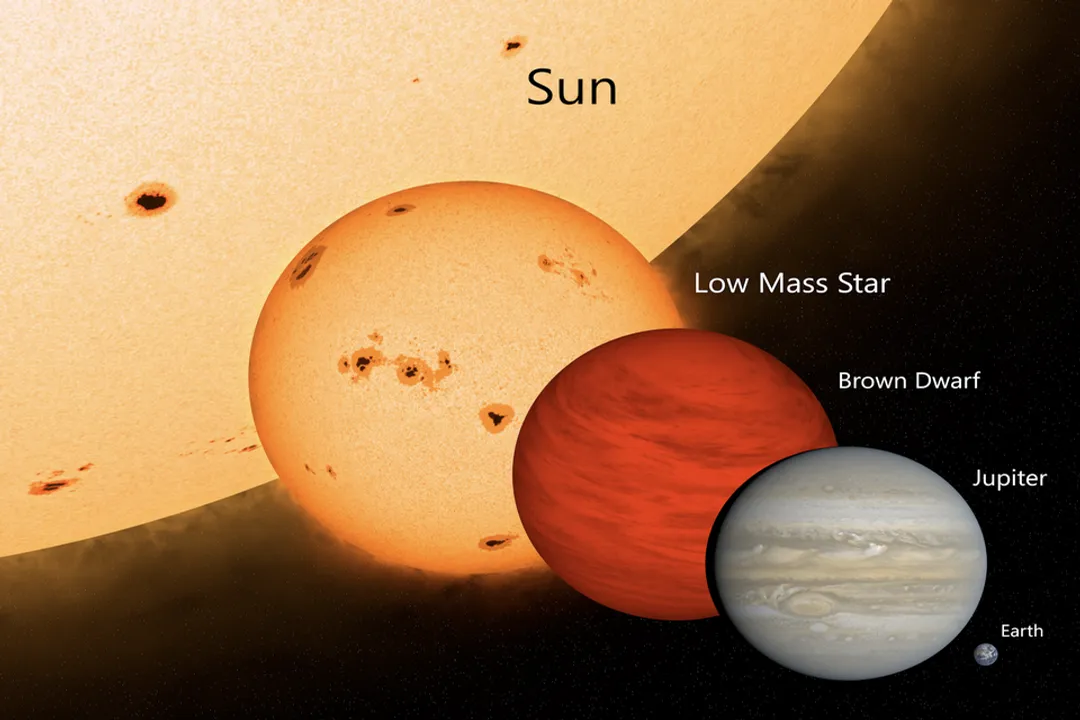
The fundamental classification for a true star in astronomy hinges on a singular, powerful process: sustained nuclear fusion in its core. [8] When we look up at the night sky, the pinpricks of light we see are overwhelmingly main-sequence stars, locked in a stable, long-term reaction where hydrogen atoms combine to form helium, releasing the energy that makes them shine. [8] However, the cosmos is full of objects that nearly achieve this status or have already finished that chapter, leading to the question of which stellar objects do not perform this critical fusion reaction. The most prominent answer lies in the dim, enigmatic realm of brown dwarfs, often colloquially called "failed stars," but the category also includes objects that were once stars but are now defunct.
# Failed Stars
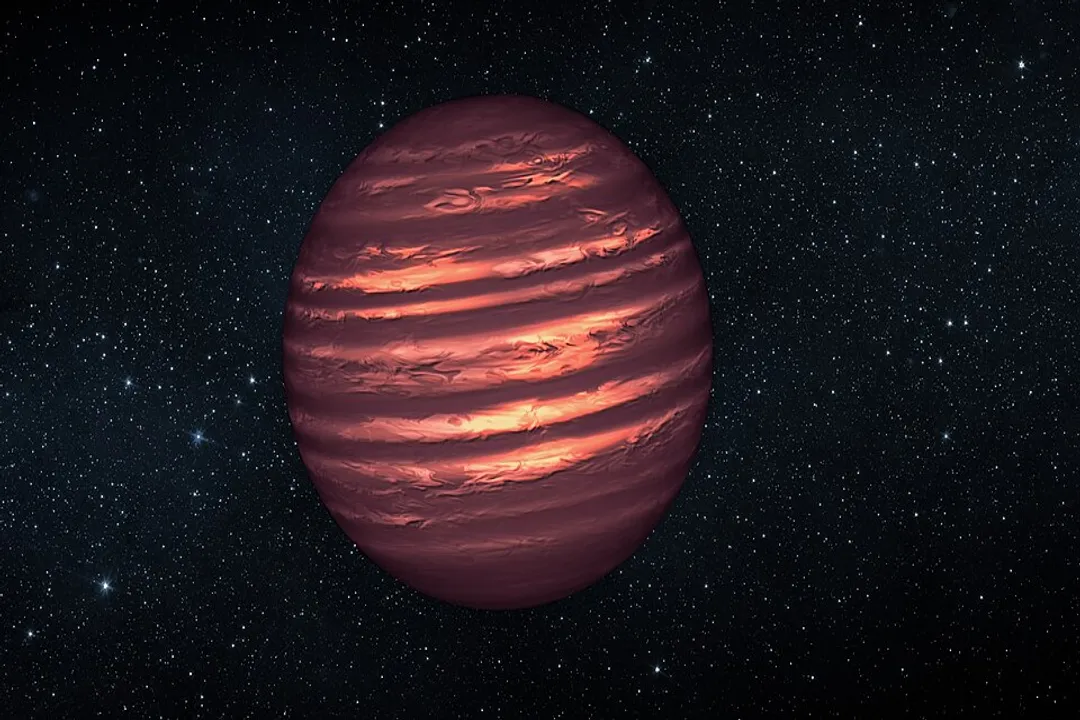
Brown dwarfs represent a fascinating celestial middle ground, positioned gravitationally above the largest planets but below the threshold required to maintain hydrogen fusion like a true star. [1] Their existence challenges simple classification schemes. A standard star, like our Sun, must possess at least about $0.08$ times the Sun's mass, or $80$ times the mass of Jupiter, to generate the core temperature and pressure necessary to fuse ordinary hydrogen () into helium. [1] Brown dwarfs fall below this critical mass limit. [1]
Since they cannot sustain the primary fusion reaction, brown dwarfs are not considered true stars in the classical sense. [3] Instead of shining for billions of years on hydrogen fuel, their internal energy comes primarily from the slow, steady release of gravitational energy as they contract. [1] They are essentially objects cooling off over time after their formation. [2]
However, this description is nuanced because some of the most massive brown dwarfs do engage in a form of nuclear burning. Objects exceeding about $13$ Jupiter masses ()—the lower boundary between a planet and a brown dwarf—can briefly fuse deuterium (). [1] Deuterium fusion occurs at lower temperatures than hydrogen fusion and provides a temporary internal heat source. [2]
This temporary deuterium burning provides an interesting point of contrast in stellar evolution. Imagine a brown dwarf and a true star. The brown dwarf burns its minuscule deuterium supply very quickly, perhaps over tens of millions of years, before settling into a slow gravitational contraction and cooling, becoming dimmer and redder. [2] In contrast, the star has a hydrogen supply that will power it for hundreds of millions of years, maintaining a stable temperature and luminosity. [8] The brown dwarf's activity is a brief flash compared to the stellar main sequence lifespan.
# Pre-Stellar Stage
Another type of object that is definitely not undergoing sustained nuclear fusion is the protostar. [7] A protostar is not a star yet; it is an object in the earliest stages of formation, a dense core within a collapsing cloud of gas and dust. [7] These nascent bodies gain mass and increase their internal temperature entirely through the process of gravitational accretion—the material falling inward heats up dramatically. [7]
The distinction between a protostar and a brown dwarf often comes down to mass and time. A protostar is still gathering material and heating up toward the ignition point. If it eventually accumulates enough mass (), it crosses the threshold and becomes a main-sequence star. [7] If the collapsing core fails to reach that mass before the outward pressure from the accretion process halts its collapse, it becomes a brown dwarf. [2] Thus, a protostar is technically fusion-free because it hasn't finished forming yet, whereas a brown dwarf is fusion-free (of hydrogen) because it failed to form into a true star. [7]
We can sketch out the immediate pre-stellar phases using mass as the primary determinant:
| Object Category | Defining Characteristic | Primary Energy Source | Sustained Hydrogen Fusion? |
|---|---|---|---|
| Planet | Below | Residual heat/Slow contraction | No |
| Brown Dwarf | to | Deuterium flash, then gravitational cooling | No (Only brief deuterium fusion) |
| Main Sequence Star | Above | Core Hydrogen Fusion | Yes |
| Protostar | (Varies) Still Accreting Mass | Gravitational Contraction | No (Not yet reached ignition temp) |
This table illustrates the mass gap that makes defining these objects tricky. For general astronomical purposes, the defining feature of the brown dwarf is the absence of sustainable hydrogen fusion. [1]

# Stellar Remnants
The final category of objects that do not undergo nuclear fusion includes the stellar corpses—the remnants left behind after a true star has exhausted its core fuel supply and died. [9] Once a star exhausts its primary hydrogen supply, it leaves the main sequence. If it is not massive enough to initiate further fusion stages (like helium fusion), or if it has gone through all its available fuel cycles, it settles into a state where no significant fusion occurs. [9]
These remnants are often incredibly dense objects that simply cool down over cosmic timescales. Depending on the original mass of the star, the remnant could be a white dwarf, a dense core supported by electron degeneracy pressure. [9] More massive stars end their lives as even stranger objects, like neutron stars or black holes, the latter being regions of spacetime from which nothing, not even light, can escape. [9] In all these cases, the powerhouse has shut down; the object shines only from residual heat, not from active nuclear generation. [9] Therefore, the term "dead star" perfectly encapsulates this entire class of non-fusing stellar objects. [9]
# Defining Boundaries
Understanding which object is not fusing requires pinpointing exactly where the line for fusion lies. Astronomers use mass—specifically the Chandrasekhar limit for white dwarfs, and the mass limits mentioned earlier for stars versus brown dwarfs—to delineate these zones. [1]
While a brown dwarf struggles to reach the temperature needed for fusion, a massive gas giant planet, like Jupiter, simply does not have the mass to initiate even the brief deuterium fusion seen in the smaller brown dwarfs. [2] For the largest planets, the energy output is solely the result of slow Kelvin-Helmholtz contraction, leading to a very slow cooling process. [2]
When considering the entire spectrum from the smallest gas giant up to the largest star, the common thread among all objects that are not undergoing sustained hydrogen fusion is their inability to maintain the necessary core pressure to keep the reaction running indefinitely. [1][8] This failure defines the brown dwarf, the protostar (temporarily), and the stellar remnant. It highlights that being like a star—having a massive, spherical shape—is not the same as being a star, which requires that internal, self-sustaining furnace.
For observers hoping to spot these non-fusing objects, the search is often focused on the infrared spectrum. While true stars emit strongly across the visual spectrum, brown dwarfs and dead stars are primarily observed by their relatively cool thermal emission, especially in the infrared wavelengths. [2] A very cool, very dim object that shows no indication of active hydrogen burning is almost certainly one of these boundary-line or post-main-sequence bodies.
Related Questions
#Citations
Brown dwarf - Wikipedia
Protostars And Brown Dwarfs | Research Starters - EBSCO
Are brown dwarfs which don't sustain any fusion considered stars?
Chapter 12 Practice Test Flashcards | Quizlet
Which group represents stars that have no ongoing nuclear fusion?
isn't a star at all, but the leftover remains of a one-time star that's now ...
The Life Cycles of Stars: How Supernovae Are Formed
What are dead stars that can no longer undergo nuclear fusion ...