After a star exhausts its core fuel, what generally happens to stellar remnants like neutron stars or black holes?
Answer
They simply cool down over cosmic timescales using residual heat
When a star dies by exhausting its primary hydrogen fuel—and potentially subsequent fuel cycles if it was massive enough—its internal nuclear powerhouse shuts down permanently. Objects that transition into remnants like neutron stars or black holes have ceased generating significant internal energy through fusion. These corpses do not have an ongoing energy source comparable to stellar burning; instead, they shine only faintly from the heat accumulated during their active life, slowly radiating this residual energy away, causing them to cool over extremely long cosmic durations.
Related Questions
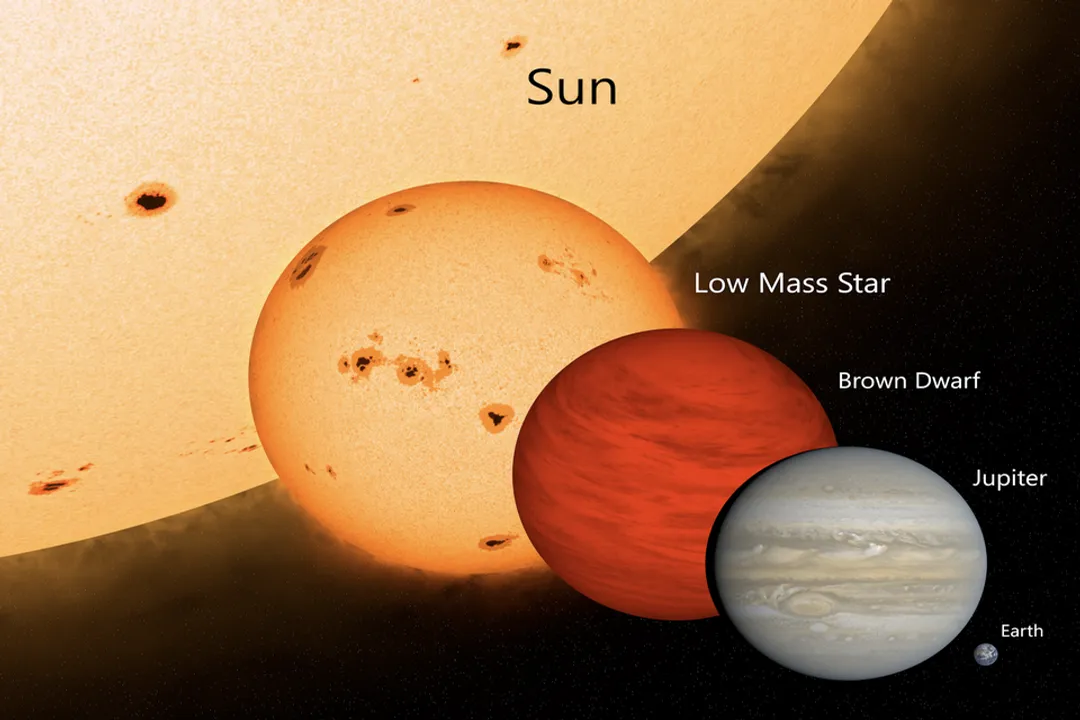
What primarily powers brown dwarfs instead of sustained hydrogen fusion?What mass threshold must an object exceed to fuse ordinary hydrogen ($ ext{}^1 ext{H}$) into helium?How do protostars primarily gain internal temperature during their earliest formation stages?Which nuclear reaction can massive brown dwarfs, exceeding 13 Jupiter masses, briefly engage in?Which stellar remnant is described as a dense core supported by electron degeneracy pressure?What is the common thread defining brown dwarfs, protostars, and stellar remnants as non-fusing objects?In which specific electromagnetic spectrum are brown dwarfs and dead stars primarily observed?After a star exhausts its core fuel, what generally happens to stellar remnants like neutron stars or black holes?What mass value defines the lower boundary separating the largest planets from brown dwarfs?Why are brown dwarfs characterized as objects that failed to form a true star?