How long will the Sun continue nuclear fusion?
The core question of how long our Sun will keep burning — that is, sustaining the nuclear fusion that bathes Earth in light and warmth — takes us on an extraordinary tour of stellar evolution, a process that operates on timescales almost impossible for the human mind to grasp. We are fortunate to exist during the Sun's most placid and predictable era. For the last approximately 4.6 billion years, our star has resided in the stable, hydrogen-burning phase known as the main sequence. [1] This stability is the result of a perfect, ongoing cosmic standoff: the crushing force of the Sun's own immense gravity pulling inward is precisely counteracted by the tremendous outward pressure generated by nuclear fusion deep within its core. [4]
Currently, the Sun is converting hydrogen nuclei into helium nuclei, releasing vast amounts of energy in the process. [1] Every second, about 600 million tons of matter are converted into solar energy, neutrinos, and other byproducts. While that sounds like an infinite resource, it is strictly finite. Astronomers estimate that this steady, dependable hydrogen consumption in the core will continue for another five billion years. [1][4] Some models push this slightly further, suggesting the main sequence ends in around 5.4 billion years, but the consensus centers on a half-decade-long countdown to the next major change. The fact that the Sun is a G-type main-sequence star, or "yellow dwarf," means it follows a relatively long and moderate path compared to more massive stars, ensuring a protracted period of relative calm.
# The Speeding Engine
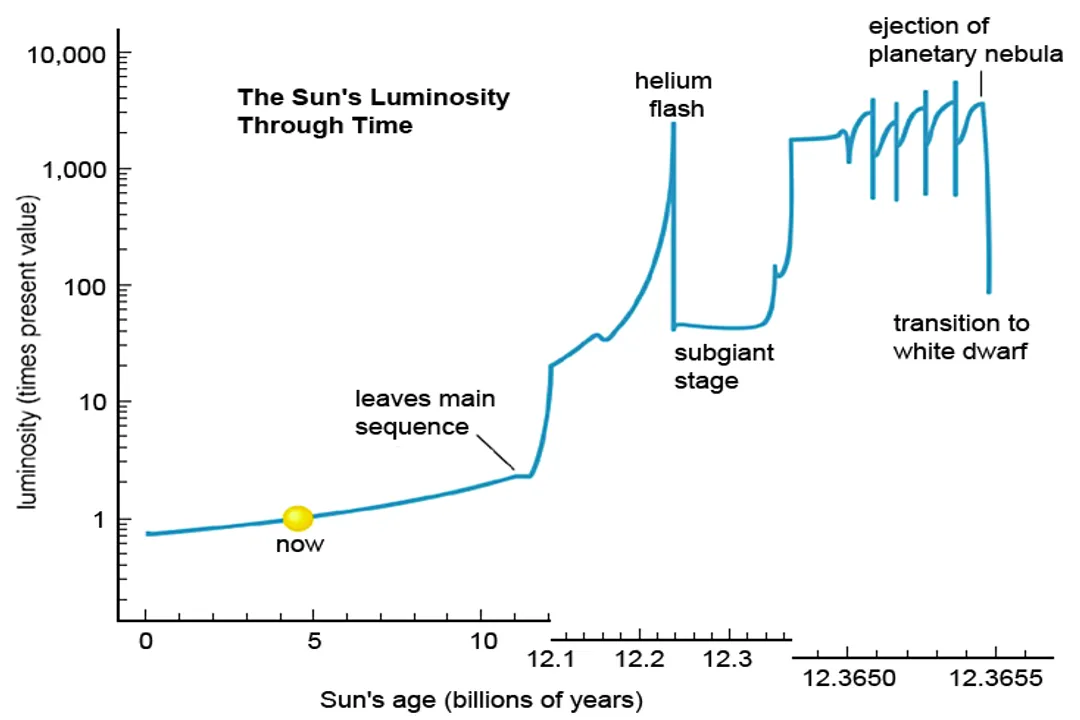
It might seem counterintuitive that the Sun's lifespan is fixed, yet its energy output is slowly increasing. As hydrogen is fused into helium ash in the core, the core shrinks because gravity begins to win a small battle against fusion pressure. This compression causes the core temperature and density to rise, which, in turn, accelerates the rate of fusion occurring there. This self-regulation mechanism means the Sun is gradually getting brighter and hotter even now. Over the past 4.5 billion years, this has resulted in a luminosity increase of about 30%. Looking ahead, this increased output poses a more immediate threat to life on Earth than the eventual end of fusion itself. Within the next couple of billion years, the rising heat will become catastrophic. [1]
Consider the timeline for our planet's habitability. In as little as 1.1 billion years, the Sun will be 10% brighter than today, likely triggering a runaway moist greenhouse effect as Earth’s atmosphere traps more heat. Fast forward to about 3.5 billion years from now, and the Sun will be 40% brighter. At this intensity, the oceans will boil away entirely, and water vapor will be lost to space, turning Earth into a desiccated, hot environment similar to present-day Venus. This means that while the Sun has billions of years of fusion left, the conditions necessary for life as we know it will cease long before the hydrogen fuel in the core runs dry. [4]
This insight into increasing luminosity provides a sobering context: the extinction event for Earth's biosphere is a slow-motion consequence of current fusion rates, not a sudden catastrophe awaiting the final burnout. If humanity were to survive for billions of years, migration would become a necessity purely due to the steady, predictable increase in solar radiation output over time. [4]
# Exit Main Sequence
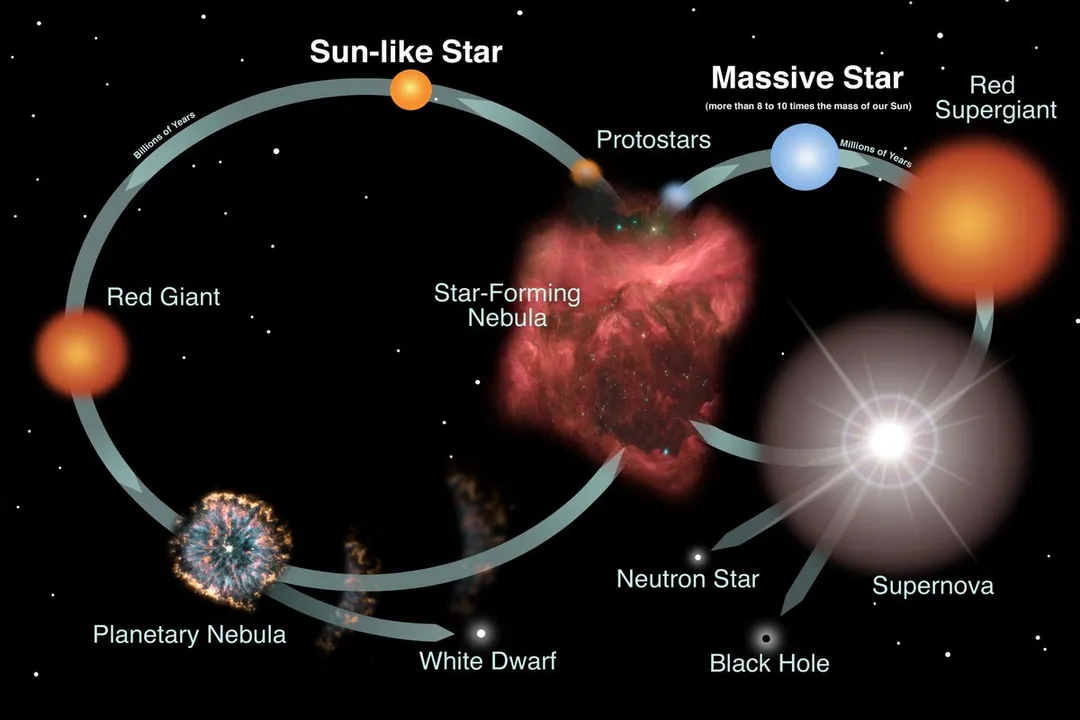
The transition out of the main sequence, the period where the Sun fuses hydrogen in its core, is not an instantaneous flick of a switch; rather, it is a drawn-out process spanning roughly one billion years. [4] When the core runs out of hydrogen, the outward pressure drops, and gravity causes the core—now primarily made of helium—to contract and heat up significantly. [4] This heating ignites a new source of energy: hydrogen fusion begins in a shell surrounding the now-inert helium core. [1][4]
This shell burning fuels the star’s dramatic expansion into a Red Giant. [1] During this phase, the Sun's radius will swell enormously. Calculations suggest it will expand enough to engulf Mercury and Venus, and the fate of Earth—orbiting right in the middle—is uncertain, though most models predict it will either be swallowed or baked into a sterile cinder by the intense radiation. [1][4] As the Sun puffs up, its gravitational influence lessens because the stellar mass is redistributed over a much larger surface area, causing the orbits of the outer planets to drift outward. [1]
# Helium Ignition
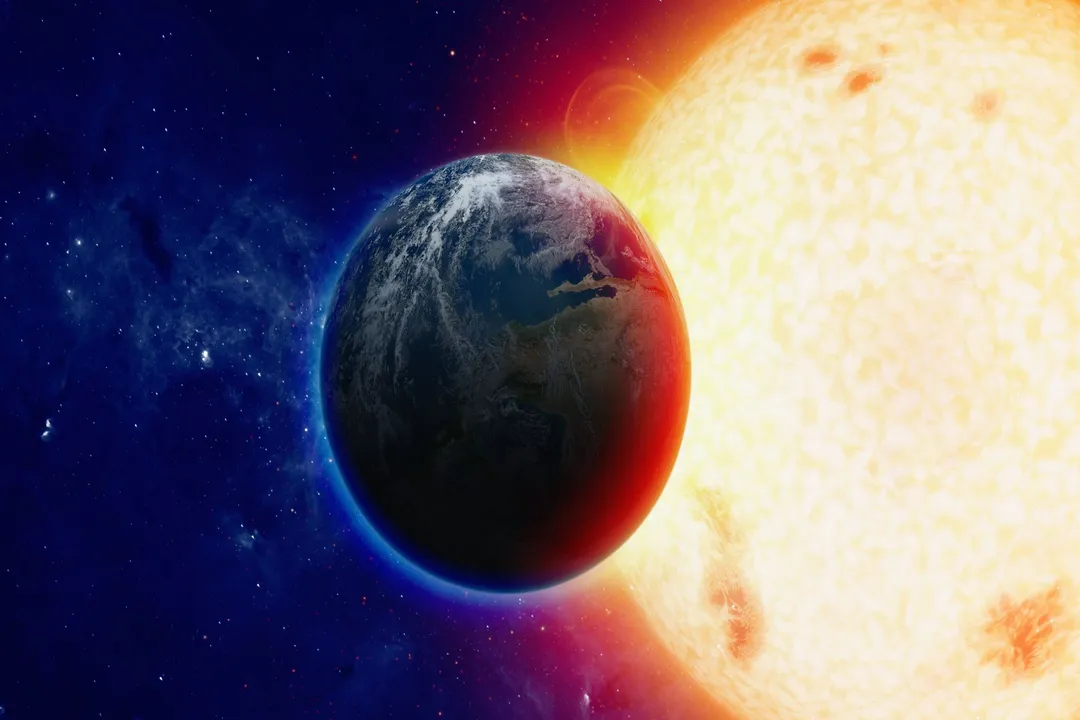
The Red Giant phase itself lasts for about half a billion years before the next major nuclear event occurs in the core. [4] As the helium core continues to contract under gravity, its temperature and pressure continue to soar until a critical threshold of about 100 million Kelvin is reached. [4] At this point, helium atoms begin to fuse into heavier elements, primarily carbon (and oxygen) through a process known as the triple-alpha process. [4]
In a star with the Sun’s mass, this ignition is uniquely violent because the helium ash accumulates in an electron-degenerate state—matter so dense that adding heat does not cause it to expand and cool down, thus removing the star's natural self-regulating mechanism (hydrostatic equilibrium). When fusion finally starts, it does so uncontrollably in a massive surge known as the Helium Flash. This flash is utterly spectacular on a galactic scale, releasing as much energy in just a few minutes as the current Sun generates in 200 million years. However, most of that energy is immediately consumed by the titanic gravitational work needed to lift the degenerate core out of its compressed state—essentially, the core "vaporizes" back into a normal, albeit extremely dense, gas, causing the Sun to suddenly shrink again.
# Shrinkage and Slow Death
Following the Helium Flash, the star settles into a new, temporary equilibrium, sometimes called the "helium main sequence". The Sun contracts to about ten times its current size and significantly increases its luminosity, burning at roughly 45 to 50 times its present output. This phase, sustained by helium fusion in the core and hydrogen fusion in an outer shell, is relatively brief, lasting about 100 million years before the helium in the core is exhausted.
The Sun then moves onto the Asymptotic Giant Branch (AGB), expanding for a second, more dramatic time. This expansion is faster and more chaotic than the first Red Giant phase, characterized by increasingly violent thermal pulses that occur roughly every 100,000 years. During these pulses, the Sun will reach a peak luminosity of over 3,000 times its current output. It is during this unstable period that the star sheds the majority of its outer material, ejecting up to 45% of its mass into space. This ejected gas and dust, illuminated by the incredibly hot, exposed core, forms a beautiful, glowing structure known as a planetary nebula. [1]
The Sun will not end in a supernova or collapse into a black hole; it simply lacks the necessary mass for those spectacular deaths, which are reserved for stars at least 8 to 10 times solar mass. Instead, the remnant left behind is the stellar core itself: a White Dwarf. [4]
| Stellar Phase | Approximate Duration (from now) | Key Energy Source(s) | Sun/Earth Context |
|---|---|---|---|
| Main Sequence | Billion Years | Core Hydrogen Fusion | Stable life for Earth [1][4] |
| Early Expansion | Billion Years | Shell Hydrogen Fusion | Oceans evaporate on Earth [1] |
| Red Giant Peak | Billion Years | Core Helium Fusion | Swallows inner planets [4] |
| Helium Main Seq. | Billion Years | Core Helium Fusion | Shorter, brighter period |
| Final Mass Loss | A few hundred thousand years | Shell-burning pulses | Forms Planetary Nebula |
| White Dwarf | Trillions of Years | None (Cooling remnant) | Earth likely destroyed/uninhabitable [1] |
# The Fading Remnant
The White Dwarf left at the center of the planetary nebula will be roughly the size of Earth but packed with matter so densely that a sugar-cube-sized piece would weigh about a ton. [1] This core is composed mainly of carbon and oxygen from the burned helium, with thin outer layers of leftover helium and unburnt hydrogen. The planetary nebula itself disperses relatively quickly, perhaps in only 10,000 years, leaving the intensely hot core shining brightly. Initially, this remnant core will be incredibly hot—over 170,000 K—emitting more X-rays than visible light, achieving a temporary luminosity of about 4,000 times the modern Sun’s output.
This brilliant phase is the final act of energy generation. With no further fuel it can ignite, the White Dwarf simply begins a very long, slow process of cooling down. [1] This cooling takes eons; in fact, the oldest white dwarfs we can currently detect—nearly 12 billion years old—have not yet cooled enough to become truly "black dwarfs". Our Sun’s remnant will continue to radiate away its residual heat for trillions of years before finally fading into a cold, dark black dwarf and effectively vanishing from the universe's stellar census. [1]
The ejected material—the ashes of hydrogen and helium fusion, enriched with carbon and oxygen—will enrich the interstellar medium, providing the raw ingredients for future generations of stars and planets. In that sense, the Sun's death is a fundamental recycling process, ensuring that the building blocks for future cosmic systems are distributed throughout the galaxy. While the fusion in our Sun will continue for another five billion years, the timeline for habitability on Earth is much shorter, measured in single-digit billions of years, a perspective that puts our long-term survival into sharp contrast with the deep, slow clock of stellar physics.
Related Questions
#Citations
Ask Astro: How quickly will the Sun become a red giant?
Chapter 6: Aging Into Gianthood - NASA Science
When will the sun die? - Space
The End Of The Sun
How long will the Sun continue to shine?
What is the Life Cycle Of The Sun? - Universe Today