What is the ion tail often composed of, and what characteristic phenomenon pushes it directly away from the Sun?
Answer
Ionized gases pushed by the solar wind
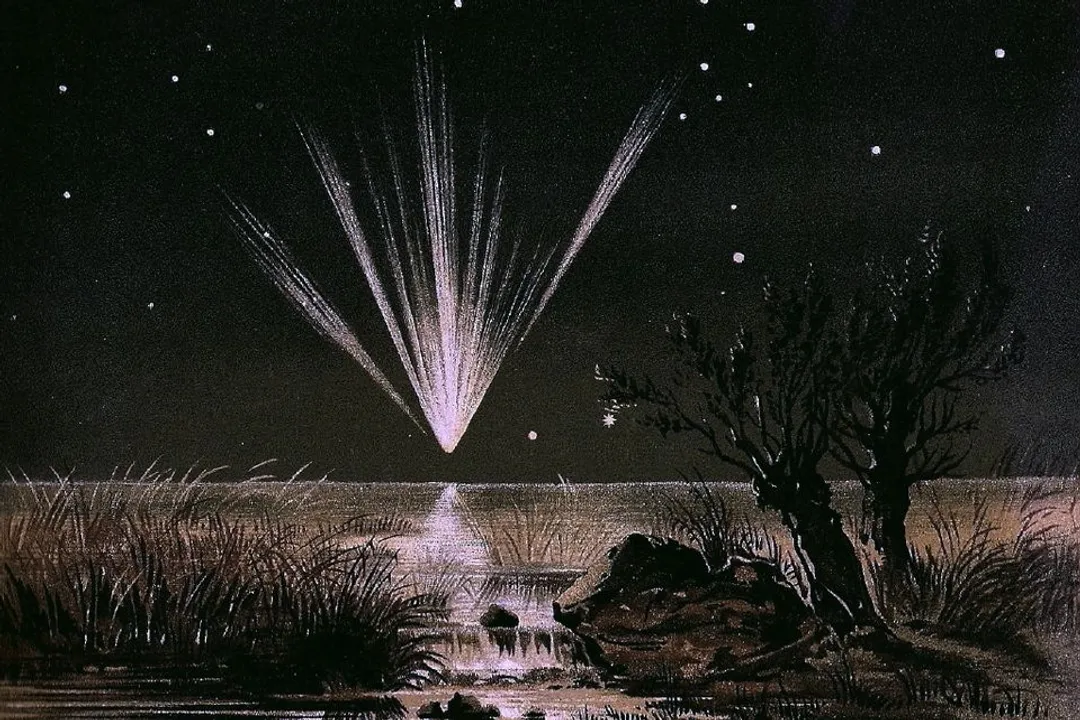
A comet often displays two main components when active: a dust tail and an ion tail. The ion tail, which generally appears pale blue, is composed of ionized gases that have been stripped from the nucleus by solar radiation and interaction with the interplanetary medium. The key factor driving this tail component is the solar wind—a stream of charged particles constantly emitted from the Sun. The solar wind exerts a strong electromagnetic force, pushing these ionized gases into a straight stream directly away from the Sun, regardless of the comet's orbital path.
#Videos
A comet is heading for earth, how close will it get? - YouTube
Related Questions
What popular description is given to comets, the ancient icy remnants from solar system formation?What process creates the temporary atmosphere, or coma, when comets approach the Sun?Historically, how frequently do truly exceptional "great comets" appear, bright enough to capture widespread public attention?What molecule is responsible for the distinct emerald glow exhibited by Comet C/2025 A6 (Lemmon)?Where are the ancient, icy remnants of solar system formation stored in frozen reservoirs?What is identified as the single greatest enemy when attempting to view faint comets?What technique utilizes more light-sensitive areas of the eye to better reveal dim details of a faint object?Roughly how many comets per year are typically visible to the naked eye for a casual observer?What is the ion tail often composed of, and what characteristic phenomenon pushes it directly away from the Sun?Which highly anticipated comet famously underperformed relative to optimistic predictions in 1973?