What is the expected core remnant difference between a Type II and a Type Ia supernova event?
Answer
Type II almost always leaves a compact object, while Type Ia often leaves none.
The nature of the progenitor star dictates the remnant left behind. A Type II supernova results from the core collapse of a single massive star, which almost inevitably leaves behind a compact object, either a neutron star or a black hole, at its center. Conversely, a Type Ia supernova typically results from a white dwarf in a binary system accumulating mass beyond stability and detonating completely. Because the white dwarf detonates entirely, astronomers generally expect these events to leave behind no compact core whatsoever; the star disintegrates fully.
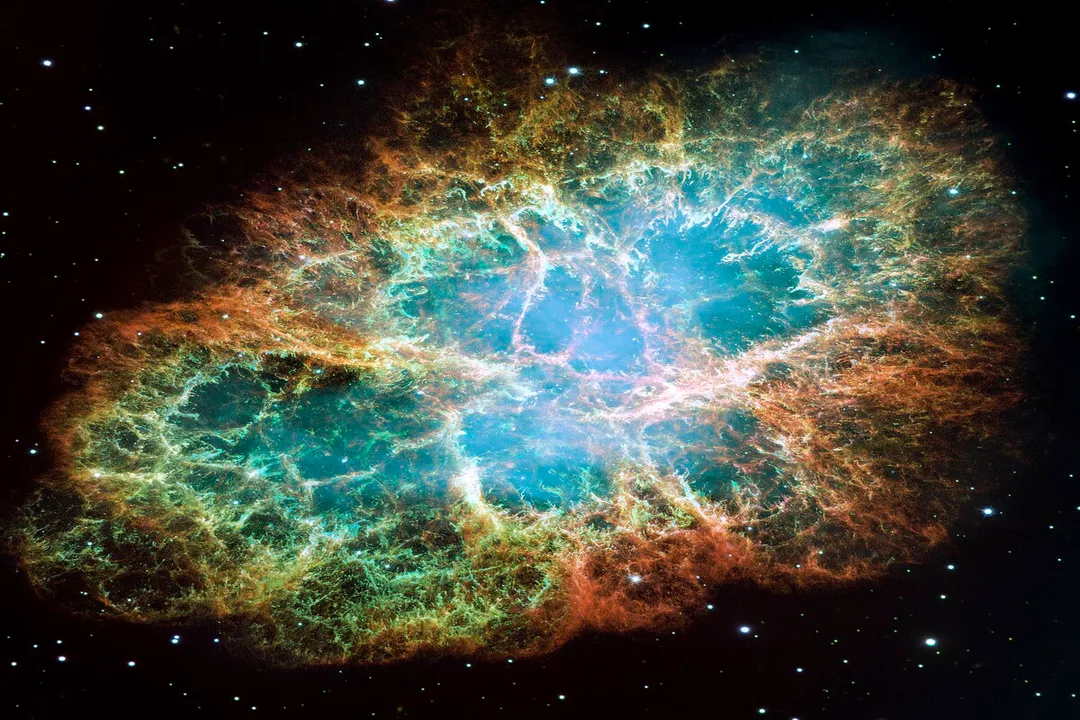
#Videos
After A Supernova Event, What Is Left Behind? - Physics Frontier
Related Questions
What constitutes the immediate and visually striking aftermath known as a supernova remnant (SNR)?In which forms of electromagnetic radiation do Supernova Remnants (SNRs) glow intensely?What highly magnetized, rapidly spinning stellar object can sometimes be found at the center of a core-collapse supernova remnant?What is the expected core remnant difference between a Type II and a Type Ia supernova event?What specific physical force halts the collapse of a core remnant below roughly $3 M_{\odot}$ to form a neutron star?What condition causes a stellar core to collapse completely into a black hole instead of stabilizing as a neutron star?Which elements are primarily forged under the immense energies available only during a supernova explosion?How long might it take for the ejected material from a supernova blast to become fully homogenized into the general galactic gas reservoir?During a core-collapse supernova, what physical event causes the initial shockwave that blasts out the star's outer layers?What density analogy is used to describe the extreme compression characteristic of neutron star material?