What is in Orion's left hand?
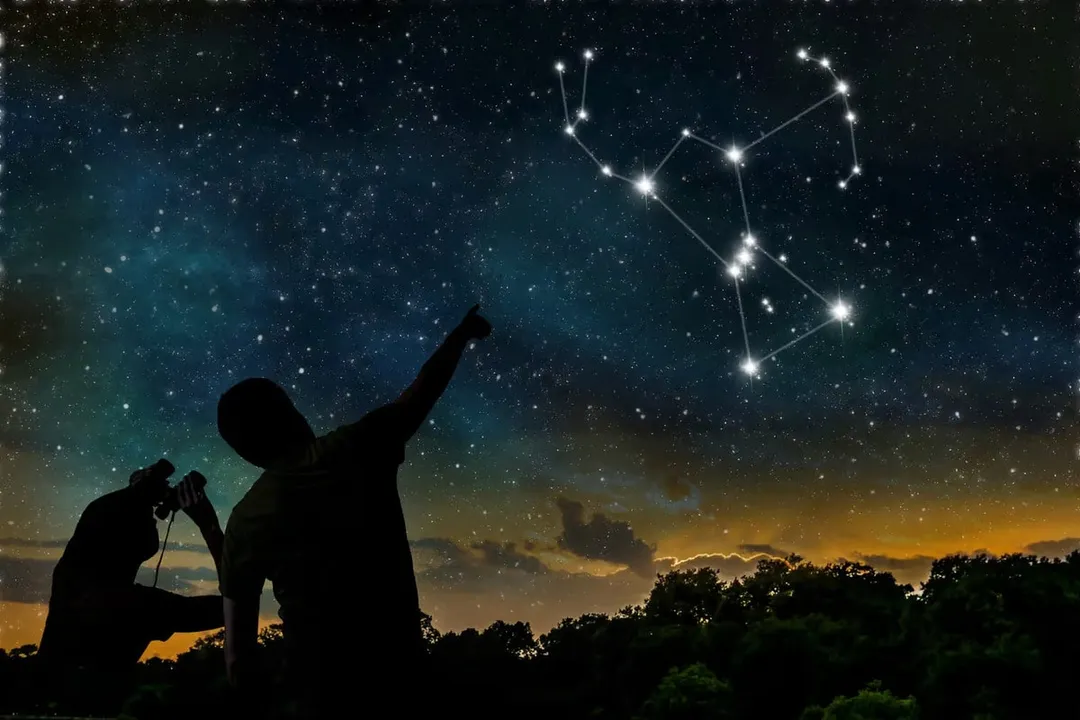
The magnificent constellation Orion, often recognized by its brilliant belt of three stars, represents a legendary hunter striding across the winter sky for observers in the Northern Hemisphere. [1][4] When mapping the stick figure of this celestial giant, understanding which item resides in which hand requires looking beyond just the brightest points of light and delving into the artistic and mythological traditions that assigned meaning to these stellar groupings. [7] Specifically, the question of what Orion holds in his left hand relates directly to the ancient iconography associated with the stars that form his outstretched arm and grasping digits.
# Hunter's Form
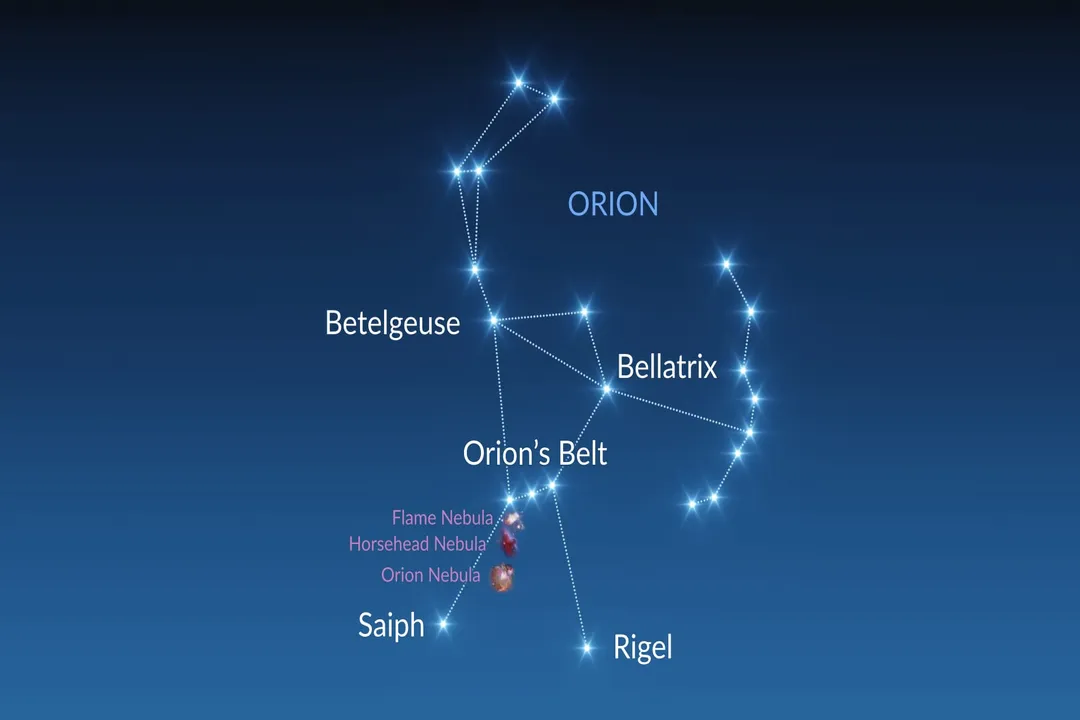
Orion is one of the most recognizable constellations visible from Earth, containing many bright stars that make its outline easy to trace. [4][5] Its sheer visibility ensures it remains a popular target for both amateur and professional stargazers. [2][5] The recognizable shape is defined by several prominent stars: Betelgeuse, a reddish supergiant marking his shoulder, and Rigel, a blue supergiant marking his left foot (or knee, depending on the depiction). [1][4][6] Connecting these are the three stars forming the famous belt: Alnitak, Alnilam, and Mintaka. [1][2][4]
The rest of the figure is composed of stars marking the head, the knees, the feet, and, importantly for this discussion, the arms holding his implements. [1] The structure is generally seen as a standing figure facing the observer, which dictates which stars comprise the left and right sides of the celestial man. [7]
# Defining The Hand
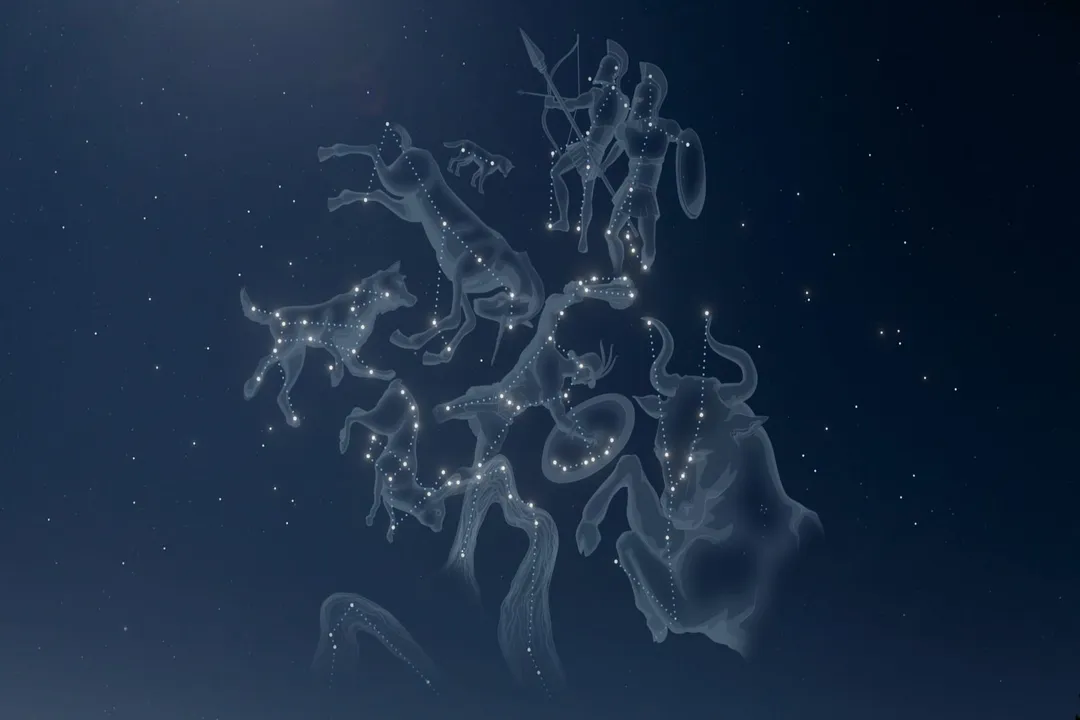
In the standard artistic representation that has been projected onto the stars for millennia, Orion is not depicted empty-handed. [7] He is shown as an active hunter, carrying the tools of his trade. The two primary items attributed to his hands are a weapon—often a club or sword—and a defensive or symbolic covering, frequently identified as a shield or the skin of a slain lion. [1][7]
The key distinction lies in assigning these items correctly to the left and right limbs as viewed from our perspective on Earth. The stars that form the arm extending toward the upper left of the constellation—our observer's upper left, corresponding to Orion's right side—are typically associated with the weapon, the club. [1] This arm is anchored near the bright shoulder star, Betelgeuse. [1]
This leaves the left hand, which extends toward the lower right of the constellation's main body, responsible for holding the shield or the lion's skin. [1][7] This area involves stars that are generally less brilliant than those marking the belt or the primary shoulder and foot markers. For instance, Bellatrix, often marking the other shoulder, is near the upper part of the figure's right side, further distinguishing the limbs. [1]
It is important to note that while the bright stars of the belt and the shoulders are universally agreed upon, the fainter stars that outline the hands and legs are subject to more variation across ancient cultures. [7] However, in the Greco-Roman tradition that heavily influences modern astronomy catalogs, the left-hand object remains consistently represented as the defensive piece. [1] If we consider the constellation as a hunter prepared for battle, the left hand holding the shield makes perfect visual and mythological sense, protecting the vital side near the bright shoulder star, Betelgeuse. [1]
# Stellar Composition
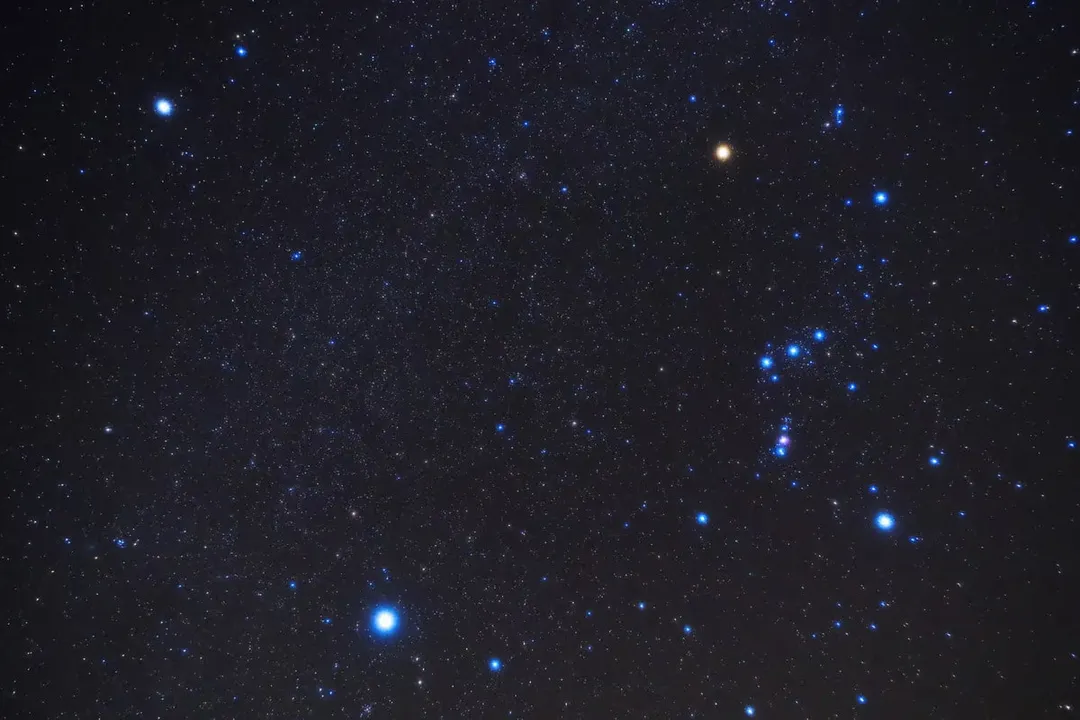
To better appreciate the difference between the two sides of the hunter, one can compare the stellar anchor points associated with each hand. While the club side anchors near the brilliant orange Betelgeuse ( Orionis), the shield side is anchored near the bright blue star Bellatrix ( Orionis). [1]
When observers locate the belt stars—Alnitak, Alnilam, and Mintaka—they are essentially looking at the center of the figure. [4] A line drawn upward from the belt leads toward Betelgeuse (the right shoulder) and the club. [1] Conversely, looking toward Bellatrix ( Orionis), which marks the left shoulder, directs the eye toward the stars that define the arm holding the shield. [1]
| Limb Feature | Associated Bright Star(s) | Traditional Object Held | Relative Brightness |
|---|---|---|---|
| Orion's Right Arm | Betelgeuse ( Ori) | Club or Sword | Very Bright |
| Orion's Left Arm | Bellatrix ( Ori) | Shield or Lion's Skin | Bright |
| Center Mass | Alnilam, Alnitak, Mintaka | N/A (Belt) | Very Bright |
| Orion's Left Foot | Rigel ( Ori) | N/A (Foot) | Very Bright |
| [1] |
The visual contrast is telling: the club arm seems more aggressively defined by the massive light of Betelgeuse, whereas the shield arm, while marked by the bright Bellatrix, is tasked with holding the less distinct outline of the shield, which is often only faintly suggested by dimmer background stars. [1]
# Mythological Echoes

The identification of Orion's implements isn't arbitrary; it stems from the rich mythology surrounding the giant hunter. [7] Different cultures have interpreted the figure in unique ways, yet the hunter archetype persists. [7] For instance, some sources highlight that stars associated with Orion’s legs and arms are dimmer, making the overall figure sometimes appear less defined than the central stars. [4] This lack of stellar definition in the limbs means that the objects held—the club and the shield—are more a product of cultural storytelling overlaid onto the stellar pattern rather than being explicitly defined by multiple, independent bright stars forming the object itself. [7]
Interestingly, even when viewing the constellation from near the equator, where the belt remains high but the orientation shifts relative to the zenith, the names of the objects held do not change, even if the apparent angle of the hunter seems different. [8] The figure remains defined by its mythological roles, irrespective of the observer's latitude. [8]
If you are trying to trace the figure out on a cold night—perhaps while observing the Belt and Sirius, the brightest star in Canis Major which often trails Orion in the sky [2]—remember that the difference between the two hands reflects a classic pairing: offense and defense. The sheer brightness of the stars associated with the belt and the primary feet/shoulders (Rigel and Betelgeuse) often dominates the amateur's view, making the less luminous stars defining the shield in the left hand an exercise in tracing faint connections. [4][6]

# Practical Observation
Locating the object in Orion's left hand is more about understanding the structure than pinpointing one specific, famous star. When you find the belt, remember that the entire figure is laid out symmetrically around it. [4] If you draw a line from the belt stars toward the star Rigel (marking the lower left foot), you are tracing the line of the body that includes the left leg and the arm holding the shield. [1]
It is a common experience for new observers to confuse which hand is which, especially if they try to superimpose the image of a standing person onto the sky without accounting for celestial orientation. For example, if an observer finds Betelgeuse and identifies it as the right shoulder, they must then mentally map the remaining stars outward. The star furthest to the left of the belt (from the observer's view looking up) often marks the head or the upper part of the figure, while the arm holding the shield extends away from the belt in the opposite direction of the club. [1]
This ambiguity in tracing the faint outlines offers a small exercise in astronomical interpretation. Think about the environment where this constellation was first mapped. For observers in ancient cultures, perhaps the most crucial celestial feature needed to be clearly defined (the belt), while the accessories (the shield/club) were defined by the nearest available, though dimmer, stars. [7] The fact that the shield stars are generally fainter than the club stars might even suggest that historically, the weapon was considered the more important identifier for the celestial hunter, relegating the shield to a secondary, fainter stellar border. [1]
Furthermore, consider the time of observation. While Orion is a prominent winter constellation in the Northern Hemisphere, appearing high in the south after sunset, [5] its exact position changes throughout the night and the year. If you see the figure oriented unusually, it is simply because the Earth's rotation has turned the hunter in the sky, but the relationship between the stars that constitute the shield remains constant relative to the stars that make up the belt. [8]
# Cultural Significance
The importance of Orion transcends the simple identification of his equipment. Across various cultures, the constellation signified strength, hunting prowess, and the changing seasons. [3][7] The Arabian interpretation, for example, often referred to the figure as al-Jabbār, meaning "the giant". [7] Similarly, in the context of European folklore, this figure was often associated with winter and the transition out of the harvest season. [6] The tools he carries—the club and shield—reinforce this universal narrative of a powerful, protective entity striding through the heavens. [7]
The very act of naming the features, down to the objects in his hands, reveals a human desire to impose narrative order onto the seemingly random scattering of lights. While the bright stars like Rigel and Betelgeuse define the boundaries of the figure, it is the assigned props, like the shield in the left hand, that complete the story of the celestial giant. [1][7] For anyone taking the time to trace the less obvious stars defining that arm, they are engaging directly with the ancient tradition of celestial storytelling that has linked humanity to the stars for thousands of years. [7]
#Videos
Bright Stars of Orion - Betelgeuse, Rigel, Bellatrix, Belt Stars
Related Questions
#Citations
Orion (constellation) - Wikipedia
I can see Orion's Belt, Betelgeuse and Sirius, can anyone else point ...
What are the celestial objects in this foreground photo of a lion?
Orion Belt - the Hunter Constellation - Star Walk
Rigel marks Orion's 'left foot' - The Register-Guard
Orion constellation: what it really means in the night sky - Futura
What does Orion's Belt look like from the Equator?
Bright Stars of Orion - Betelgeuse, Rigel, Bellatrix, Belt Stars
Orion Constellation • Quick and easy • Everything worth knowing!