What is the brightest star next to Orion?

The brightest beacon shining near the mighty constellation Orion is unequivocally Sirius, often affectionately known as the Dog Star. While Orion dominates the winter sky with its three distinctive belt stars, the star that commands attention just off to the side, shining with unparalleled brilliance, is Sirius, which resides in the constellation Canis Major, the Greater Dog. It is a frequent topic of discussion for stargazers, partly because it is so easy to find using Orion as a landmark, and partly because other, even brighter objects occasionally steal its show.
# The Brightest

Sirius holds a special rank in the celestial sphere; it is the brightest star in the entire night sky. Its luminosity is what makes it stand out so dramatically, even when other bright celestial neighbors are present. For observers in the Northern Hemisphere, Orion becomes a familiar sight, rising in the east during the evening in late autumn and winter months, parading westward throughout the night. As Orion stands tall, Sirius is positioned below and to the left of the constellation, acting as a radiant anchor for the entire scene.
# Using the Belt
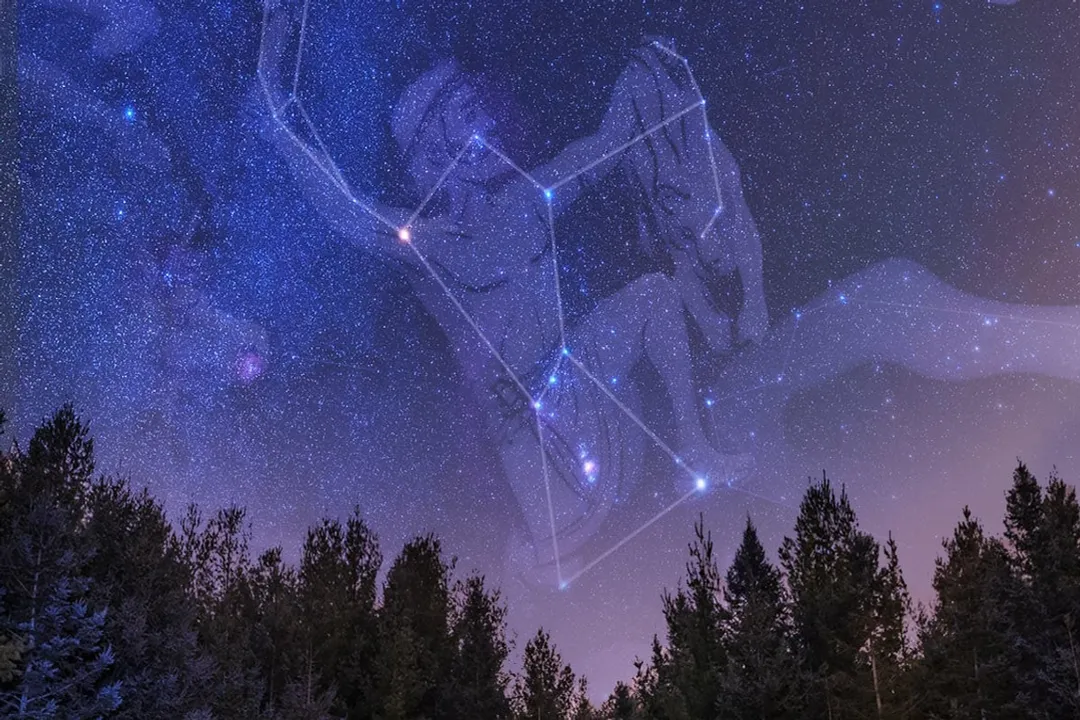
The easiest way to confirm you are looking at Sirius and not just some random bright point is by employing Orion’s most recognizable feature: its three aligned stars known as Orion's Belt. To guide your eye to the Dog Star, one simply needs to extend an imaginary line through the three belt stars, continuing in the direction away from Aldebaran (the ruddy star in Taurus). Following this line in the opposite direction from Aldebaran leads directly toward Sirius in Canis Major. This method works regardless of where you are on Earth, though you may need to orient your chart upside down if observing from the Southern Hemisphere. The reliability of this method means that when Orion is visible, you can always locate the sky's brightest star with confidence.

# Other Neighbors
While Sirius is the reigning champion of brightness next to Orion, the Hunter’s celestial neighborhood features other notable stars. By drawing the line through Orion’s Belt toward the red giant Aldebaran, which marks the eye of Taurus the Bull, one can locate another significant stellar neighbor. Aldebaran is visually striking, often appearing ruddy or reddish. Furthermore, if we look within the outline of Orion itself, the two brightest stars are the blue-white supergiant Rigel (located below the belt, toward the lower right) and the red supergiant Betelgeuse (located above the belt, toward the left). Rigel is recognized as the sixth brightest star in the sky, while Betelgeuse ranks among the top ten brightest. However, none of these stars, not even Rigel, rivals the apparent magnitude of Sirius when viewed from Earth.
# Planetary Pretenders

A common source of confusion for even attentive observers is mistaking the planet Venus for a nearby star. Depending on the time of year and the time of night, Venus can appear as an incredibly bright spot near Orion, sometimes even outshining Sirius itself. When Venus is visible in the early morning sky near Orion, it can be so bright that it remains visible even as the sky begins to glow before dawn, a feat no true star can manage. Some observers note that while they see a brilliant object near Orion, they observe it twinkling like a star, which makes them doubt it is Venus. Yet, if this brilliant object is significantly brighter than Sirius—outshining it by several magnitudes—it is almost certainly Venus, as planets are capable of outshining every star combined. Even the planet Jupiter can outshine Sirius on occasion. Planets can, however, exhibit twinkling, especially if they are low to the horizon where atmospheric turbulence is greater, which can complicate identification.
# Constellation Context
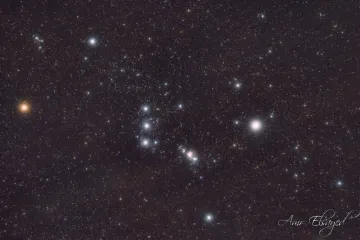
The constellation of Orion is a fixture in the celestial equator, most easily spotted across the globe from November through February or March in the Northern Hemisphere. Orion is bordered by several other constellations, forming part of the wider winter asterism often called the Winter Hexagon. To the south lies Canis Major (home to Sirius), and to the northwest lies Taurus (home to Aldebaran). The fixed relationship between Orion and Sirius—Sirius residing in Canis Major—means that their relative positions remain constant night after night, which helps differentiate Sirius from the planets, whose positions shift daily.
When assessing the brightness of Sirius versus the stars that define Orion’s shape, we see a clear hierarchy. Rigel, Orion’s brightest, is a blue supergiant that shines about 85,000 times brighter than our Sun, and it is the sixth brightest star overall. Betelgeuse, the other shoulder/foot star, is a red supergiant even more luminous, potentially 100,000 times brighter than the Sun. Yet, Sirius remains visually supreme in our sky due to its relative proximity to Earth compared to these distant giants.
For an observer learning the sky, this comparative brightness is an immediate lesson in celestial scale. Sirius, at an apparent magnitude of roughly -1.46, is dramatically brighter than Rigel (around 0.12) or Betelgeuse (around 0.5). The fact that Sirius appears so much brighter than Rigel, even though Rigel is physically much more luminous—thousands of times more so—underscores the non-linear nature of the apparent magnitude scale and the critical importance of distance in what we observe from our vantage point. A star’s intrinsic power is irrelevant if it is too far away; proximity rules apparent visual impact.
# Seasonal Observation Tip
The prominence of Sirius next to Orion is also tied directly to the season you are viewing. Because Orion is the quintessential winter constellation in the north, the sky's single brightest star, Sirius, is also at its most visible and highest in the sky during those colder months. If you are looking up in the summer sky, Orion will be in the daytime sky and functionally invisible. This seasonal visibility means that the easiest time to train yourself to spot the Orion-Sirius pair is during the clear, dark nights of winter, making the initial identification of the brightest star next to the hunter a reliable annual event, unless, of course, Venus is positioned close by as a temporary, overwhelming rival in the twilight hours. This yearly cycle of reappearance is a great way to build observational consistency; you learn the pattern of the constellation first, then you reliably locate its famous, bright neighbor.
#Videos
Rigel: The Brightest Star in Orion Constellation - YouTube
Bright Stars of Orion - Betelgeuse, Rigel, Bellatrix, Belt Stars
Related Questions
#Citations
Use Orion's Belt to find 4 bright stars in the sky - EarthSky
Rigel: The Brightest Star in Orion Constellation - YouTube
Brightest star of the night sky - Astronomy Stack Exchange
The Orion Constellation | Pictures, Brightest Stars, & How to Find It