Why is Orion's belt so famous?
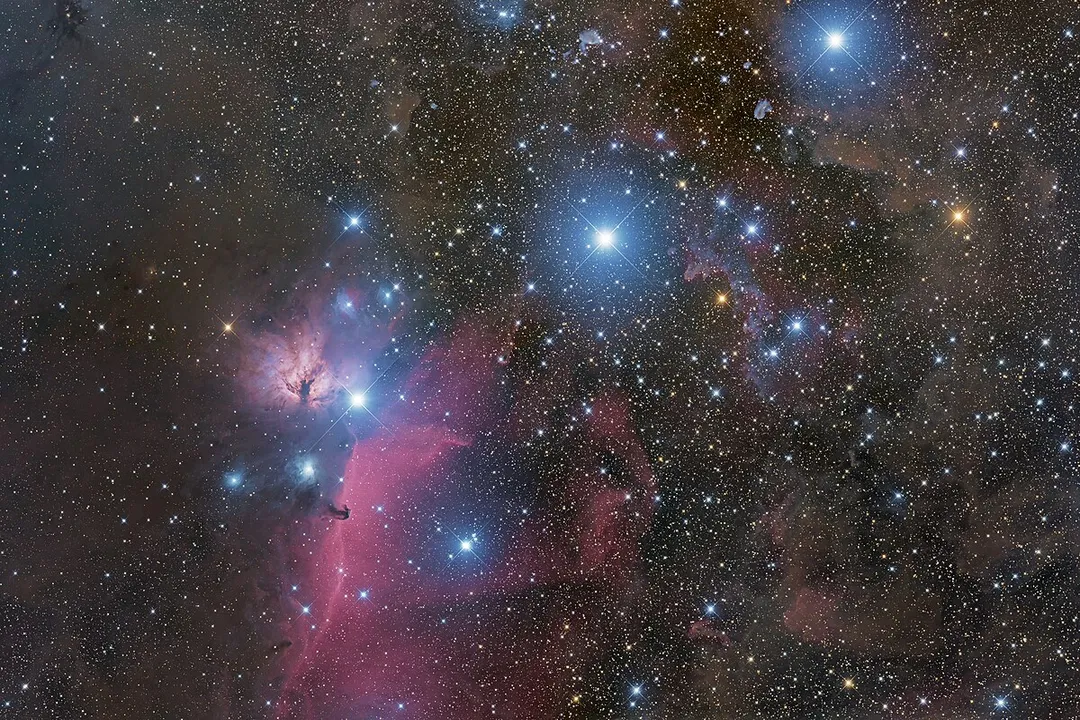
The simple, unmistakable line of three bright stars holds a unique place in the night sky, drawing the attention of skywatchers for millennia. This alignment, known as Orion’s Belt, is famous not just for its visual appeal but because it serves as a reliable cosmic pointer, anchoring one of the most recognizable constellations visible from Earth. [2][8] Unlike many constellations that require careful tracing of faint patterns, the Belt is immediately apparent, often being the first asterism people learn to spot after the Big Dipper. [3] Its fame stems from this immediate recognizability combined with its high placement in the winter sky for Northern Hemisphere observers. [6][8]
# Visual Simplicity
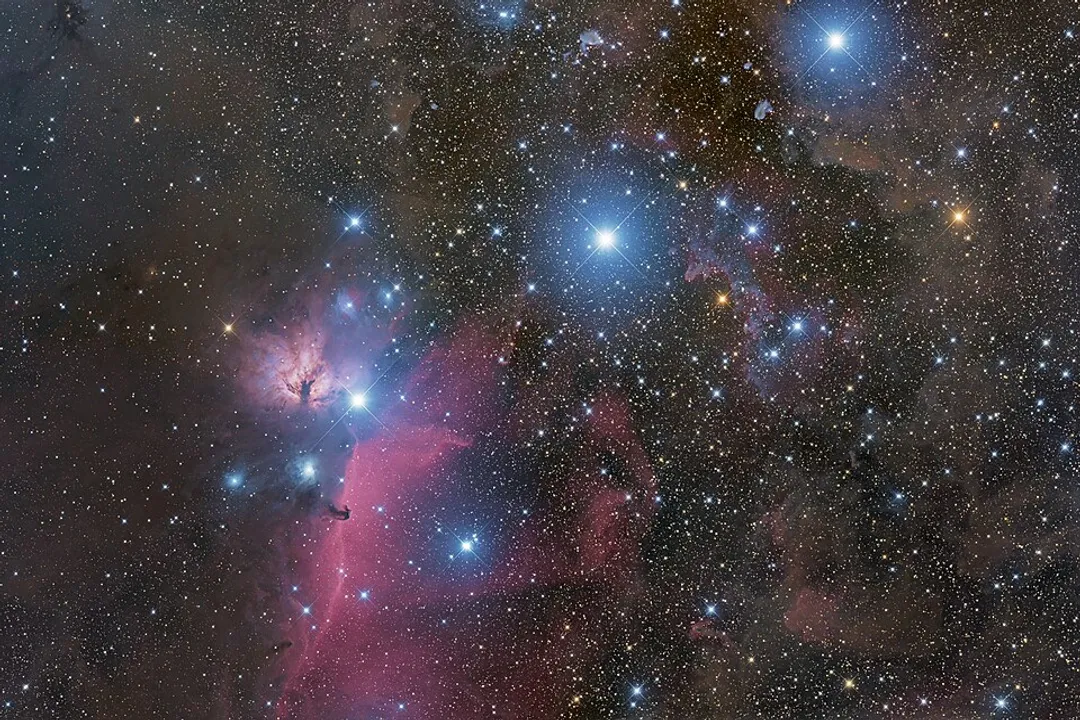
The reason for its fame begins with pure aesthetics: three stars arranged in a remarkably straight line. [1] This geometric purity sets it apart from the often scattered appearance of other star groups. Whether viewed from a city porch or a remote dark site, those three points of light stand out prominently against the backdrop of the larger figure of the hunter, Orion. [7] The stars comprising the Belt are also intrinsically bright and massive, ensuring they remain visible even through light pollution or when the Moon is out. [2] They are, by astronomical definition, a signpost rather than a formally bound cluster, yet they appear tightly grouped to the naked eye. [1]
# Key Components
The three stars are named from west to east: Mintaka, Alnilam, and Alnitak. [1] These names, derived from Arabic, reflect the constellation’s historical significance across various cultures that interacted with Middle Eastern astronomy. [1]
If you were to calculate the apparent brightness (magnitude) of these stars, you might assume they are roughly equal neighbors, but the reality involves a fascinating disparity. Mintaka, the westernmost star, shines at about magnitude +2.2, while Alnilam, the center star, is noticeably brighter at magnitude +1.7. [1] Alnitak, the eastern star, sits between them at magnitude +1.8. [1] This difference in observed brightness is compounded by the actual physical distances involved; Alnitak is actually farther from us than Mintaka, yet its intrinsic luminosity must be far greater to appear as bright as it does. [1] This subtle variance in magnitude, visible upon careful observation, adds a layer of observational detail beyond the initial simple line. [3]
# Celestial Landmark
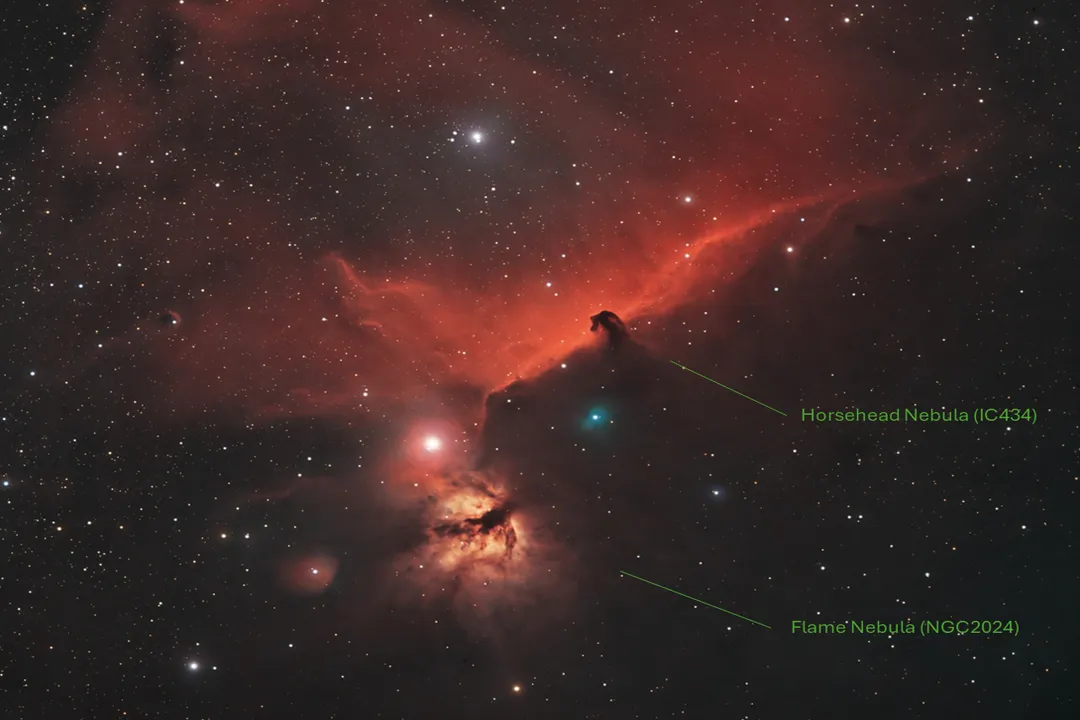
Beyond their individual brilliance, the Belt’s primary functional fame comes from its role as a navigational marker. [7] It functions as a celestial bridge, pointing directly toward other significant, visible deep-sky objects. [8]
If you trace a line downward (southward) from the Belt, you will eventually find the brilliant ruby glow of Betelgeuse (Orion’s shoulder) and, further still, the dazzling blue-white light of Sirius, the brightest star in the entire night sky. [8] Conversely, drawing a line upward (northward) leads toward Aldebaran in Taurus and the famous Pleiades star cluster, often referred to as the Seven Sisters. [8][7]
The consistency of this pointing ability makes Orion’s Belt an indispensable tool for novice astronomers. An amateur stargazer unfamiliar with the entire figure of Orion can simply locate the three aligned stars and immediately know where to look next for nearby targets. This relationship to Sirius, in particular, cements its importance; knowing where the Belt is automatically tells you where the brightest star in the sky lies, providing an anchor point for orientation during the winter months in the Northern Hemisphere. [6][9]
# Cultural Names

The immediate visibility of the Belt has ensured it carries cultural significance across nearly every civilization that observed the sky. [3] While Western astronomy uses the Arabic names mentioned earlier, other traditions assigned their own evocative meanings. [9]
For instance, in many parts of Christian Europe, the three stars were known collectively as the Three Kings or the Three Marys. [9] This naming convention ties the celestial feature directly into terrestrial religious calendars and narratives, further embedding it in cultural memory. Across different continents and time periods, the pattern has been interpreted as three hunters, three soldiers, or even a plow. [3] This universality in recognition—despite the differences in interpretation—is a strong contributor to its long-standing fame. It is a shared marker of the season when the constellation is highest in the sky. [9]
# Scientific Depth

Orion is not just famous for its three belt stars; the entire constellation is a beacon for deep-sky observation, and the Belt acts as the keyhole to that region. [4] The area surrounding the Belt is one of the richest star-forming regions visible from Earth. [4]
The most compelling scientific fame associated with the Belt is its proximity to the Orion Nebula (M42). [2][4] If you extend the line drawn downward from the Belt through the star Alnilam—about the same apparent distance as the gap between Alnilam and Mintaka—you land almost exactly on the coordinates of the Great Orion Nebula. [2] This nebula, a stellar nursery where new stars are actively being born, is visible to the naked eye as a fuzzy patch, but binoculars or a small telescope reveal its structure. [4]
This association is critical: the Belt provides the direct visual guide to one of the few nebulae visible to the naked eye, making the entire region the premier destination for anyone beginning to use optical aid for stargazing. [4] The fame is therefore twofold: one part for the simple beauty of the line itself, and another for the incredible treasure trove of star formation it points toward. [2]
If you are planning a night of observation during the winter months, remember that the visibility of Orion dictates the timing for observing M42. While the constellation is visible throughout the night in winter, it is highest in the sky—offering the thickest, clearest atmospheric path—around midnight local time. [8] This specific window is when the light from the Orion Nebula travels the shortest distance through Earth’s atmosphere, providing the sharpest views possible for those trying to resolve the structure of the gas clouds surrounding the nascent stars within. [8] The fame of the Belt, therefore, extends into a sort of practical celestial scheduling tool for modern astrophotographers and observers alike.
Related Questions
#Citations
Orion's Belt - Wikipedia
Orion's Belt — Stars, mythology and how to find it | Space
What is so special about Orion's belt? - Quora
Discovering the Universe Through the Constellation Orion
Orion's Belt is one of the most famous and easily recognizable sights ...
Why do I always see Orion's Belt? : r/Astronomy - Reddit
Orion Across 3 Cultures: One Sky, Many Stories
See Orion's Belt as a celestial bridge between hemispheres - EarthSky
Orion's Belt - The Three Kings - Expand your horizons through ...