What is the most famous dark nebula?

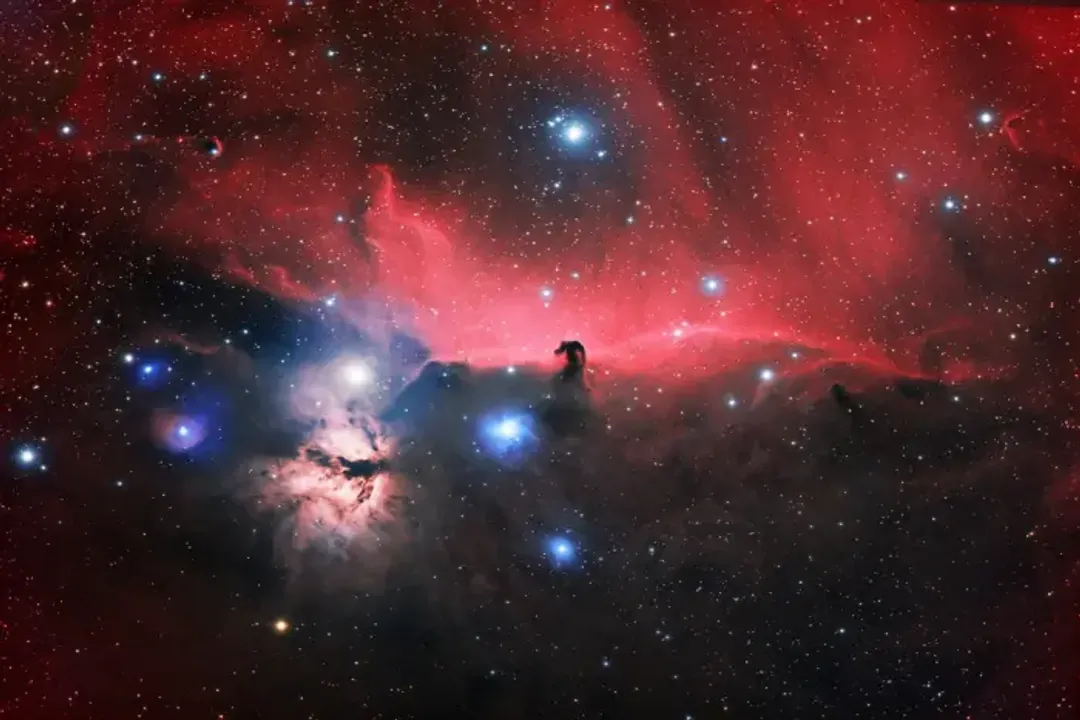
The undisputed champion when naming a single, recognizable dark nebula is almost certainly the Horsehead Nebula, also known by its catalogue designation, Barnard 33. This object, etched against the glow of a background nebula, has become the visual shorthand for an entire class of cosmic objects: the dark nebulae. These aren't empty voids in space; they are actually vast, cold congregations of interstellar dust and gas so dense that they effectively block the visible light emanating from the stars or glowing gas situated behind them.
# Obscuring Structures
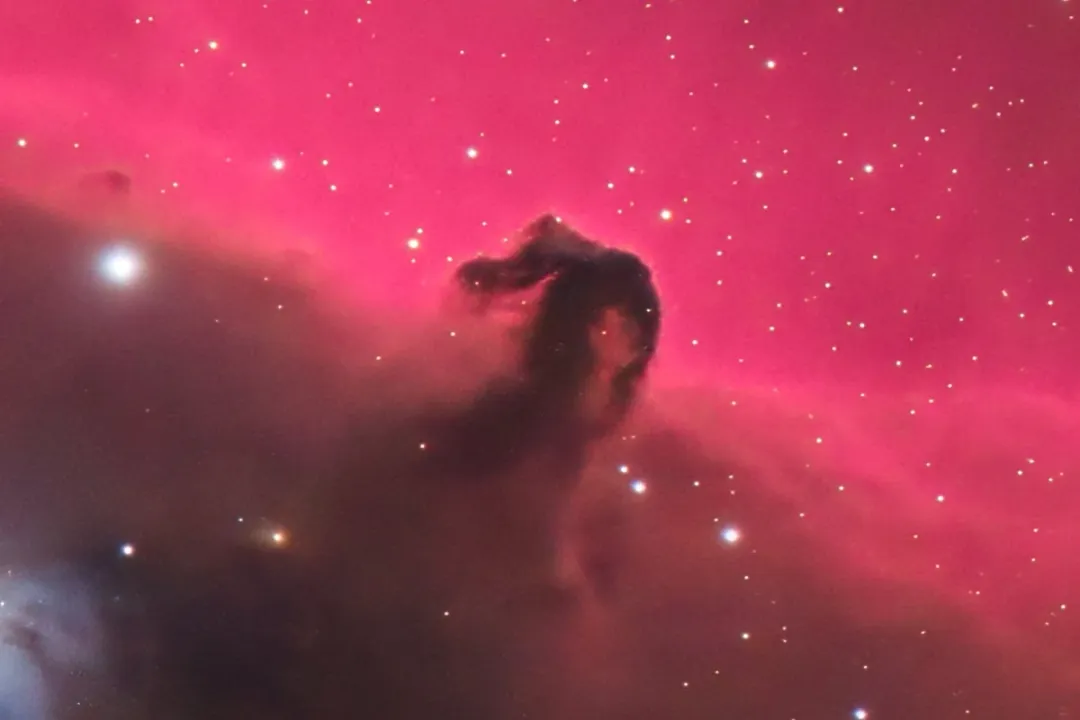
To appreciate why the Horsehead is so famous, one must first understand its brethren. Dark nebulae, sometimes called absorption nebulae, are essentially cosmic clouds where the primary visible action is subtraction rather than addition. Unlike emission nebulae, which glow red because they are energized by nearby hot stars, or reflection nebulae, which scatter blue light from stars, dark nebulae are defined by what they prevent us from seeing.
The material composing these clouds is predominantly molecular hydrogen and dust grains, often laced with molecules like carbon monoxide. These dust grains are microscopic—far smaller than the wavelength of visible light—which allows them to efficiently absorb and scatter that light, making the cloud appear opaque against any brighter backdrop. If you were to observe one of these clouds away from a bright stellar nursery, it would simply appear as a patch of blackness against the background field of distant stars. The contrast provided by an illuminated background is what turns an inert cloud into a spectacular silhouette.
The material density within these structures is incredibly low by terrestrial standards, yet it is concentrated enough to obscure distant light sources over light-years of distance. For those interested in observation, the necessity of a bright background means that the most famous dark nebulae are often found near or embedded within brighter nebular complexes, such as the Orion Molecular Cloud Complex.
# The Icon Defined
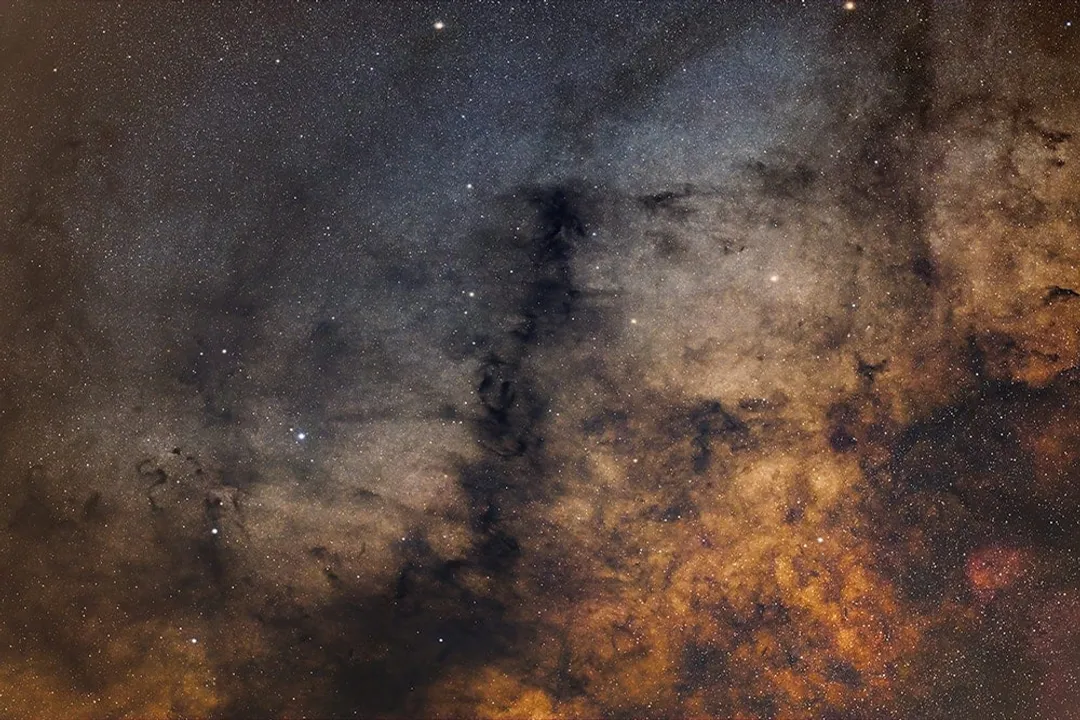
The Horsehead Nebula stands out not just because it exists, but because of its distinctive shape. Officially cataloged as Barnard 33 (B33), its structure strikingly resembles the profile of a horse's head and neck. This visual clarity is a stroke of luck in cosmic terms.
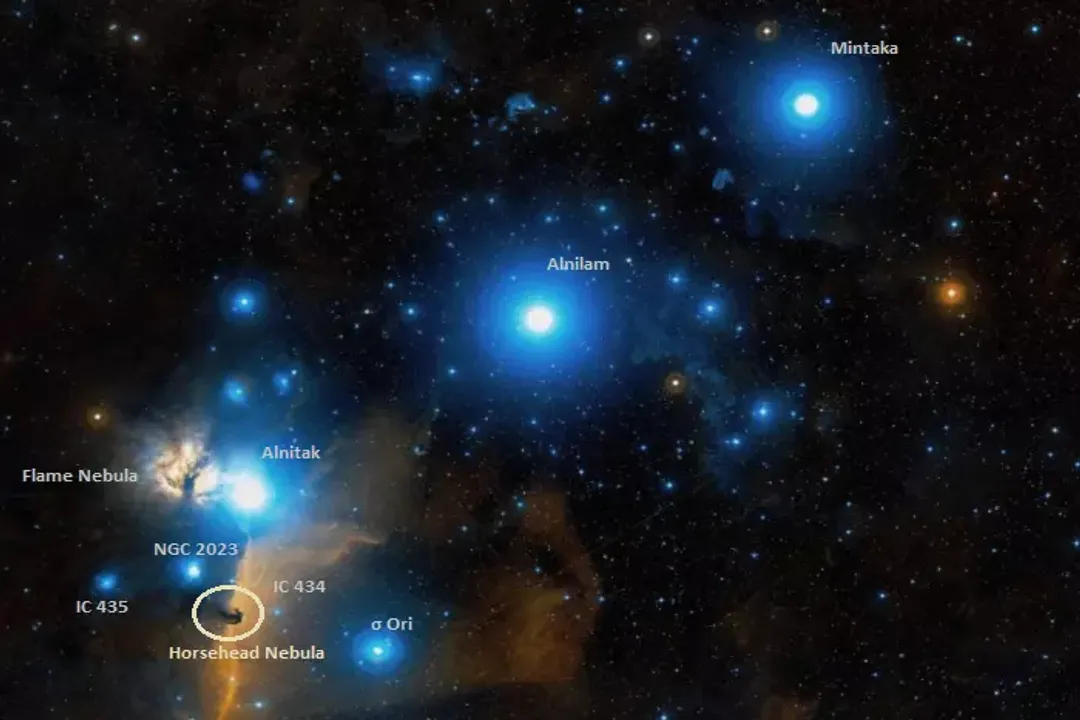
The nebula resides in the constellation Orion, near the bright star Alnitak (Zeta Orionis), which is the easternmost star in Orion's Belt. This placement is key to its visibility and fame. The dark dust cloud is seen silhouetted against the bright red glow of the background emission nebula, IC 434. This dramatic backlighting provides the sharp contrast necessary for the "horsehead" outline to become recognizable to both visual observers and imagers.
Measurements place the Horsehead at a distance of roughly 1,500 light-years away from Earth. In terms of physical size, the "head" structure itself is estimated to be about 5.5 light-years high. While five and a half light-years sounds vast—far larger than our entire solar system—the context of the massive Orion complex makes it a localized feature of denser dust.
Its fame is cemented by its role in astrophotography. Countless deep-sky images showcase its crisp form, making it a prime target for both amateur and professional telescopic observers, often near the more famous Orion Nebula. The Horsehead’s enduring popularity suggests that humans are naturally drawn to recognizable patterns, even those written in interstellar dust on a scale of light-years.
# Cataloging Shadows
The systematic study and naming of these dark patches largely began with the astronomer Edward Barnard. Barnard, known for his extensive work cataloging nebulae, compiled a significant list of these obscuring clouds, resulting in the Barnard Catalogue of Dark Nebulae. His efforts provided a structure for identifying and locating these seemingly empty regions.
While B33 (the Horsehead) is arguably the most famous, the Barnard Catalogue contains many other fascinating objects that challenge observers. For example, Barnard 68, often nicknamed the Pipe Nebula, is another well-known example. Unlike the dramatically backlit Horsehead, the Pipe Nebula is often described as a dense, isolated dark cloud set against a field of dimmer background stars, creating a different, perhaps more subtle, visual experience.
Another striking example listed by Barnard is Barnard 163, known popularly as the Bat Nebula due to its wing-like appearance. Forum discussions among amateur astronomers frequently list these objects alongside the Horsehead as top targets when the sky is dark enough for such faint contrasts.
When comparing the Horsehead (B33) to the Pipe Nebula (B68), the difference in perceived fame is largely environmental. B33 is situated near the energetic Orion complex, ensuring it is always near bright, colorful neighbors for comparison. B68, on the other hand, is often cited as a textbook example of an isolated Bok Globule—a small, dense, and relatively dark cloud that may be in the early stages of forming stars, though it requires extremely dark skies to be appreciated fully. The Bat Nebula (B163) offers yet another morphology, showcasing how interstellar dust can be sculpted into recognizable, yet entirely different, shapes.
# Viewing Challenges
Observing dark nebulae presents a unique challenge compared to hunting for glowing galaxies or emission nebulae. Telescopes are primarily designed to collect light, whereas viewing a dark nebula requires one to perceive the absence of light against a background field. This means that atmospheric clarity, the brightness of the background stars, and the observer's dark adaptation are paramount.
For visual observers, especially those using binoculars or small aperture telescopes, the trick is often to look slightly beside the area where the dark nebula is supposed to be, allowing your eye to adjust to the surrounding star field. When you then shift your gaze back to the target area, the slight reduction in the number of visible stars against the sky background can reveal the cloud's silhouette. This technique relies on averted vision, where the more sensitive rods in your peripheral vision detect the slight dimming more effectively than the cones in your direct line of sight.
Astrophotography, however, changes the dynamic entirely. Modern digital sensors can accumulate light over many minutes or hours, making faint light sources visible. Crucially, they also capture the lack of photons where the dark nebula lies. In long-exposure imaging, the Horsehead Nebula, for instance, is revealed not just by the red glow of IC 434, but by the black void cutting into that glow. The camera records the brightness difference over time, effectively making the dark nebula "brighter" in the final processed image by exposing the background glow it blocks.
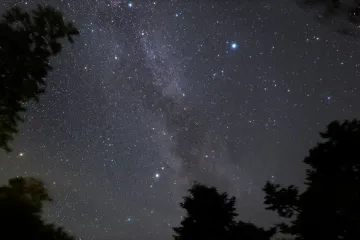
One point worth noting for aspiring observers is that the vastness of some dark structures, such as the Great Rift—a sprawling lane of dust dividing the Milky Way’s central plane—is often difficult to grasp in small fields of view. While the Horsehead is a distinct, compact feature, the Great Rift is an enormous foreground structure, making it less of a single "object" and more of a large-scale feature of our galaxy's appearance, showcasing the diversity in scale among dark nebulae.
# Insights into Cosmic Dust
The continued fascination with nebulae like Barnard 33 points to a fundamental human attraction to recognizable form, even when that form is merely a chance alignment of foreground dust against a brilliant background. The Horsehead’s iconic status is perhaps less about its physical properties—which are shared by countless other dark clouds—and more about its photographic serendipity. If the cloud happened to be silhouetted against a dim background, it would likely be known only to cataloguers like Barnard, rather than the general public.
Another interesting comparison arises when considering the fate of these clouds. While the Horsehead is famous for blocking light, it is also a site of future stellar creation, embedded within the massive Orion Molecular Cloud Complex. The dust and gas within are gradually cooling and condensing due to gravity. The density differences—some regions being denser, like B68, and others being more diffuse like the faint edges of B33—dictate their evolutionary path. This comparison highlights that dark nebulae are not static features; they are dynamic, cold nurseries where the next generation of stars begins its slow contraction toward ignition, eventually illuminating the dust that once hid them.
The prevalence of these catalogued objects near Orion also offers a subtle lesson in observational bias. Since Orion is a dominant, easily recognizable constellation, many of the most famous dark nebulae are found in that celestial neighborhood, making them accessible targets for both beginners and seasoned observers. This proximity to other spectacular targets effectively ensures that anyone photographing or visually searching the region for the bright Orion Nebula will inevitably encounter the dark silhouettes nearby.
Related Questions
#Citations
Horsehead Nebula - Wikipedia
Dark Nebulae - APOD Index - NASA
What is a Dark Nebula? | Pictures, Key Facts, & Best Examples
Barnard 33 also known as The Horsehead Nebula is a ... - Facebook
Explore dark nebulae | Astronomy.com
The Best of Barnard's Dark Nebulae - Saguaro Astronomy Club
Favorite Dark Nebulae? - Deep Sky Observing - Cloudy Nights
Horsehead Nebula (B33): Dark Nebula in Orion - Constellation Guide