Why are some nebulae dark?
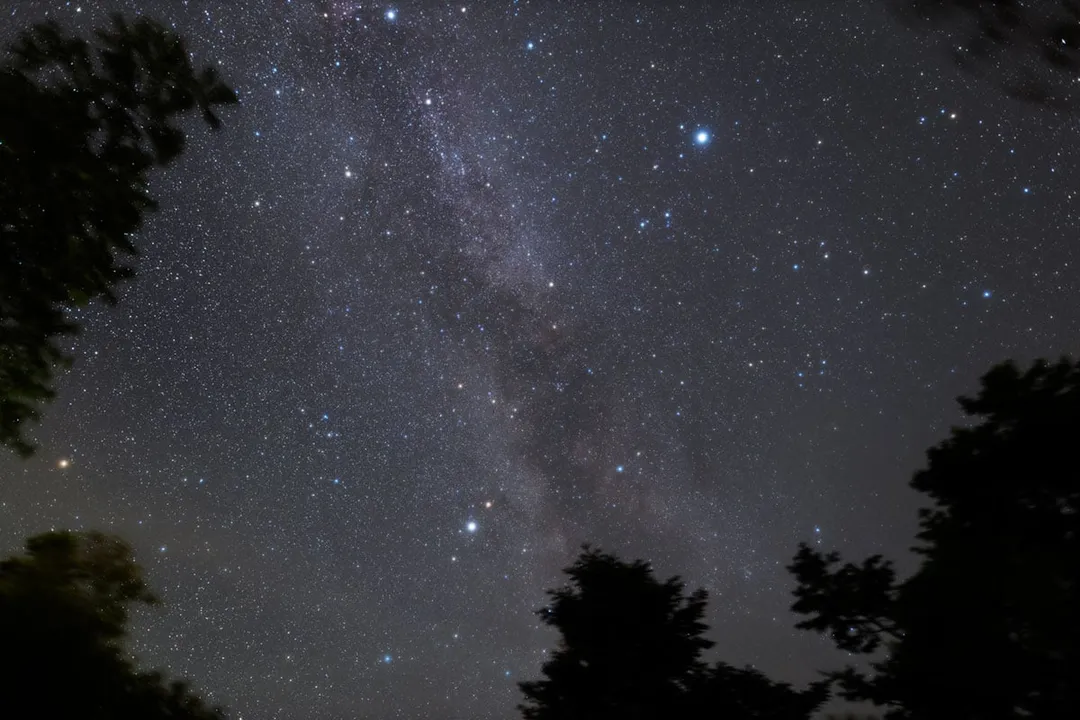
The appearance of the night sky is often dominated by brilliant, glowing clouds of cosmic gas, the emission nebulae that blaze with the light of newborn stars. Yet, scattered among these luminous regions are patches of profound blackness—vast regions that seem to swallow the starlight behind them. These are the dark nebulae, and their darkness is not an absence of material, but rather the result of an intense concentration of obscuring matter. They are clouds of gas and dust so thick that they effectively block the visible light originating from objects situated beyond them.
# Cosmic Concealment
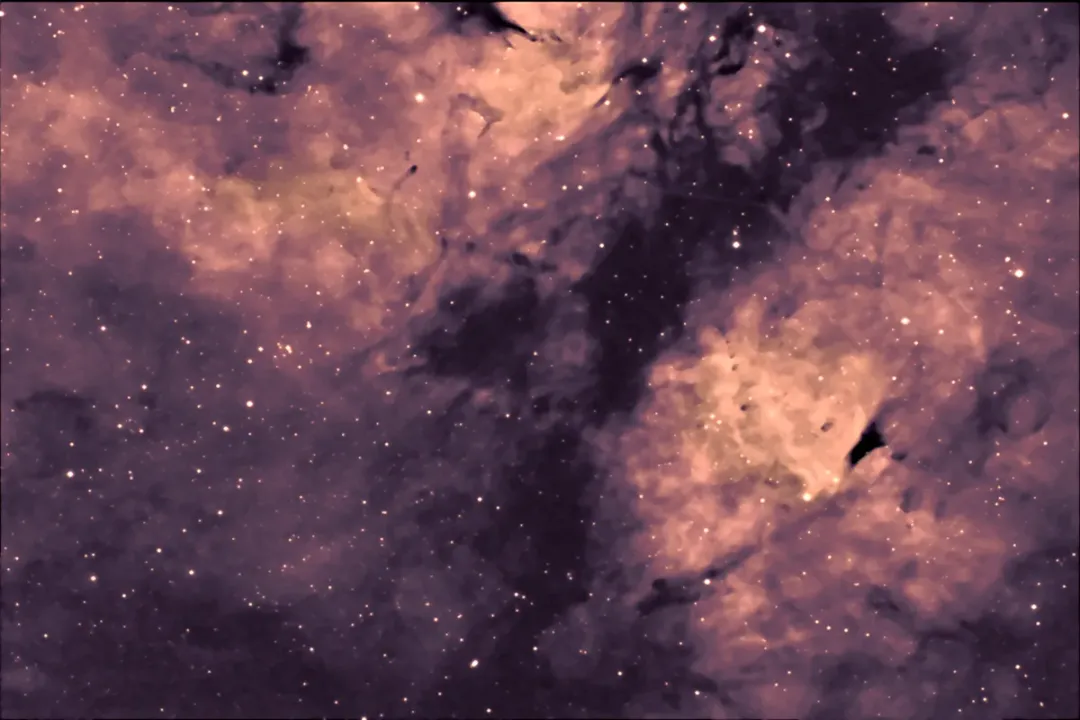
The fundamental reason a nebula appears dark is its composition and density relative to the background illumination. While other types of nebulae, such as emission nebulae, glow because their gas atoms are excited by nearby hot stars, dark nebulae do the exact opposite: they absorb or scatter the light that tries to pass through them. This process is known as extinction.
These clouds are primarily composed of interstellar dust mixed with gas, notably molecular hydrogen. The dust grains are microscopic particles, sometimes composed of silicates or carbon-based compounds, which are highly effective at blocking the shorter wavelengths of visible light. When we look at a dark nebula, we are seeing a massive, opaque curtain pulled across the starscape. This is why they are also sometimes referred to as absorption nebulae.
# Seeing Silhouettes
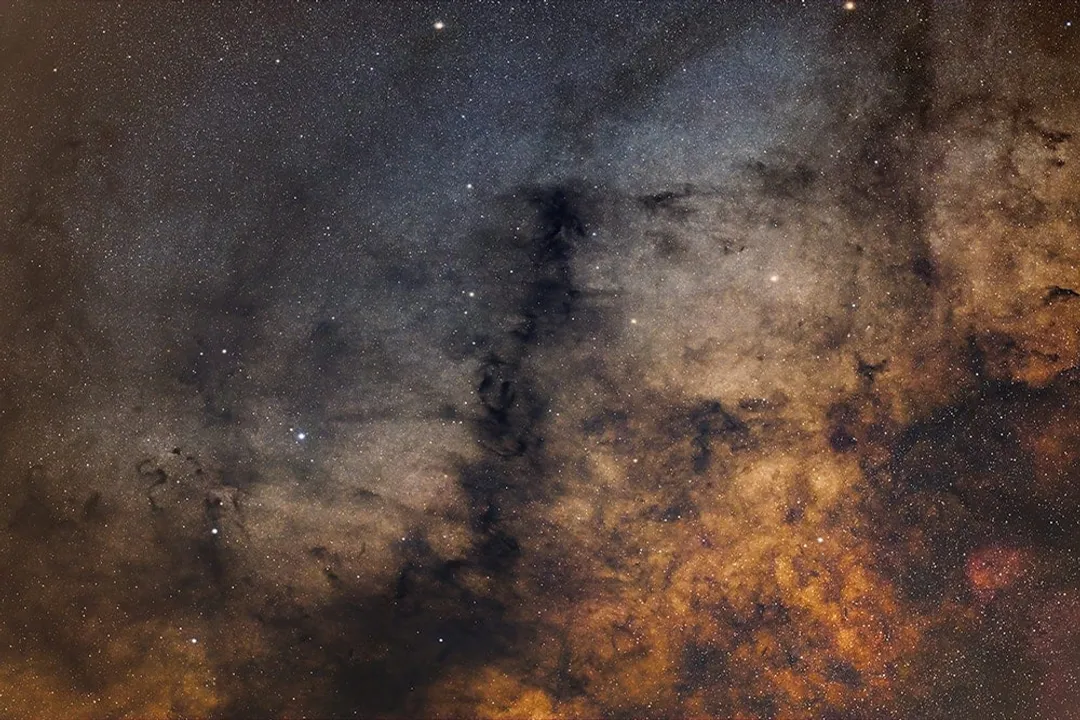
A dark nebula is rarely seen in complete isolation against the void of space. If they were positioned in front of empty space, they would be essentially invisible to optical telescopes. Their dramatic appearance arises when they are viewed against a brighter backdrop.
This backdrop can take a few forms:
- Star Fields: The nebula passes in front of the densely packed stars within the Milky Way’s galactic plane, creating a sharp contrast between the scattered pinpricks of light and the smooth, dark foreground cloud.
- Emission or Reflection Nebulae: Sometimes, a dark cloud is so close to a bright, glowing nebula that it appears as a stark, dark shape superimposed upon the bright emission or reflection cloud.
It is worth noting that while they block visible light, these dust clouds are not entirely opaque across the entire electromagnetic spectrum. They often emit their own radiation in the infrared region because the dust grains, warmed by surrounding starlight, glow faintly there. However, to the naked eye or standard optical telescopes, they remain stubbornly dark.
# Iconic Examples
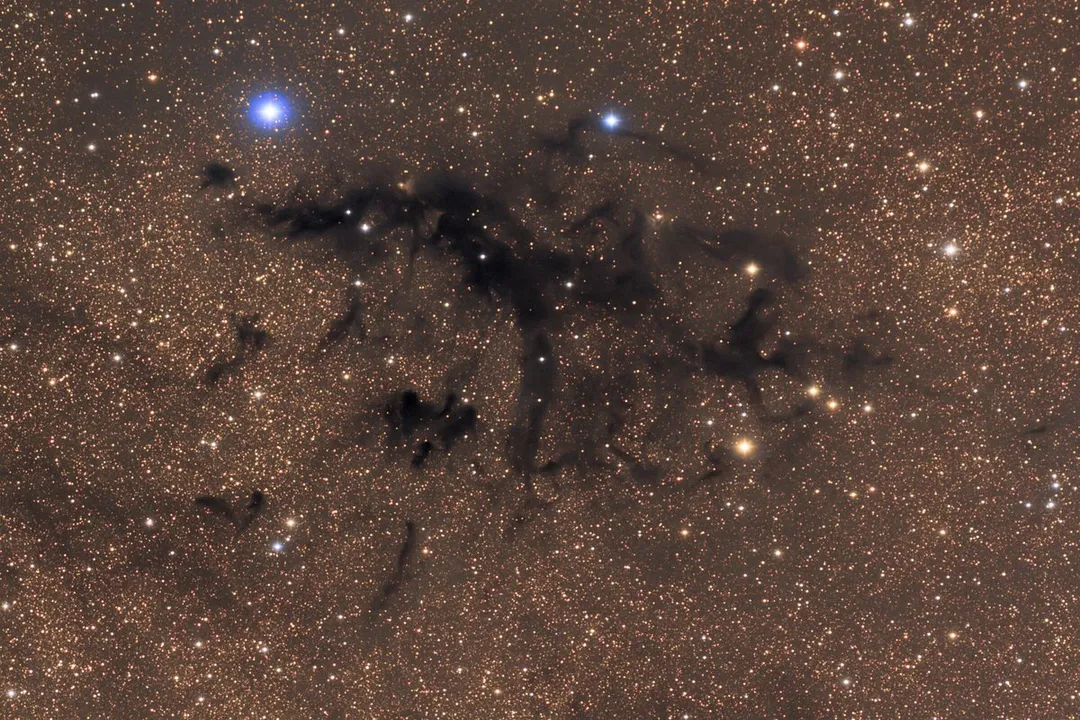
Astronomy boasts several iconic dark nebulae that are favorites among astrophotographers precisely because of their dramatic shapes defined by surrounding light.
The Horsehead Nebula is perhaps the most famous example. Formally cataloged as Barnard 33, it is a relatively small feature carved out of a much larger, sprawling molecular cloud complex known as the Orion Molecular Cloud Complex. Its distinctive profile is visible because it is silhouetted against the glowing red hydrogen gas of the emission nebula IC 434, which lies directly behind it.
Another well-known object is the Coalsack Nebula, visible to the naked eye in the Southern Hemisphere near the constellation Crux (the Southern Cross). It is one of the most prominent dark nebulae visible from Earth, appearing as a noticeable patch of sky devoid of the usual Milky Way glow. While large, spanning several degrees, it is relatively close to us, perhaps only about away.
# Structure and Scale
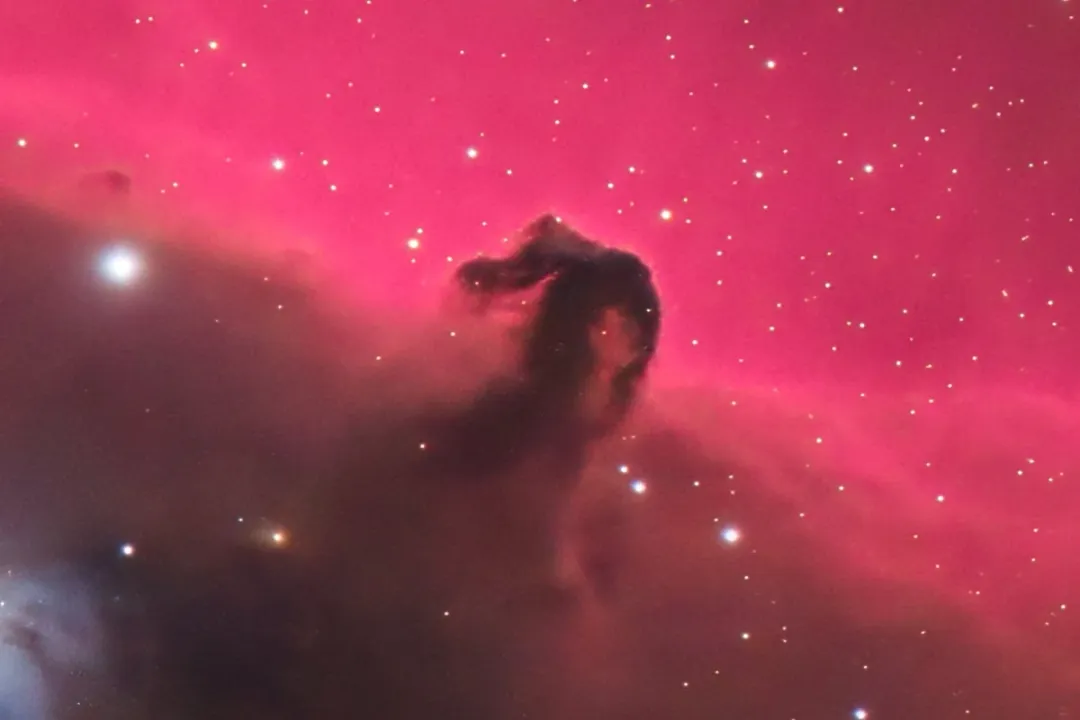
Dark nebulae are not uniform blobs; they possess intricate structures shaped by the violent and subtle forces acting within interstellar space. These structures, which can look like tendrils, wisps, or dense knots, are maintained by a combination of internal gravity, turbulence from stellar winds, and the influence of interstellar magnetic fields.
These clouds vary dramatically in size. While the Horsehead is a relatively localized feature, some dark nebulae can be immense, stretching across hundreds of light-years. Their sheer scale suggests they are significant reservoirs of the raw material needed for future stellar generations.
| Nebula Type | Primary Interaction with Visible Light | Typical Appearance | Energy Source |
|---|---|---|---|
| Emission Nebula | Emits light after gas is ionized | Glowing reds, pinks, or blues | Nearby hot, young stars |
| Reflection Nebula | Scatters starlight | Blueish glow | Nearby bright stars |
| Dark Nebula | Absorbs and scatters light | Black silhouette | Requires background source |
This table illustrates a key difference: emission and reflection nebulae need an immediate source of energy or illumination to be seen optically, whereas a dark nebula requires a bright source behind it to define its outline. If you were to remove all stars and bright nebulae from the background, a dark nebula would cease to be visible through absorption alone.
# Stellar Genesis Sites
The very properties that make these nebulae dark—their density and richness in gas and dust—also make them the primary breeding grounds for stars. Gravity acts on these dense clumps of material, causing them to contract. As the material collapses, the core heats up, eventually igniting nuclear fusion, and a new star is born.
Dark nebulae are therefore intrinsically linked to star formation. The Horsehead Nebula, for instance, is part of a vast cold gas cloud where stars are actively forming, even though the dark part itself is shielding us from the view of the youngest members embedded within its depths.
When observing these regions, astronomers often look for infrared signatures. The densest knots within the dark cloud—the places where gravity is winning the battle against internal pressure—are often warmer internally because the dust is heated by the slow compression or by newly formed protostars hidden within the opaque core.
# Visual Interpretation and Density Clues
For an amateur astronomer capturing these deep-sky objects, recognizing the context of a dark nebula can provide interesting visual context. Consider two dark clouds, both appearing equally black. If one is set against the sparse, distant stars of the galactic halo, and the other is set against the brilliant, dense star field near the galactic center, the apparent contrast changes significantly. A closer, moderately dense cloud will create a very sharp, clean edge against a busy background because it blocks a high percentage of the light coming from thousands of stars located behind it. A cloud of similar density but placed much farther away, behind a population of foreground stars, might appear fuzzier or less distinct against the same background panorama, as the intervening space itself has some minor obscuration. This phenomenon shows that while darkness indicates opacity, the sharpness of the edge can sometimes hint at the relative viewing geometry between the observer, the cloud, and the background illuminators.
Furthermore, the shapes within these clouds, often appearing like voids or tunnels, are not necessarily holes but rather areas where the overlying dust is thinner, allowing slightly more background light to peek through. The seemingly empty spaces between the dark filaments are often still dusty but are illuminated by a brighter, diffuse source behind them, making them look like faint reflection nebulae rather than true black voids. This subtle variation in background brightness against the black material highlights the complex three-dimensional geometry of these cosmic structures.
In summary, the mystery of dark nebulae dissolves when we realize they are not voids, but rather incredibly dense concentrations of stellar building blocks. They are the universe’s raw material, momentarily hidden in shadow because they are doing the critical work of absorbing light before they eventually become the bright beacons of new stars. They offer a profound look at the necessary stages of cosmic evolution that precede the spectacular light shows of their brighter, gaseous cousins.
#Videos
What Makes Parts Of Emission Nebulae Appear Dark? - YouTube
Related Questions
#Citations
Dark nebula - Wikipedia
Did you know about dark nebulas? : r/spaceporn - Reddit
Dark nebulae are clouds of gas and dust that block visible light ...
What Makes Parts Of Emission Nebulae Appear Dark? - YouTube
Dark Nebulae - APOD Index - NASA
Dark Nebula
Dark nebulae explained - BBC Sky at Night Magazine
What is a Dark Nebula? | Pictures, Key Facts, & Best Examples
Did we discover how nebulae hold their shapes?