What constitutes the immediate and visually striking aftermath known as a supernova remnant (SNR)?
Answer
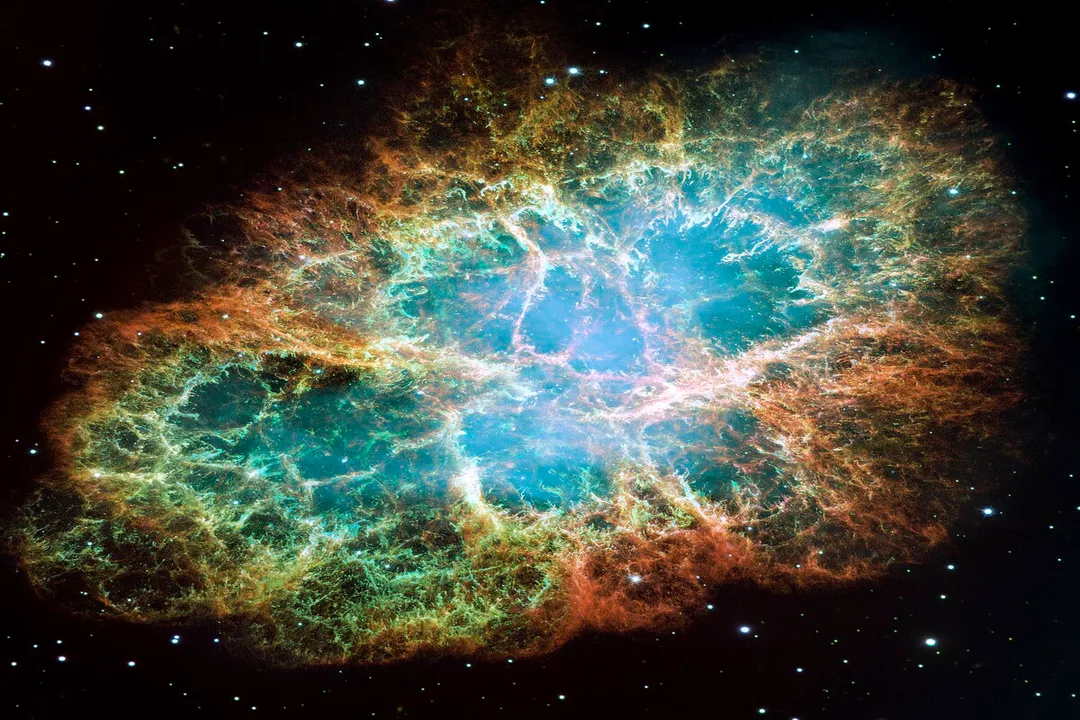
Expanding, illuminated cloud of ejected stellar material slamming into the ISM.
The supernova remnant (SNR) represents the visible, expanding aftermath of a massive star's violent death. It is formed when the stellar material ejected during the explosion slams into the surrounding interstellar medium (ISM). This collision creates a shockwave that heats the gas to millions of degrees, causing it to glow brightly. Although the initial explosion is instantaneous, this illuminated cloud structure can persist for tens of thousands of years as it slowly disperses and mixes with the galaxy.
#Videos
After A Supernova Event, What Is Left Behind? - Physics Frontier
Related Questions
What constitutes the immediate and visually striking aftermath known as a supernova remnant (SNR)?In which forms of electromagnetic radiation do Supernova Remnants (SNRs) glow intensely?What highly magnetized, rapidly spinning stellar object can sometimes be found at the center of a core-collapse supernova remnant?What is the expected core remnant difference between a Type II and a Type Ia supernova event?What specific physical force halts the collapse of a core remnant below roughly $3 M_{\odot}$ to form a neutron star?What condition causes a stellar core to collapse completely into a black hole instead of stabilizing as a neutron star?Which elements are primarily forged under the immense energies available only during a supernova explosion?How long might it take for the ejected material from a supernova blast to become fully homogenized into the general galactic gas reservoir?During a core-collapse supernova, what physical event causes the initial shockwave that blasts out the star's outer layers?What density analogy is used to describe the extreme compression characteristic of neutron star material?