How long might it take for the ejected material from a supernova blast to become fully homogenized into the general galactic gas reservoir?
Answer
Several million years.
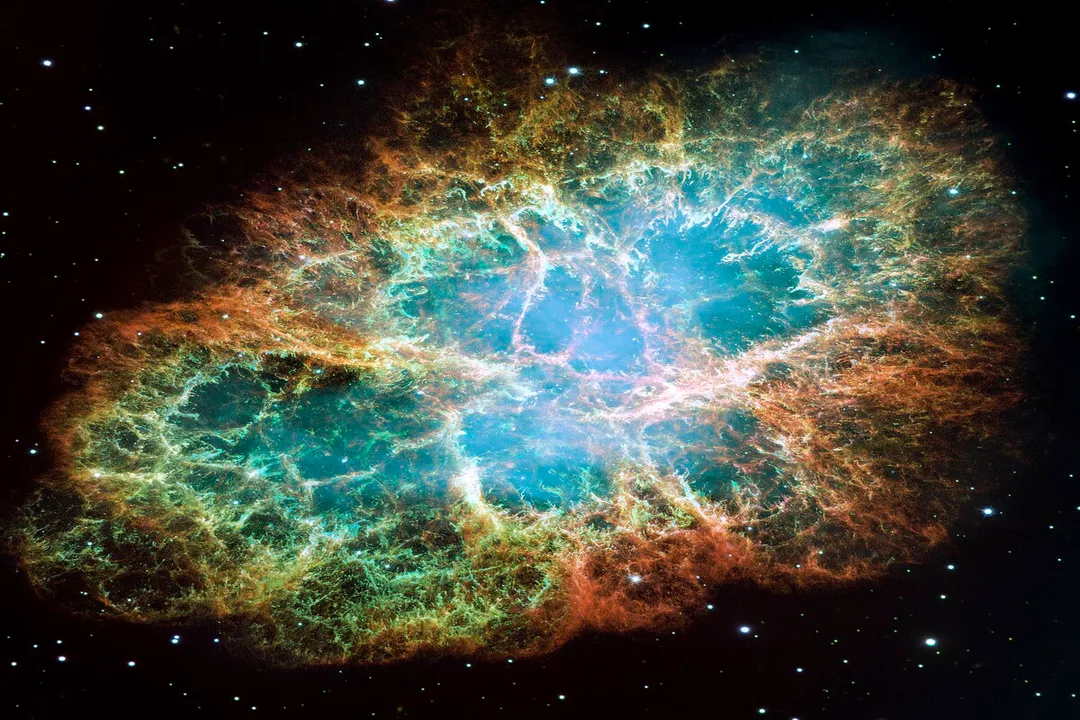
Although the visible supernova remnant (SNR) fades significantly and the blast's kinetic energy drives enriched material outward within tens of thousands of years, the process of complete chemical integration into the galaxy is far longer. The enriched material must travel vast distances and mix thoroughly with pre-existing clouds of gas and dust. This homogenization process, whereby the signature of the single explosion becomes fully diffused throughout the general galactic reservoir, is estimated to take several million years to complete.
#Videos
After A Supernova Event, What Is Left Behind? - Physics Frontier
Related Questions
What constitutes the immediate and visually striking aftermath known as a supernova remnant (SNR)?In which forms of electromagnetic radiation do Supernova Remnants (SNRs) glow intensely?What highly magnetized, rapidly spinning stellar object can sometimes be found at the center of a core-collapse supernova remnant?What is the expected core remnant difference between a Type II and a Type Ia supernova event?What specific physical force halts the collapse of a core remnant below roughly $3 M_{\odot}$ to form a neutron star?What condition causes a stellar core to collapse completely into a black hole instead of stabilizing as a neutron star?Which elements are primarily forged under the immense energies available only during a supernova explosion?How long might it take for the ejected material from a supernova blast to become fully homogenized into the general galactic gas reservoir?During a core-collapse supernova, what physical event causes the initial shockwave that blasts out the star's outer layers?What density analogy is used to describe the extreme compression characteristic of neutron star material?