What condition causes a stellar core to collapse completely into a black hole instead of stabilizing as a neutron star?
Answer
The core mass exceeding approximately $3 M_{\odot}$.
The ultimate fate of a collapsed stellar core depends on its final mass exceeding a critical threshold. If the mass of the core surpasses roughly three times the mass of our Sun ($3 M_{\odot}$), the force of gravity becomes overwhelming. At this point, even the immense resistance provided by neutron degeneracy pressure is insufficient to counteract the inward crush. Consequently, the core collapses indefinitely, compressing the matter to infinite density and forming a singularity enclosed by an event horizon—a black hole.
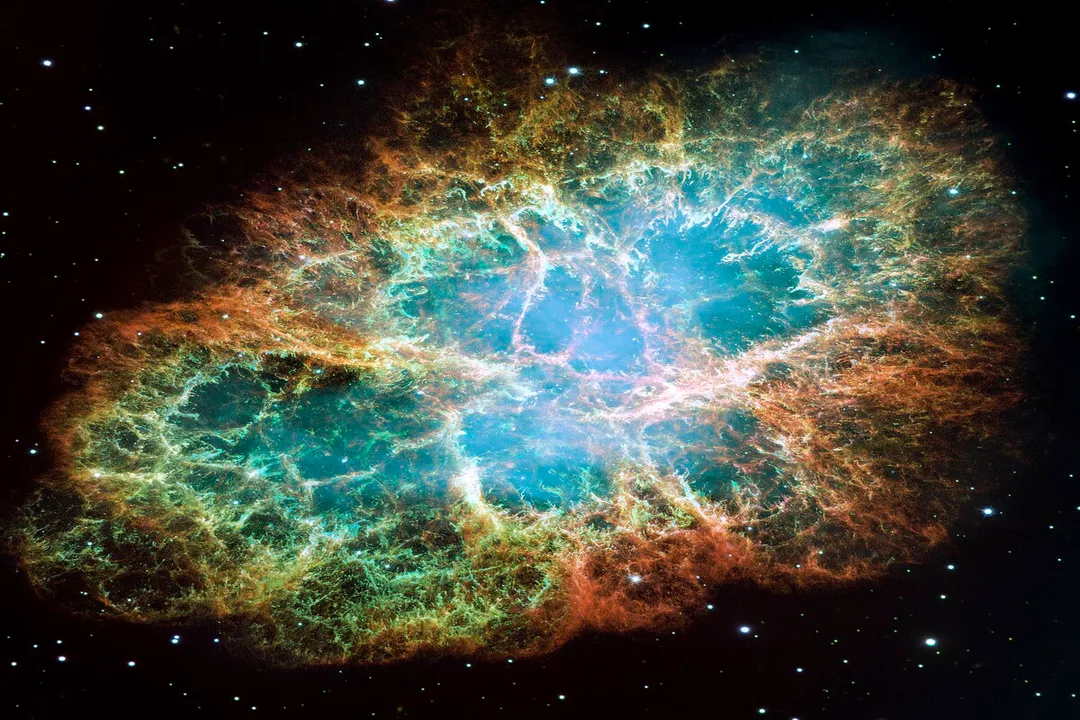
#Videos
After A Supernova Event, What Is Left Behind? - Physics Frontier
Related Questions
What constitutes the immediate and visually striking aftermath known as a supernova remnant (SNR)?In which forms of electromagnetic radiation do Supernova Remnants (SNRs) glow intensely?What highly magnetized, rapidly spinning stellar object can sometimes be found at the center of a core-collapse supernova remnant?What is the expected core remnant difference between a Type II and a Type Ia supernova event?What specific physical force halts the collapse of a core remnant below roughly $3 M_{\odot}$ to form a neutron star?What condition causes a stellar core to collapse completely into a black hole instead of stabilizing as a neutron star?Which elements are primarily forged under the immense energies available only during a supernova explosion?How long might it take for the ejected material from a supernova blast to become fully homogenized into the general galactic gas reservoir?During a core-collapse supernova, what physical event causes the initial shockwave that blasts out the star's outer layers?What density analogy is used to describe the extreme compression characteristic of neutron star material?