What crucial information is required to convert the angular separation measured for a visual binary into the physical semi-major axis ($a$) needed for the mass calculation?
Answer
The distance to the binary system, typically determined through stellar parallax measurements.
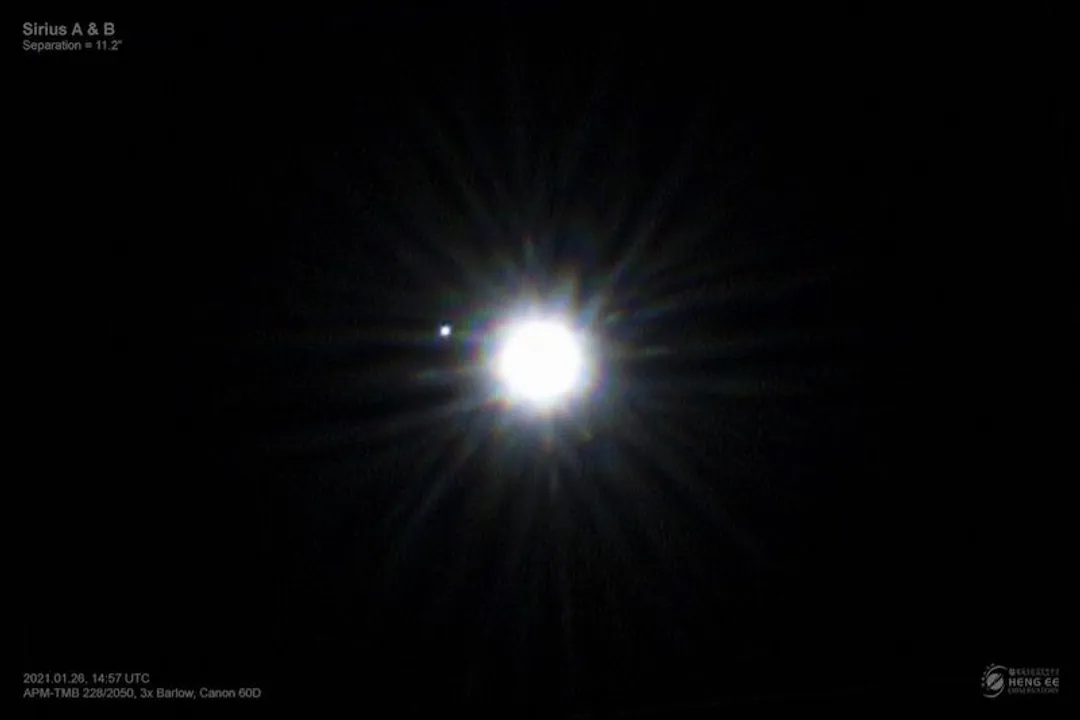
Angular separation measured in arcseconds must be converted into a physical distance in astronomical units (AU) before being used in the mass calculation, a conversion that necessitates knowing the system's distance, usually found via stellar parallax.
Related Questions
What primarily allows astronomers to determine the mass of most stars, including our Sun?What is the formula used to calculate the total mass ($M_1 + M_2$) of a binary system based on the refined Kepler's Third Law?How is the mass ratio ($
rac{M_2}{M_1}$) of two stars related to the semi-major axes ($a_1$ and $a_2$) of their relative orbits around the center of mass?What crucial information is required to convert the angular separation measured for a visual binary into the physical semi-major axis ($a$) needed for the mass calculation?Spectroscopic binaries rely on measuring spectral line shifts to determine orbital velocity. Which physical phenomenon causes these shifts?What is the major limitation when calculating the mass of components in a purely spectroscopic binary system?How does an eclipsing binary system resolve the inclination uncertainty that plagues standard spectroscopic binaries?What important physical characteristic of the stars, besides the orbital period, is determined by analyzing the timing of eclipses in a light curve?When combining dynamically derived mass measurements with observable properties like luminosity and temperature, what does a strong alignment between these data points confirm?For both visual and spectroscopic methods, what ultimately dictates the precision of the final calculated stellar mass?