What composition is hypothesized for the ancient liquid material whose freezing and expansion may have formed Mercury's chaotic terrain?
Answer
Salty liquid water or brine
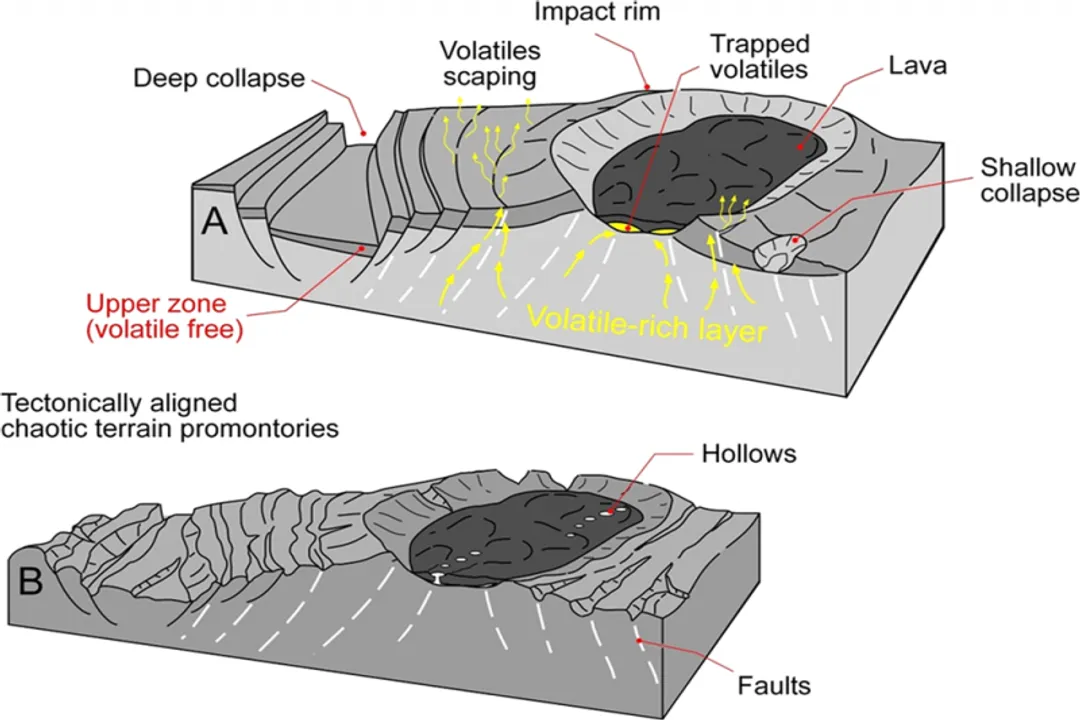
The chaotic terrain observed beneath Mercury's surface, marked by jumbled blocks and depressions, is theorized to have formed due to the freezing and subsequent expansion of material that once existed deep beneath the crust. The leading hypothesis posits that this material was ancient, salty liquid water or brine. If this interpretation is accurate, it suggests Mercury once had substantial subsurface liquid reservoirs. Such a sustained, insulated liquid environment could have provided a stable thermal regime, potentially allowing microbial life to arise or persist for a duration that surface conditions could never support.
Related Questions
What is Mercury's specific spin-orbit resonance relative to its orbit around the Sun?What valuable accessible resource is preserved in Mercury's Permanently Shadowed Regions (PSRs)?What subsurface feature observed by the MESSENGER mission suggests ancient liquid reservoirs?What is the official term used to describe Mercury's incredibly thin atmosphere?What is the approximate temperature range experienced between day and night on Mercury's surface?Why is building self-sustaining biospheres utilizing local materials preferable to planetary terraforming on Mercury?What characteristic of Mercury, related to its axial tilt, enables the existence of Permanently Shadowed Regions (PSRs)?What composition is hypothesized for the ancient liquid material whose freezing and expansion may have formed Mercury's chaotic terrain?Unlike habitats on Mars, why must underground structures on Mercury function as entirely self-contained pressure vessels, even when buried deep?Besides intense heat, what environmental factor makes Mercury's surface hostile due to the near-total lack of atmosphere?