What elements classify Saturn as a gas giant, similar to Jupiter, rather than an ice giant?
Answer
Its primary constituents are much lighter elements, mainly hydrogen and helium.
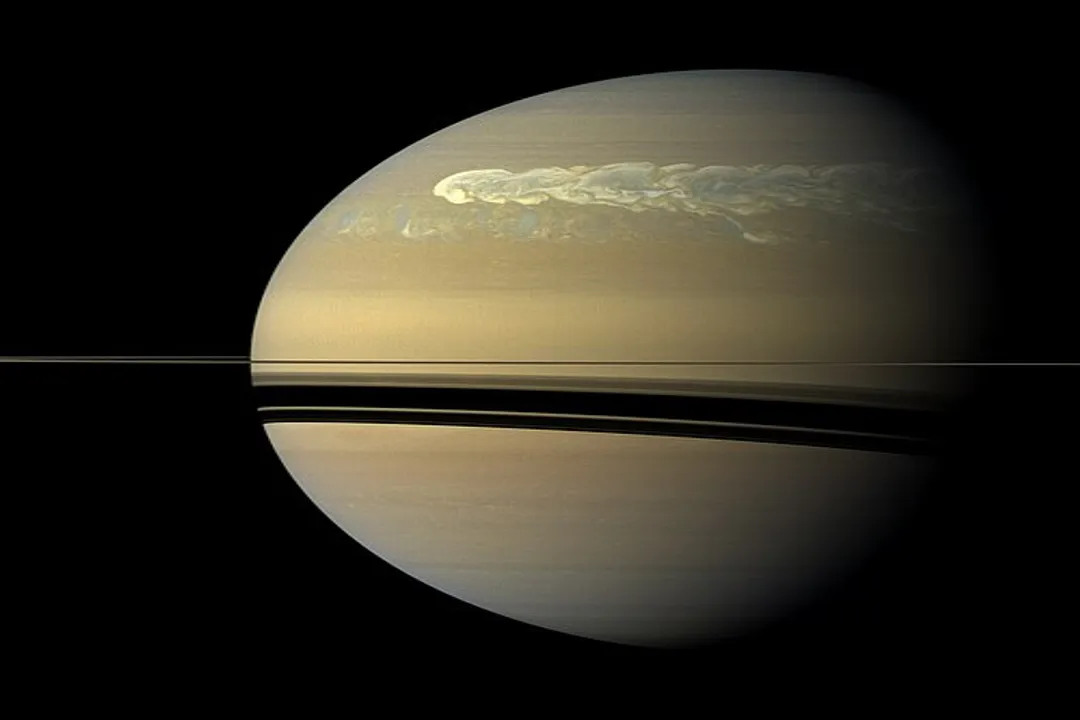
Saturn, like Jupiter, falls into the category of gas giants because its bulk composition is overwhelmingly dominated by the lightest elements in the universe: hydrogen and helium. This contrasts sharply with Uranus and Neptune, where the internal mass budget is heavily weighted toward heavier molecules referred to as ices (water, methane, ammonia). Although Saturn does contain trace amounts of these heavier volatiles deep inside, its overall mass distribution classifies it firmly as a gas giant, defined by its hydrogen and helium dominance.
Related Questions
What characterizes the interior composition of Uranus and Neptune compared to Jupiter and Saturn?What specific volatile ices primarily constitute the hot, dense fluid mantle surrounding the core of Uranus and Neptune?What elements classify Saturn as a gas giant, similar to Jupiter, rather than an ice giant?What feature of Saturn is most closely associated with the description of ice and dust content?How do the volatile ices in the mantle of Uranus and Neptune exist under immense internal pressure and temperature?Why are Saturn's rings extremely bright and reflective when compared to the faint ring systems of Uranus and Neptune?What specific orbital characteristic distinguishes Uranus among the Ice Giants?What substances are included in the broad definition of 'ice' used in planetary science for the outer solar system giants?What characterizes the faint, dark rings of Neptune, contrasting with Saturn's bright structure?When considering the bulk structure, which classification is used to define Uranus or Neptune as being 'most defined by ice overall'?