What is the dust tail of a comet made up of?
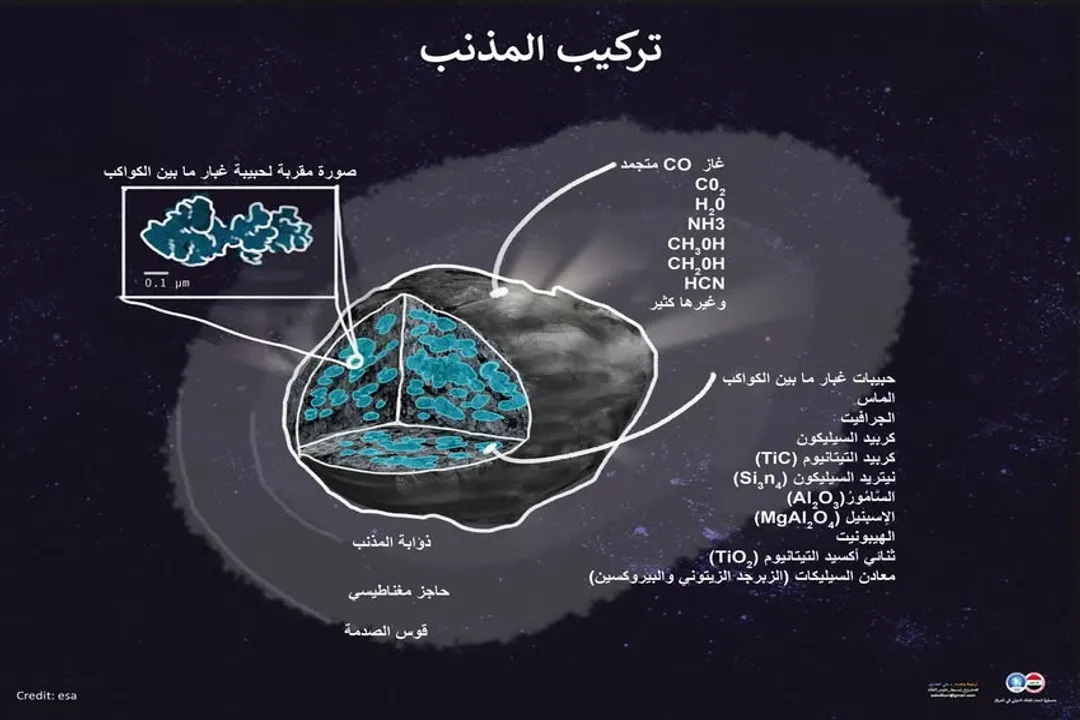
Comets occupy a unique place in our solar system, appearing as transient, glowing spectacles that have fascinated humanity for millennia. Often referred to as "dirty snowballs," these celestial bodies are composed of ice, dust, and rock. [7] As a comet approaches the sun, heat causes the ices within its nucleus to sublimate—turning directly from solid to gas. [2] This process releases trapped dust particles, creating the magnificent tails that define a comet’s appearance in the night sky. [6] While the ion tail is a common sight, the dust tail is a distinct feature, offering a specific window into the materials that formed the early solar system.
# Dust Composition
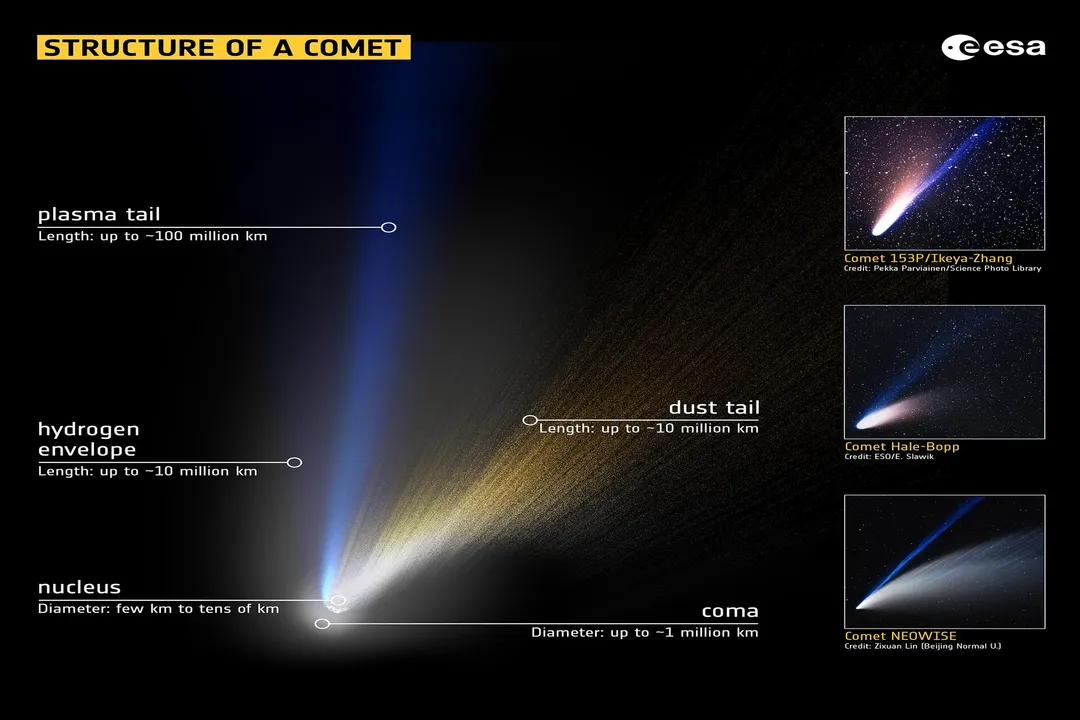
The dust tail consists primarily of small, solid particles ejected from the nucleus of the comet. [4] These grains are typically composed of silicates—essentially microscopic bits of rock and mineral—along with various organic compounds and carbon-based materials. [3][6] Unlike the gas tail, which is composed of ionized particles influenced by magnetic fields, the dust tail is entirely material in nature. [1] These particles range significantly in size, often measuring from micrometers to millimeters in diameter. [9] Because they are solid matter, they do not dissolve or disperse like gas molecules; instead, they trail behind the comet, following its orbital path.
# Radiation Pressure
The formation of the dust tail relies on a phenomenon known as radiation pressure. [1][4] Sunlight, while composed of waves of energy, also exerts a physical push against objects it strikes. [9] When sunlight hits the tiny dust grains released by the comet, it imparts a force that pushes them away from the sun. [5] Because the dust particles are relatively heavy compared to the ions in the gas tail, they respond more slowly to this force. [4] Consequently, the dust tail does not point directly away from the sun like the ion tail; instead, it lags behind, creating a distinctive, curved appearance. [9] This curve is a visual record of the comet's recent orbital history, as the particles remain in the orbit of the comet for some time before dispersing into the zodiacal cloud. [3][4]
# Tail Comparisons
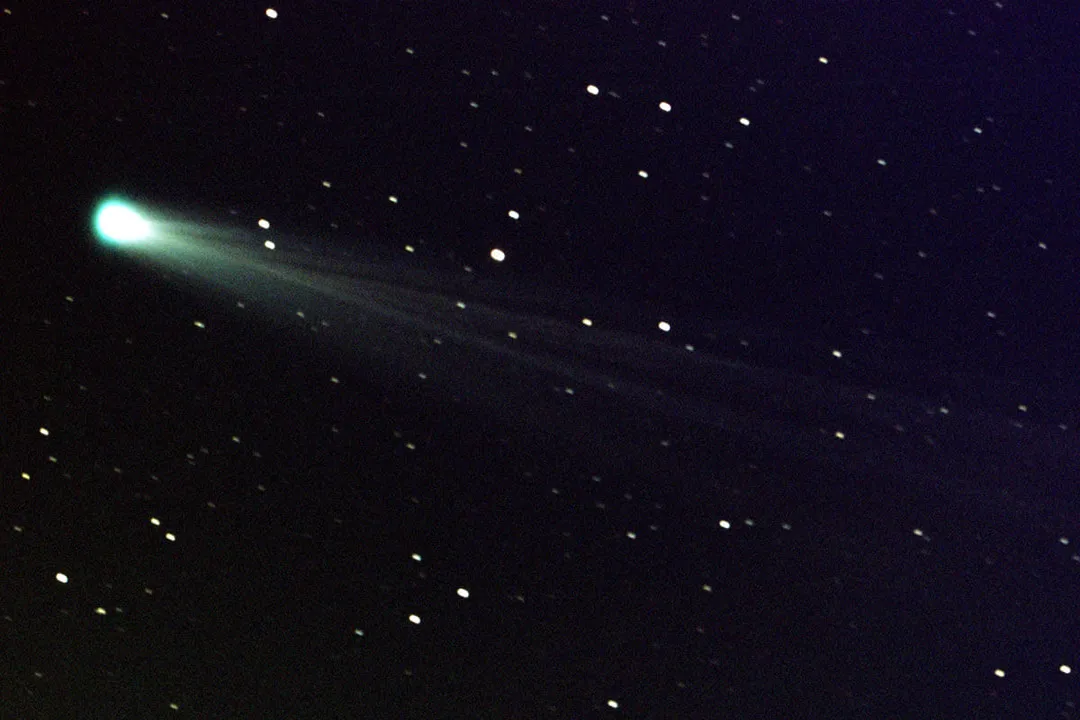
To understand the differences between the two main types of tails, it is helpful to look at their physical and visual properties. The following table provides a quick reference for these distinctions.
| Feature | Dust Tail | Ion (Plasma) Tail |
|---|---|---|
| Composition | Solid dust, silicates, organics | Ionized gas (molecules like CO+) |
| Appearance | Curved, yellowish-white | Straight, blue |
| Primary Driver | Solar radiation pressure | Solar wind (magnetic interaction) |
| Persistence | Remains in orbit | Dissipates quickly |
# Visual Properties
The yellowish hue of the dust tail is a direct result of its composition. [3] These solid particles scatter sunlight efficiently across the spectrum, reflecting the light of the sun rather than emitting their own. [4] In contrast, the blue appearance of the ion tail comes from the fluorescence of ionized gases, which emit their own light when excited by solar radiation. [7] Observers watching a comet pass through the inner solar system often see these two tails separated into distinct streamers. [2] The dust tail usually appears wider and more diffuse, while the ion tail is often narrower and more dynamic, changing rapidly in response to solar wind gusts. [1]
# Orbital History
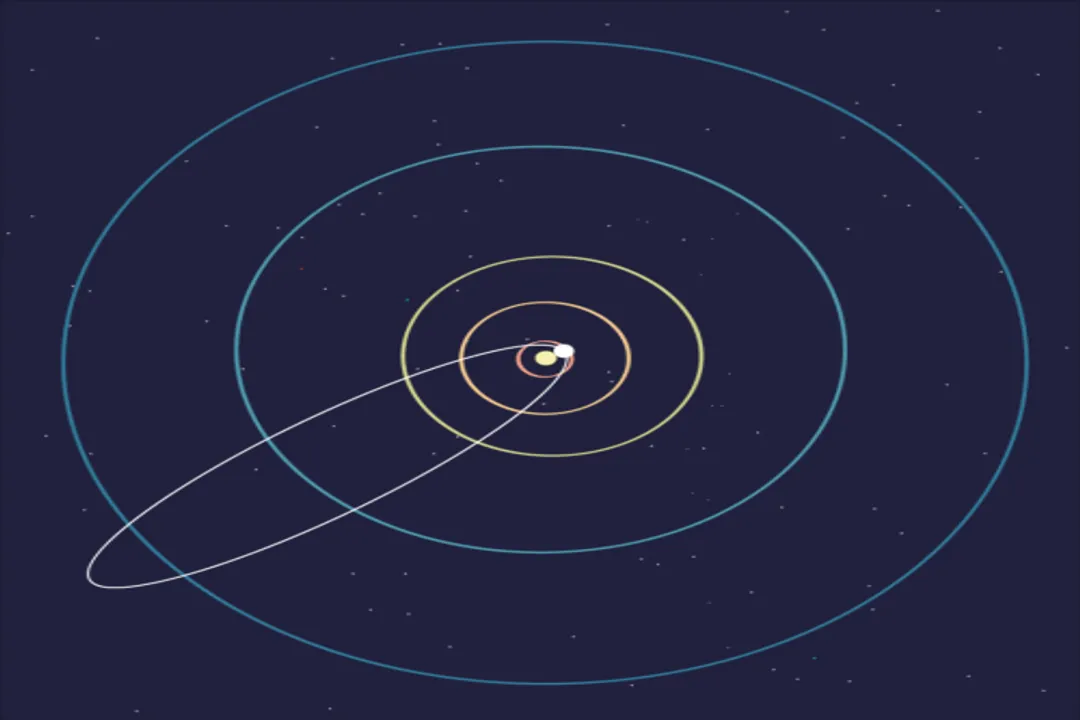
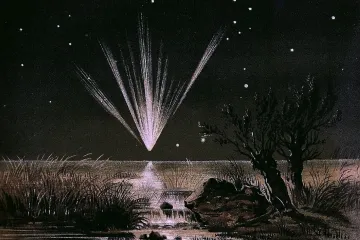
One of the most fascinating aspects of the dust tail is that it acts as a permanent record of the comet’s activity. When a comet passes the sun, it leaves a trail of debris along its orbital path. [6] Even after the comet has moved on, these dust grains continue to orbit the sun in the same path for thousands of years. [3] When Earth passes through these old, abandoned trails, we experience meteor showers. [7] These events are essentially Earth colliding with the "ghost" of a comet’s dust tail. Studying the composition of these trails helps astronomers understand the chemical makeup of the primitive solar system, as these grains have remained largely unchanged since their formation. [10]
# Analyzing Particles
While the tail appears as a single, coherent structure from the perspective of Earth, it is actually a massive collection of discrete particles. If one were to analyze the density of a comet's tail, it would be remarkably low—far thinner than the air we breathe on Earth. [5] Despite this, the sheer volume of space covered by the tail, stretching millions of kilometers, makes it visible over vast distances. The interaction between the sun's photons and these individual grains is subtle but relentless, acting as a constant stream of "light pressure" that shapes the tail's geometry over time. [8] This geometry reveals the size distribution of the dust: smaller particles are pushed away more easily, while larger, heavier grains stay closer to the orbital path of the comet nucleus. [4]
# Tail Separation
The separation of the dust and ion tails is not merely a visual quirk; it is a fundamental demonstration of physics in space. The ion tail is dominated by the solar wind, a stream of charged particles flowing from the sun, which drags the ionized gases directly away from the sun. [1] The dust tail, governed by radiation pressure, cares little for the magnetic influence of the solar wind and obeys the laws of inertia and light pressure instead. [5] This leads to the "fan-shaped" look of many famous comets, where the straight ion tail and the curved dust tail diverge. [9] By observing this divergence, scientists can determine the current state of solar activity, as the ion tail will shift its angle instantly with solar wind changes, while the dust tail remains relatively static, anchored by the mass of its grains. [10]
#Videos
Nobody Understands This About Comets
Related Questions
#Citations
Comet tail
ESA - Structure of a comet
4.2.8 A comet's tail - In the night sky: Orion
Cometary Dust Tail | COSMOS
Canon Science Lab | Why Do Comets Have Tails?
Making Heads and Tails of a Comet's Structure
What Is a Comet?
Nobody Understands This About Comets
Dust tail | comet
The Composition of a Comet As part of the “Simplifying ...