If a star orbits at 50,000 light-years, how should its speed compare to a star at 10,000 light-years in a purely visible matter model?
The star orbiting at 50,000 light-years should be moving significantly slower than the one at 10,000 light-years.
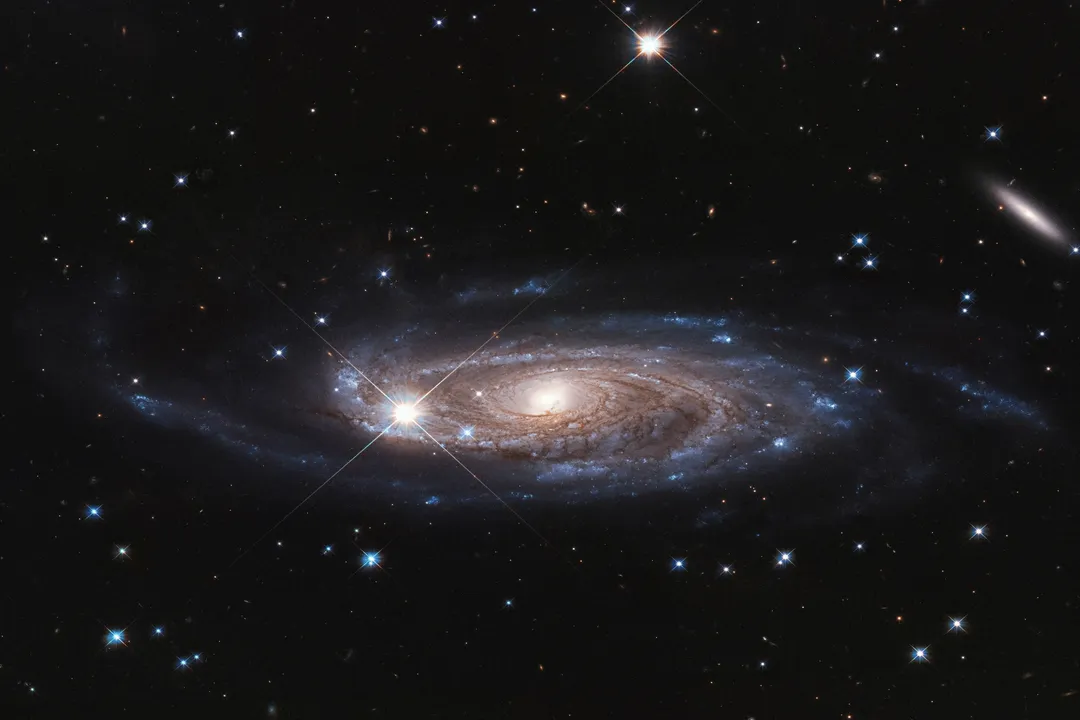
In a galaxy whose gravity is determined solely by its visible stellar mass distribution—where mass is centrally concentrated—the orbital velocity follows Keplerian principles. This means that as the radius ($R$) increases significantly beyond the main concentration of mass, the required velocity ($v$) must decrease ($ u \propto 1/\sqrt{R}$). Therefore, if one star is five times farther out (50,000 vs. 10,000 light-years), its gravitational environment, based only on visible components, dictates that it must be moving substantially slower than the star closer to the galactic center. The fact that observations show they are moving at nearly the same high speed is the core evidence requiring mass to continue accumulating far past the visible edge.
#Videos
Dark Matter: The Math Behind Galaxy Rotation Curves - YouTube