What are the galactic coordinates of Earth?
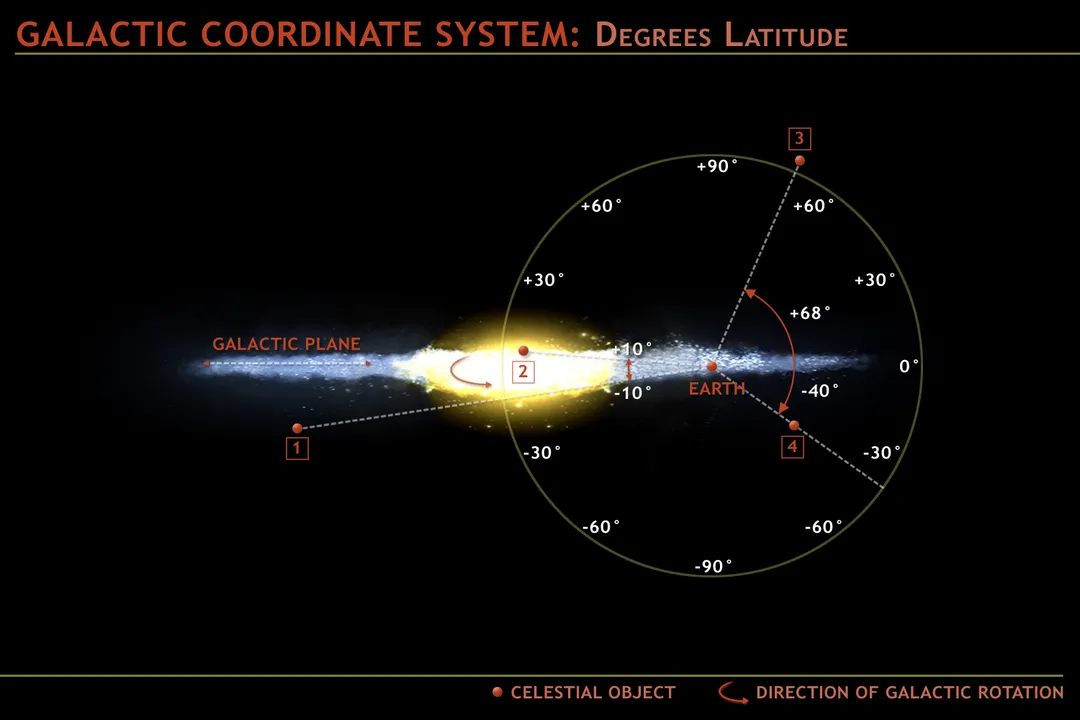
The Milky Way galaxy is our cosmic home, yet describing our precise location within it is far more complex than citing our address on Earth. When astronomers speak of Earth’s position in the sky, they usually default to the Equatorial Coordinate System, which uses the celestial equator and poles, much like latitude and longitude on our planet, referencing fixed points relative to the Earth’s orientation. [6] However, to truly map the structure of our galaxy, a coordinate system based on the galaxy itself is necessary—this is where the Galactic Coordinate System (GCS) comes into play. [5]
# System Definition
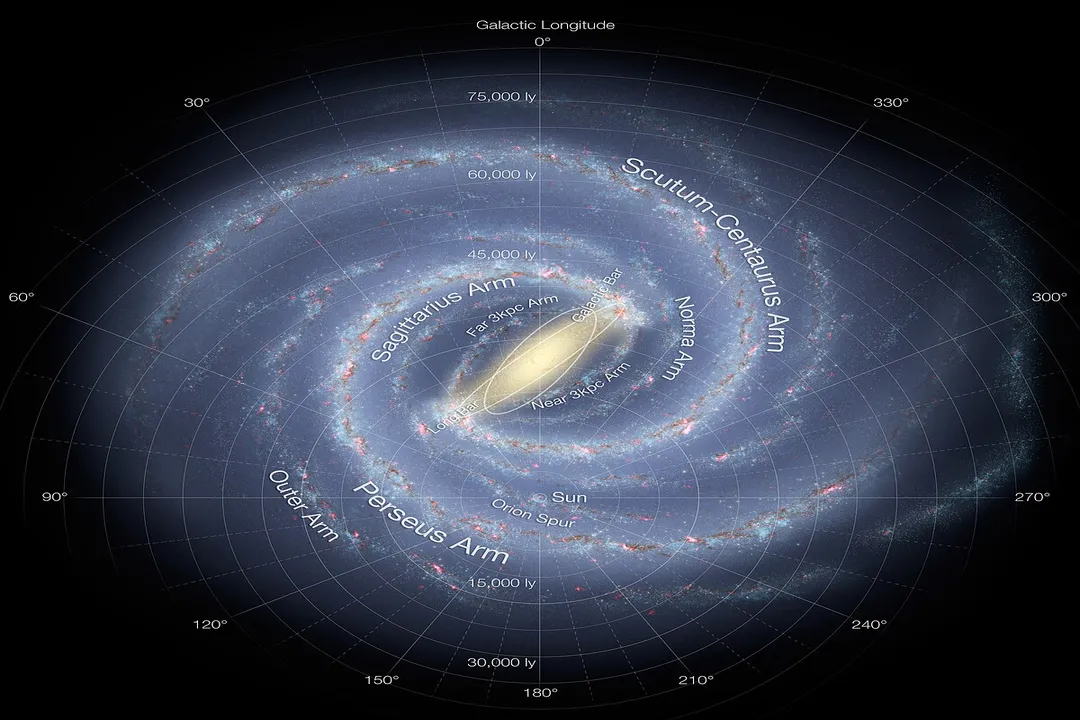
The Galactic Coordinate System establishes its own frame of reference defined by the structure of the Milky Way. [2] Imagine standing on the surface of Earth and using the equator as your line for latitude; in the GCS, the equivalent reference plane is the Galactic Plane. [5] This plane is determined by the distribution of gas and dust within our galaxy, representing the disk where most of the stellar material resides. [2][3]
The system uses two main angular measures, analogous to latitude and longitude: Galactic Longitude () and Galactic Latitude (). [1][2]
Galactic Latitude () is measured north or south from the Galactic Plane. [2] A celestial object lying directly in the plane has a latitude of . [4] Moving toward the North Galactic Pole results in positive latitude values, while moving toward the South Galactic Pole yields negative values. [2][5] The poles themselves are located at and latitude. [2]
Galactic Longitude () measures the angular distance around the galaxy within the Galactic Plane. [5] The starting point, or longitude, is defined as the direction pointing toward the Galactic Center. [2][5] This direction is critically important because the Galactic Center is the accepted origin for this entire coordinate scheme. [2] Longitude increases as one moves counter-clockwise around the plane when viewed from above the North Galactic Pole, reaching (or ). [2][5]
Contrast this with the Equatorial System, which uses Declination (north/south of the celestial equator) and Right Ascension (eastward distance from the Vernal Equinox). [6] The key difference is that the GCS is intrinsic to the Milky Way's morphology, whereas the ECS is extrinsic, tied to our planet's rotation and axial tilt. [6]
# Earth’s Location

When we place the Sun, which is the reference point for our local neighborhood, into this galactic context, its coordinates are fixed relative to the Galactic Center. [1] Since the Sun resides very close to the mid-plane of the Milky Way's disk, its Galactic Latitude () is extremely close to zero degrees. [4]
For the Sun, the Galactic Latitude () is approximately . [4]
Determining the Galactic Longitude () requires knowing precisely where the Galactic Center is located in the sky as viewed from Earth. This direction is established in the Equatorial Coordinate System and is currently accepted as being in the direction of the constellation Sagittarius. [2][5] The Sun's Galactic Longitude () is conventionally defined such that the direction toward the Galactic Center corresponds to . [2] Therefore, the location of the Sun is found by measuring the angular separation away from that mark. [1]
Sources indicate that the Sun's Galactic Longitude () is approximately to . [1][4] If we use the standard convention where longitude increases from to moving away from the Galactic Center, the Sun is located roughly away from the center in the direction of increasing longitude. [4] This places our solar system in a specific sector relative to the Milky Way’s core, making the Sun’s position a known reference point for mapping galactic objects that are far from us. [3]
To illustrate this local framing, consider that if you were looking in the direction of , you would be staring directly toward the dense core of our galaxy, likely obscured by dust clouds but visible in radio or infrared wavelengths. [10] Conversely, looking toward would mean looking toward the opposite side of the galaxy, or the anti-center, likely through less dense regions of the disk. [2]
# Galactic Parameters
Establishing a coordinate system requires more than just defining the axes; it requires fixing fundamental constants related to the origin point. The Galactic Center is not a single star but the inferred gravitational center of the galaxy. [2] Defining its exact position and the Sun's distance from it has required decades of astronomical measurement and refinement. [3]
The zero point of the GCS is defined by the location of the Sagittarius A ()* radio source, which is the compact object believed to be the supermassive black hole at the very heart of the Milky Way. [2]
A crucial parameter in this system is , the distance from the Sun to the Galactic Center. Various measurements place this distance, , in the range of approximately $7.9$ to $8.5$ kiloparsecs (kpc). [2] A kiloparsec is $1,000$ parsecs, and one parsec is about $3.26$ light-years, meaning the Galactic Center is roughly $25,700$ to $27,700$ light-years away. [2] This distance sets the scale for all other galactic coordinates expressed in kpc.
Furthermore, the GCS must account for our own movement. The Sun, along with the entire Local Bubble of stars surrounding it, is orbiting the Galactic Center. [3] The solar motion relative to the nearby stars—the Local Standard of Rest (LSR)—is often used as the reference for local measurements. [3] This local movement is typically quantified as a velocity of around $220$ kilometers per second (km/s) in its orbit around the galaxy, which is a staggering speed that defines our experience within the galactic environment. [7]
# Navigating the Disk
Understanding where Earth (or the Sun) sits relative to the Galactic Plane and the Center gives context to nearly every observation made outside our solar system. [3] For instance, objects that appear near are located near or within the galactic disk, where star formation is abundant, and interstellar medium density is high. [3] Objects with high || values are seen above or below the main spiral arms, often revealing older star populations or globular clusters located in the galactic halo. [2]
An interesting way to contextualize this is to consider how the view changes depending on the coordinate system. In the familiar Equatorial system, the Milky Way appears as a broad band stretching across the sky, passing through constellations like Cygnus, Sagittarius, and Orion. [6] This visual appearance is a direct result of our perspective from the plane. [2] If we switch to the GCS, the entire band of the Milky Way becomes the line, and our primary task is to measure how far north () or south () an object deviates from that central river of stars, with longitude () telling us if it's closer to the core () or the far side (). [5]
If we were able to view the galaxy from an external vantage point, our Sun would appear at a specific set of coordinates, with and , positioned roughly two-thirds of the way out from the center along one of the spiral arms. [9] This external view highlights that our location is not central but rather peripheral within the main galactic structure. [9] Thinking about the structure this way—using the galaxy’s inherent geometry rather than our planet’s—is essential for mapping the vast spiral arms. [3] For example, identifying the Perseus arm or the Scutum-Centaurus arm relies on observing how objects cluster in longitude, which is then used to model the overall spiral pattern. [3]

# System Comparisons
The choice between coordinate systems depends entirely on the astronomical question being asked. The Equatorial Coordinate System is excellent for cataloging and observation scheduling from Earth because its orientation is fixed relative to the ground-based telescope. [6] It is the system used for most day-to-day positional astronomy.
However, when studying the large-scale architecture of the Milky Way, such as mapping dust lanes, measuring the rotation curve, or determining the distribution of specific stellar populations across the galactic disk, the GCS is indispensable. [2][3]
Here is a quick comparison of the two primary angular reference systems:
| Feature | Equatorial Coordinate System (ECS) | Galactic Coordinate System (GCS) |
|---|---|---|
| Primary Reference Plane | Celestial Equator | Galactic Plane (defined by dust/gas) [2] |
| Angular Measures | Declination () and Right Ascension () [6] | Latitude () and Longitude () [5] |
| Zero Point (Longitude/RA) | Vernal Equinox | Galactic Center (Sgr A*) [2] |
| Earth/Sun Position | Varies by time/date (Right Ascension) | Fixed at , [4] |
| Primary Utility | Earth-based observation, local position reference [6] | Mapping galactic structure, stellar distribution [3] |
The translation between these two systems is a matter of simple, though sometimes tedious, spherical trigonometry, requiring established constants like the obliquity of the ecliptic and the precise location of the Galactic Center in ECS coordinates. [8] For instance, the transformation involves rotating the coordinate axes by a specific angle, defined by the position of the Galactic North Pole in the ECS. [8] This conversion is necessary because while we observe objects in ECS, we need their GCS equivalents to compare them to models of galactic rotation. [8]
It is worth noting that a third standard exists, the Supergalactic Coordinate System, which orients itself based on the local supercluster structure—the Laniakea Supercluster—rather than the immediate spiral arms of the Milky Way. [7] While the GCS locates us within the spiral structure, the Supergalactic system locates the Milky Way within the larger local group of galaxies. [7]
The precise, near-zero Galactic Latitude of the Sun is an astronomical coincidence based on our formation history within the disk. [9] If the Sun had formed much earlier or later, or in a more vertically extended stellar halo population, our value would be significantly non-zero, and the zero-point for our local galactic mapping efforts would be slightly different relative to the established plane. [2] This dependency on the Sun’s local context highlights why the GCS, once defined by the International Astronomical Union (IAU), provides a stable, universal standard for all future galactic research, regardless of where the Sun happens to be moving within the galaxy. [2]
# Reaching Consensus on Coordinates
The apparent slight variation in the reported coordinates—like versus for [1][4]—often arises from the fact that the definition of the Galactic Center itself has been refined over time as measurement techniques improve. [3] Early observations relied on visible light, which is heavily obscured by dust clouds near the center; modern radio and infrared astronomy allow for much more accurate placement of the actual mass concentration. [10] The current standard, set by the IAU, relies on radio measurements of . [2]
Furthermore, the coordinate system can be defined based on different reference planes. While the standard (IAU 1958/1965) system uses the plane defined by neutral hydrogen, other systems might use the plane defined by the light from distant stars or the dust extinction map. [3] These different definitions for the "zero plane" cause minor shifts in longitude and latitude for every object when switching between the systems, which is why consistency in adopting the standard definition, referenced to the galactic nucleus, is so important for astronomical catalogs. [2][5]
Ultimately, knowing Earth’s galactic coordinates is less about finding our street address and more about understanding our orientation within the grand architecture of the Milky Way. We reside close to the central plane (), situated about two-thirds of the way out from the core (), moving at hundreds of kilometers per second around a center located $26,000$ light-years away. [2][4][9] This intrinsic address allows astronomers to model the galaxy as a single, rotating entity rather than just a collection of random stars viewed from a privileged, but fixed, planetary viewpoint. [3][8]
#Videos
Celestial Sphere - Galactic Coordinates - YouTube
Related Questions
#Citations
What are the Galactic Coordinates for Earth in X Y Z format? Is it 0,0 ...
Galactic coordinate system - Wikipedia
Galactic Coordinates - Astronomy - The University of Alabama
What are earth's galactic coordinates? - Quora
Galactic Coordinate System | COSMOS
Cosmic Coordinates - Las Cumbres Observatory
Celestial Sphere - Galactic Coordinates - YouTube
Galactic Coordinate System - Wolfram Demonstrations Project
Chandra :: Resources :: Galactic Navigation & Coordinate Systems