How were early, subtle variations in Mars' brightness and color interpreted by observers with less powerful telescopes?
Answer
As evidence of seasonal changes like thawing polar ice caps or shifting water bodies
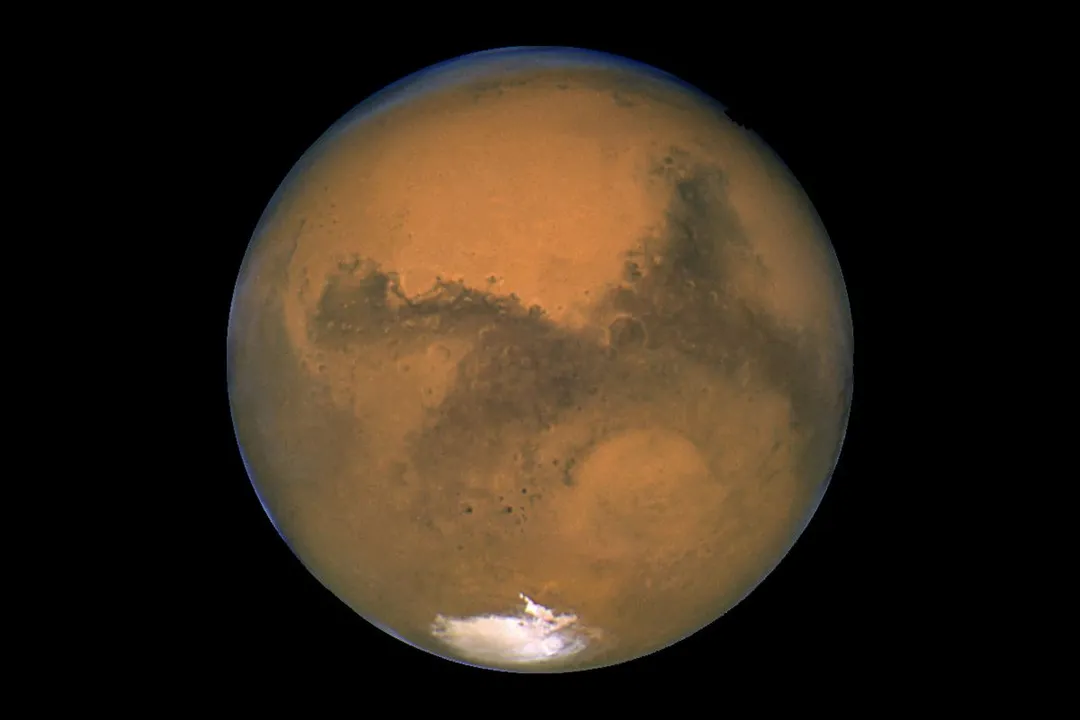
During the era utilizing early, less powerful telescopes, observers noted that the surface of Mars appeared to fluctuate in both brightness and color. These subtle changes were not immediately attributed to intelligent construction but were interpreted by many astronomers as indicators of seasonal terrestrial processes. The prevailing hypothesis was that these variations corresponded to the thawing and freezing cycles of polar ice caps, or perhaps the seasonal expansion and contraction of large bodies of surface water, such as oceans or seas, suggesting an Earth-like environment capable of sustaining life.
Related Questions
What did the translation of Schiaparelli's term *canali* imply to English speakers?What was Percival Lowell convinced Martians were attempting via the observed canal networks?What primary feature did the Mariner 4 flyby reveal about Mars in 1965?Why was the positive result from the Viking Labeled Release (LR) experiment generally dismissed by the scientific community?What caused the distinct, artificial-looking Martian canal lines to fade from view by the 1920s and 1930s?What are Curiosity and Perseverance rovers currently seeking evidence of on Mars today?How were early, subtle variations in Mars' brightness and color interpreted by observers with less powerful telescopes?What characterizes the Present Day conclusion threshold for confirming life on Mars, compared to earlier eras?What specific chemical component were subsequent Viking tests searching for that led to the rejection of the LR experiment's positive reading?Why did the intoxicating concept of a habitable Mars foster acceptance of unconfirmed visual data in the 19th century?