For how long was Kepler's Supernova (SN 1604) visible during the daytime?
Answer
For several weeks.
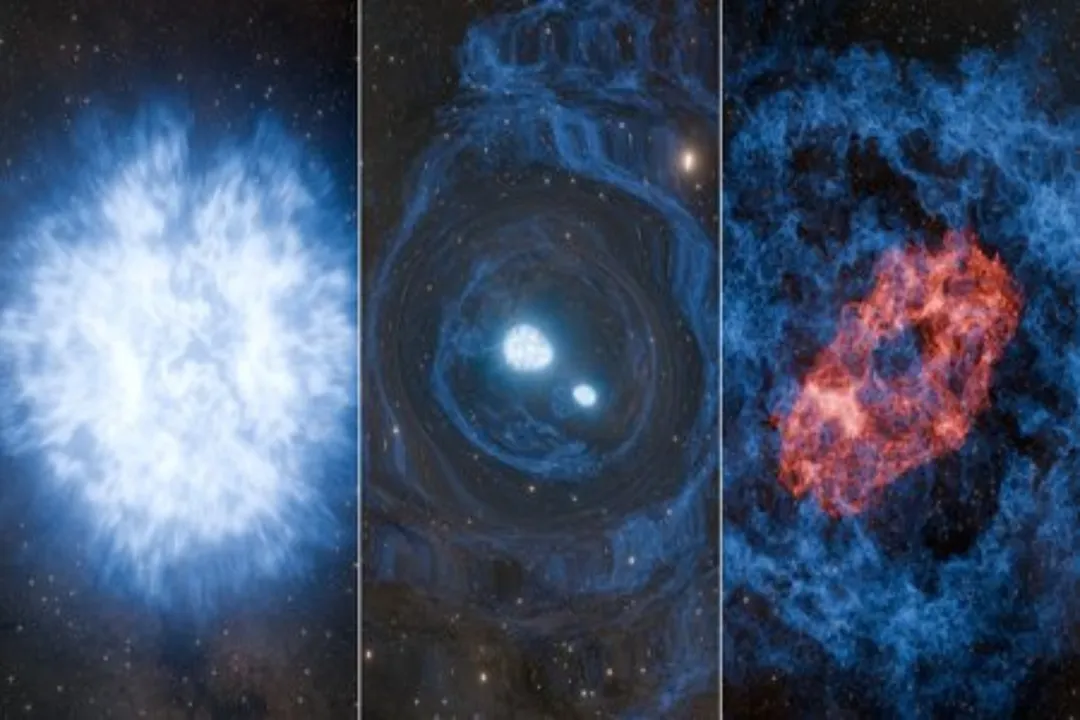
Kepler's Supernova, formally designated SN 1604, serves as a historical benchmark for understanding the extreme energy output possible in stellar explosions, particularly those vastly exceeding a standard nova like the expected T CrB event. This supernova was historically notable because it achieved such incredible luminosity that it was clearly observable in the sky even during daylight hours. The text specifies that this exceptional visibility persisted for a duration of several weeks, providing an extended period for contemporary astronomers to study the phenomenon before it eventually faded, unlike the standard nova which brightens suddenly and then diminishes.
Related Questions
What triggers the sudden brightening in a typical nova involving a white dwarf?What happens to the white dwarf star after causing a typical recurrent nova outburst?What apparent magnitude is T Coronae Borealis (T CrB) expected to reach during an eruption?How does a supernova differ fundamentally from the typical nova event observed in T CrB?For how long was Kepler's Supernova (SN 1604) visible during the daytime?What rare opportunity does monitoring T CrB provide regarding stellar evolution?What extremely rare event involving two exploding stars was reported in 2024?How quickly are modern transient events like T CrB monitored events confirmed compared to historical supernovae?What causes a white dwarf to undergo a supernova detonation instead of a standard nova?What characteristic makes the expected T CrB eruption easily visible to the public?