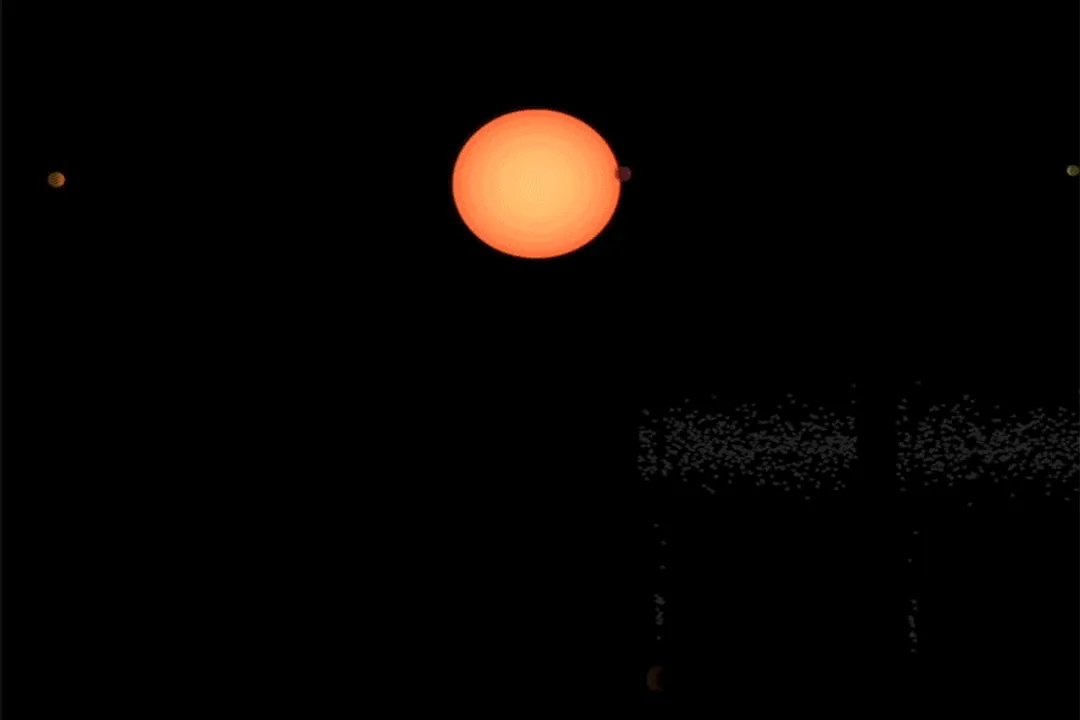
Why is the transit method significantly more sensitive for detecting planets around M-dwarfs than around large, bright stars like the Sun?
A planet represents a much larger fraction of the light output of a small star
The detectability of a transit hinges on the relative size of the planet compared to the star it obscures. For a large, bright star like the Sun, even a Jupiter-sized planet blocks an extremely small fraction of the total light, requiring near-unimaginable instrumental precision to measure the subtle dimming. Conversely, smaller, cooler stars like M-dwarfs emit significantly less total light. Consequently, when a planet transits an M-dwarf, the amount of light blocked constitutes a much larger *fraction* of the star's total output. This results in a proportionally deeper, more easily measurable dip against the background noise, increasing the sensitivity of the transit method for these systems.