Which physical characteristic of an exoplanet cannot be revealed solely by utilizing the transit method?
Answer
The planet's mass
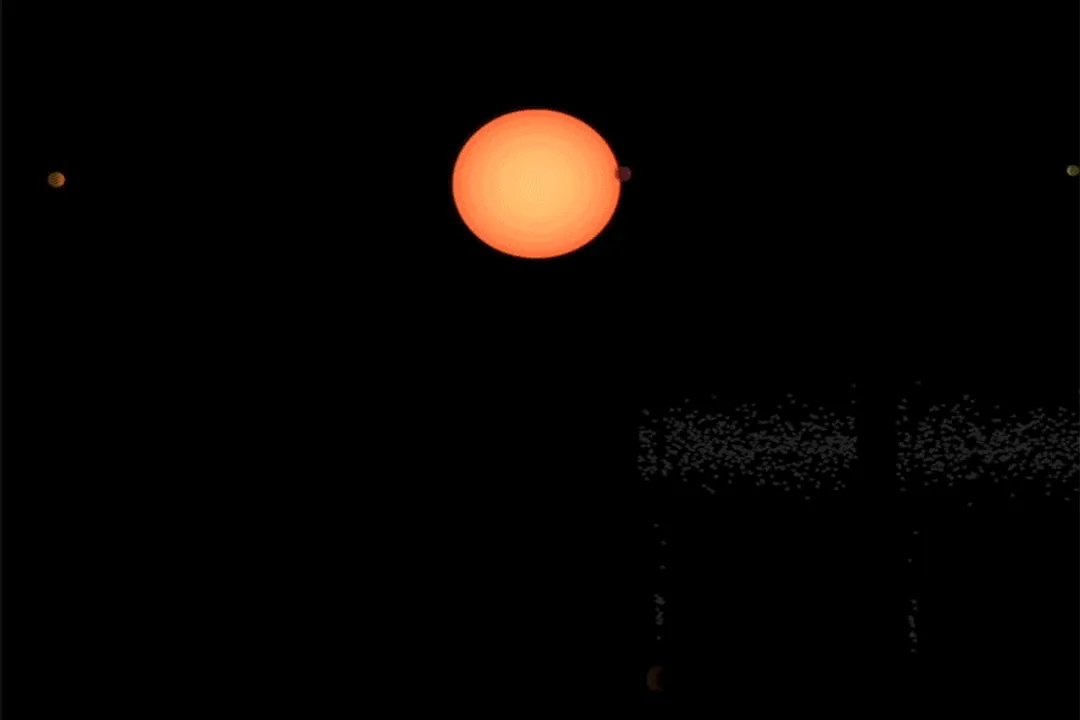
The transit method provides two primary pieces of information directly from the observation of light blockage: the planet's size (derived from the depth of the dip) and its orbital period (derived from the time between successive dips). While these are vital parameters, the transit method, by observing light alone, cannot measure the slight gravitational influence or wobble that an orbiting body exerts on its parent star. This gravitational tug, which is directly proportional to the planet's mass, requires a different observational technique, specifically the radial velocity method, to be accurately determined. Therefore, mass remains undetermined by transit data in isolation.
Related Questions
What does the time interval between successive dips in brightness measure in transit observations?What geometric constraint causes the transit method to inherently fail to detect some exoplanetary systems?What crucial factor for assessing planetary composition (rock vs. gas) requires combining transit data with radial velocity data?What feature of the resulting plot of brightness over time characterizes the light curve during a transit event?Why is the transit method significantly more sensitive for detecting planets around M-dwarfs than around large, bright stars like the Sun?What must an astronomer know accurately to calculate the radius of a transiting planet using transit depth data?What is the significance of 'periodicity' in identifying a true planetary signal using the transit method?Which physical characteristic of an exoplanet cannot be revealed solely by utilizing the transit method?When observing our Sun, what precision level in luminosity measurement is required to detect the transit of Jupiter?Which complementary technique measures the stellar wobble caused by a planet's gravitational tug to yield the planet's mass?